
Council approves 15 downtown public‑safety cameras after debate over data sharing
Get AI-powered insights, summaries, and transcripts
Subscribe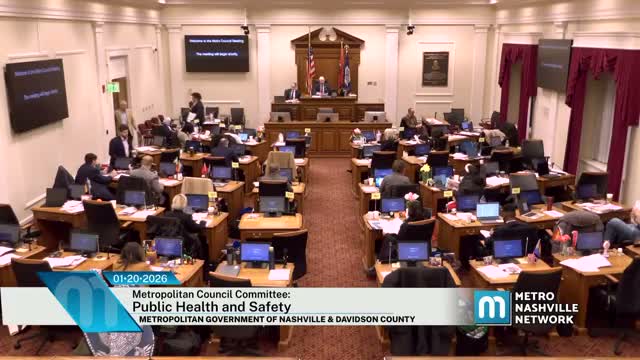
Summary
Council approved a donation-turned-grant that will fund 15 downtown public-safety cameras and requires MNPD to provide publicly available crime statistics to the Nashville Downtown Partnership; public commenters and some council members raised privacy and state-cooperation concerns.
At a committee meeting, the council approved RS2026-1733 as substituted, accepting funds from the Nashville Downtown Partnership to assist the Metropolitan Nashville Police Department in replacing or supplementing 15 downtown public-safety cameras.
The substitute converts the original donation agreement into a grant agreement and adds a condition requiring MNPD to provide publicly available crime statistics related to the grant area to the Nashville Downtown Partnership to satisfy state grant reporting requirements, Special Counsel said.
Public commenters and several council members pressed staff on camera capabilities, locations and who can access footage. "Why on earth would we need to put into a grant contract the sharing of publicly available data if that data is publicly available?" public commenter Mike Lacy asked, warning the arrangement could create a data pipeline from city systems to state and federal entities.
Deputy Chief Gilder told the council the 15 cameras will replace or supplement existing overt blue-light cameras in the downtown footprint (broadly along Broadway and Commerce between First and Sixth). He said the cameras are standard surveillance cameras "they're not LPR, facial recognition, or anything additional," and that feeds are live and used by the central precinct and the community safety center. On external access, he said, "nobody has access outside of the MMPD" absent separate arrangements, and the state could deploy its own cameras on state routes.
Council member Porterfield said she would vote against the item, citing concerns despite the department's explanations. Council member Swara said she opposed related items broadly, citing distrust of state and federal cooperation mandates and saying "nothing is broken" with current systems. By contrast, Council member Coopin and Council member Wiener supported the cameras as tools that can provide exculpatory evidence and help officers respond safely; Council member Nash traced the program's history to the early 2000s and said he was not aware of the cameras being used by ICE or with facial recognition.
The substitute was adopted and the item passed as substituted, with the chair announcing the tally: 7 in favor, 3 against, 0 not voting. The substitute requires the MNPD reporting described above to satisfy the state's downtown public-safety grant reporting.
Next steps: the resolution passed as substituted at the meeting and will be implemented per the grant conditions; the substitute specifies MNPD will provide the required publicly available crime statistics to the Nashville Downtown Partnership for grant reporting.