Get Full Government Meeting Transcripts, Videos, & Alerts Forever!
Get email alerts on the Modular Finance topic
No spam. Unsubscribe anytime.
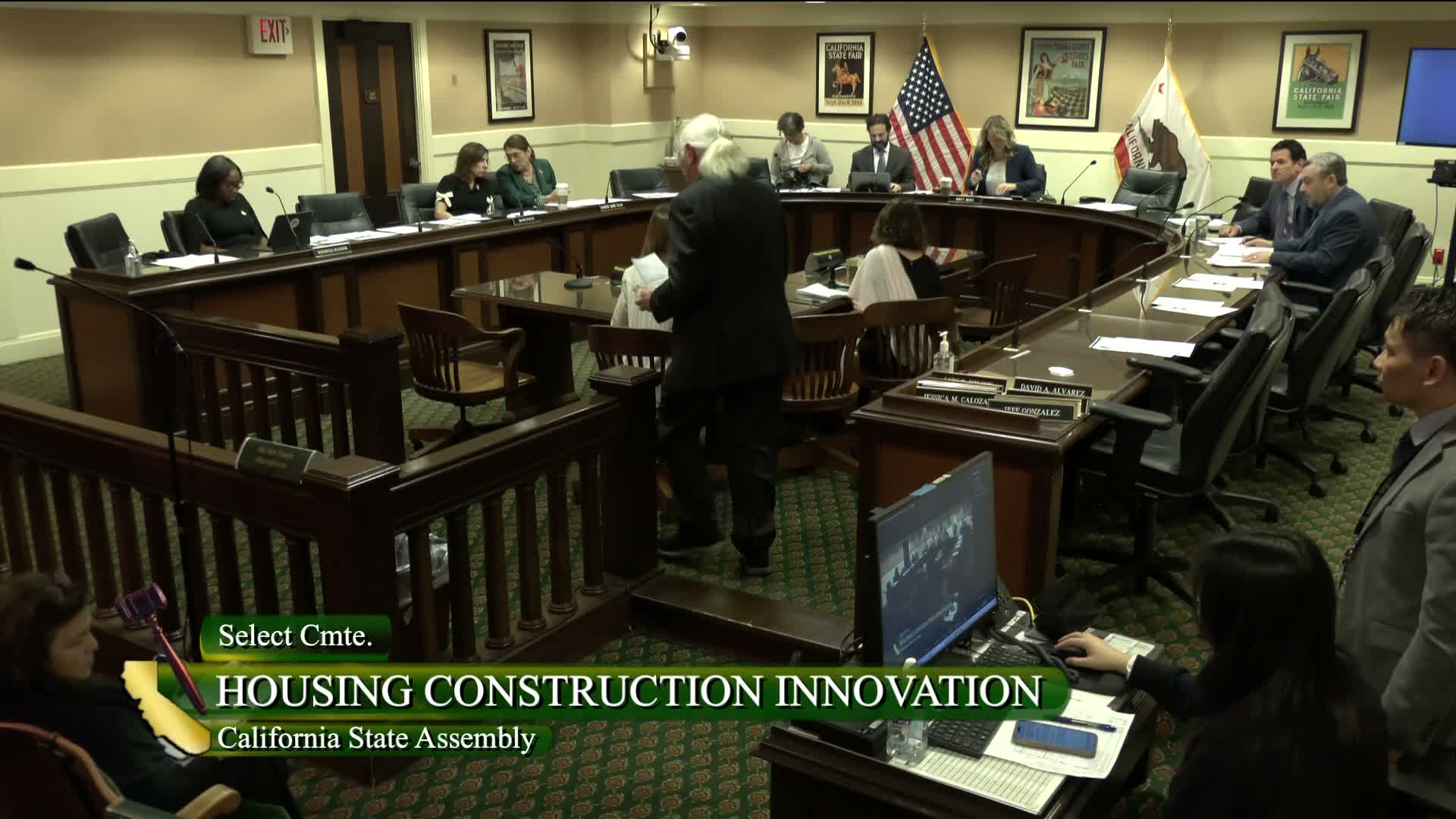
Investors and builders tell committee capital and underwriting must adapt for modular housing to scale
Summary
Investors, lenders and manufacturers told an Assembly select committee that manufacturer failure, deposit timing, tax‑credit schedules and lack of demand aggregation raise financing risk; witnesses proposed predevelopment capital, construction‑to‑perm certainty, loan guarantees and state backstops.
Speakers from the investor community, developers and manufacturers described financing frictions that keep many modular factory projects from reaching scale.
Cecile Charifo, head of community development banking for the West at JPMorgan Chase, said her team has financed more than 30 modular projects nationally and roughly 25 in California but that lenders still assign higher risk to early‑stage modular projects. "Risk major risk for us are experience...the manufacturer going out of business," Charifo said, describing gaps lenders see around early deposits, transportation and installation risks, and the lack of interchangeable manufacturers if one fails.
Rebecca Foster of the Housing Accelerator Fund described capital tools that helped deliver projects with cost and time savings, citing a San Francisco project delivered at about $383,000 per unit and noting the Fund’s industrialized construction catalyst fund and a Bay Area Housing Innovation Fund designed to provide construction‑to‑perm certainty. Foster said the ICCF pilot (a $10,000,000 early‑stage fund) offers low‑interest predevelopment loans and subordinate positions to reduce lender concerns and increase modular adoption.
Manufacturers warned that factory startup costs and early volatility make investment risky. Mister Dawson, founder of Gurdon (Boise), said a new factory can cost roughly $30–$50 million and require one to two years of startup losses before reaching profitable volume, making predictable demand and reliable pipelines essential to attract private capital.
Witnesses and committee members discussed policy options to address these frictions: aligning tax‑credit and bonding timelines, expanding state programs to support early deposits or provide credit enhancements, and creating state‑backed products to underwrite predevelopment or factory bonding. Committee members asked for follow‑up on program scalability and how pilot funds could be expanded or supported by state backstops.