Get Full Government Meeting Transcripts, Videos, & Alerts Forever!
Get email alerts on the Factory Built Housing topic
No spam. Unsubscribe anytime.
Assembly committee hears state, agency and research proposals to scale factory‑built housing
Summary
State officials, funders and researchers told a California Assembly select committee that factory‑built housing can accelerate delivery and reduce waste if regulators, financing and demand are aligned; speakers urged code consistency, financing certainty and pilots to aggregate demand.
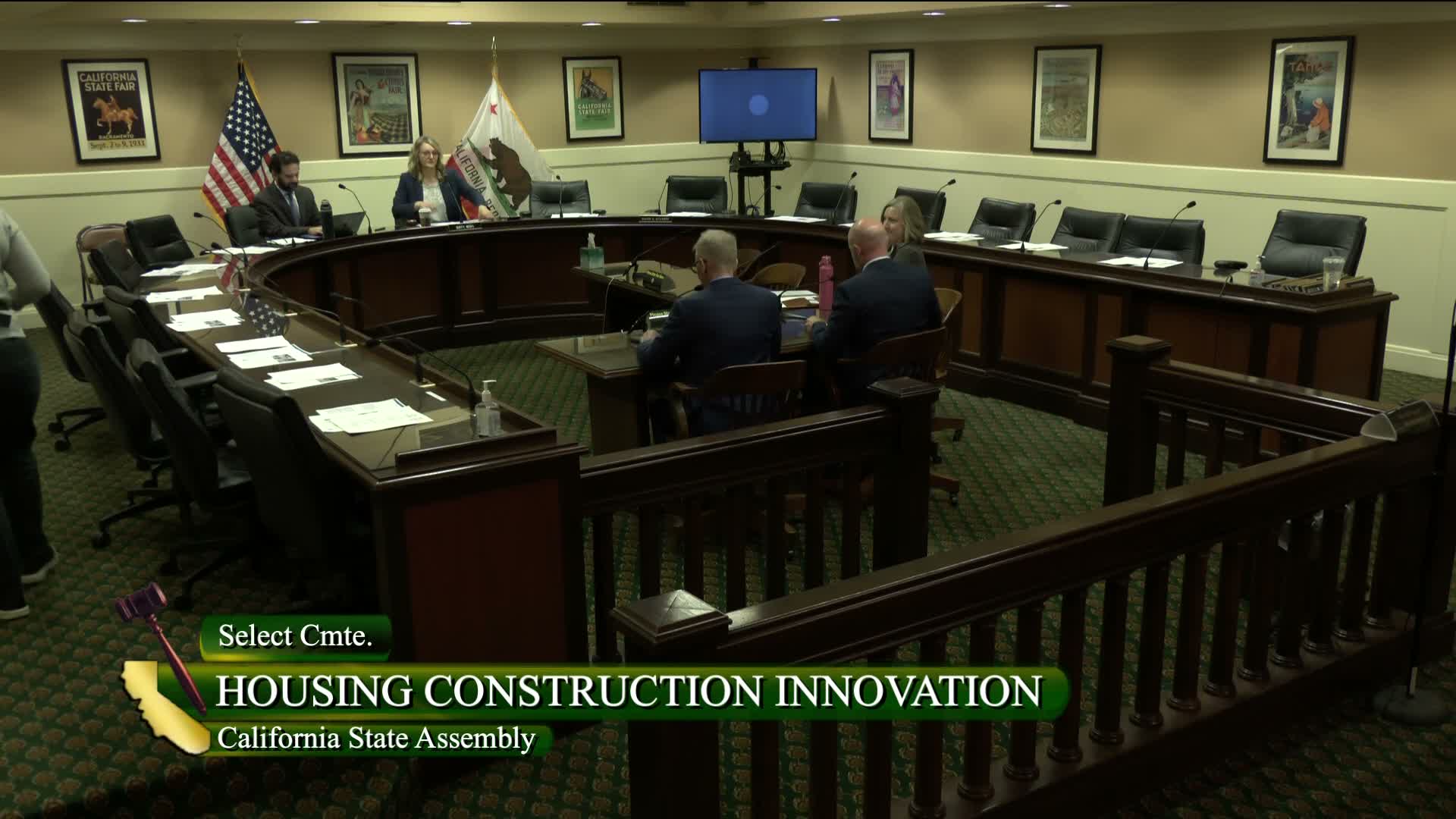
Assemblymember Wicks convened the California State Assembly Select Committee on Housing Construction Innovation to examine how factory‑built housing (FBH) might be scaled to lower housing costs.
Kyle Krause, deputy director at the California Department of Housing and Community Development, told the committee FBH includes “any residential structure, single or multifamily” built in whole or in part off‑site to California building standards and described HCD’s role in third‑party design approval and in‑factory quality assurance. He said HCD certifies design approval agencies (DAAs) and quality assurance agencies (QAAs) that inspect production and that HCD issued roughly 3,200 insignias of approval in 2024 and about 3,400 in 2025 to products designed for use in California. Krause also said there are 258 manufacturers that produce FBH products designed for California, with manufacturers located in California, elsewhere in the U.S., and abroad.
Sean Kennedy, deputy director of energy investments at the Strategic Growth Council, said the SGC is launching a $12,000,000 pilot predevelopment program to help regions build the local conditions needed to support factories and aggregate demand. Kennedy said the pilot offers two tracks — smaller catalyst grants and larger planning grants — and that early rounds produced few applicants, underscoring the need to address barriers beyond factory capacity, such as zoning, inconsistent codes across jurisdictions and misaligned financing timelines.
Marina Wyan, executive director of the California Tax Credit Allocation Committee and the California Debt Limit Allocation Committee, described a federal tax‑code change she said (in testimony) lowered the bond threshold that governs 4% tax credits from 50% to 25%, allowing the program to fund many more units. Wyan reported that TCAC/CDLAC financed about 18,000 units in 2024 and about 28,850 units in 2025 and warned committee members that state investments will be important to sustain leverage of federal resources.
Researchers from the Turner Center for Housing Innovation at UC Berkeley urged near‑term steps to reduce regulatory friction and improve evidence. Tyler Pullen said policymakers could increase certainty by aligning code review and enforcement, allow state‑certified third‑party inspectors for on‑site FBH work, establish clear review timelines, and invest in data collection and training for local officials.
Committee members pressed witnesses on program timing, grant sizes and next steps. SGC said its NOFA and application window would be released imminently; the committee requested follow‑up materials and additional detail about how pilot dollars will be allocated and evaluated.
The hearing closed with public comment from industry and community groups and the chair signaled the committee would continue developing policy proposals based on these hearings and a Turner Center white paper expected later this winter.