Get Full Government Meeting Transcripts, Videos, & Alerts Forever!
Get email alerts on the Housing Policy topic
No spam. Unsubscribe anytime.
Assembly Housing Committee advances five housing bills, debates nonprofit role in affordable home sales
Summary
The Assembly Committee on Housing and Community Development advanced five bills to Appropriations or the next committee on voice and roll-call votes, including a contentious debate over AB 939’s carve-out allowing qualified nonprofits to buy income-restricted units before a 180-day resale period ends.
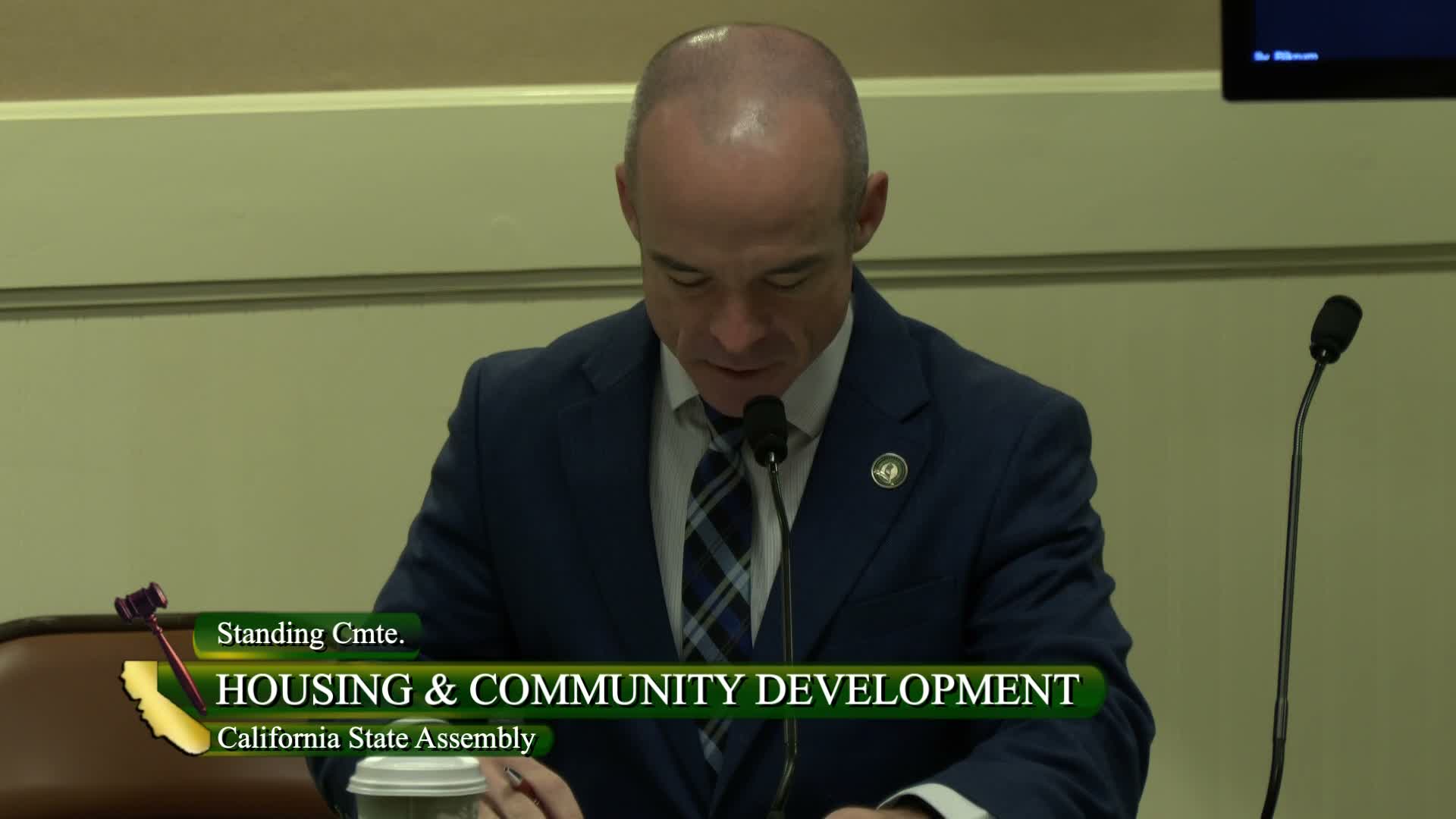
The California State Assembly Committee on Housing and Community Development met in Room 437 and moved five housing bills forward for further review, hearing testimony from nonprofit and industry witnesses and recording roll-call tallies for each measure.
Assemblymember Schultz, author of AB 939, said the bill ‘‘provides a targeted, no-cost fix to streamline affordable homeownership’’ by allowing developers under contract with qualified nonprofits to transfer income-restricted units without the 180-day resale delay, arguing that otherwise such units ‘‘sit vacant for months generating unnecessary carrying and marketing cost.’’ Debbie Arakow of Habitat for Humanity California testified in support, saying the change would help move homes to low-income buyers ‘‘much more efficiently than currently under state law.’’
Opposition came from Amy Garrett of the California Association of Realtors, who said AB 939 ‘‘sets a dangerous precedent’’ by creating a nonprofit role in sales that could erode private property protections and deny buyers independent representation. Schultz and supporting witnesses said the bill is narrow, limited to deed-restricted, income-qualified units, and that safeguards (including nonprofit eligibility tests and deed restrictions) would prevent abuse. The committee recorded an initial favorable tally of 6–1 on AB 939 and left the roll open for absent members.
Earlier in the hearing, the committee considered AB 748, which would expand a preapproved-plan/catalog approach originally used for accessory dwelling units to single-family and small multifamily projects under 10 units. The bill’s author described local interest and limited fiscal impact; Debbie Arakow and other nonprofit witnesses described prior successful use of such catalogs for disaster recovery and said the approach reduces design costs and approval time. The vice chair announced an initial subcommittee-level favorable result of 7–0 on AB 748.
The committee also advanced AB 739, a disclosure measure requiring managing agents of homeowners associations to provide a summary of fees billed to HOAs. Paul Herrera (Inland Valley Association of Realtors) supported the bill as ‘‘essentially a receipt’’ that improves transparency. The California Association of Community Managers said the committee amendments resolved cost and mailing concerns and removed their opposition.
AB 1070, a measure directing study and potential alignment of building-code rules for small, low-rise multifamily (3–10 unit) projects to reduce cost and complexity, was presented by the bill author with technical supporters including the Council of Infill Builders and the Casita Coalition. Supporters said the proposal is a cautious, evidence-based way to make middle‑housing feasible. The committee moved the measure as due pass to Appropriations.
AB 1184, presented by Vice Chair Patterson, would increase transparency and resident access to information about homeowners associations, including recorded meetings; Patterson said he accepted committee amendments and asked for an aye vote. The committee moved AB 1184 as amended and later completed roll calls to capture returning members before adjourning.
Votes at a glance (as recorded during the hearing): AB 739 — moved as amended (initial subcommittee tally announced 7–0; roll left open); AB 748 — moved as amended (initial subcommittee tally announced 7–0); AB 939 — moved as amended (initial tally 6–1; roll left open); AB 1070 — moved as due pass to Appropriations (tally recorded on the roll); AB 1184 — moved as amended (tally recorded on the roll). Several items had roll calls left open for absent members and later roll calls captured returning members.
What’s next: Each bill was moved to the Assembly Appropriations Committee or otherwise advanced so authors may continue negotiations and amendments; authors (notably Assemblymember Schultz on AB 939) said they would continue working with opponents to refine language before a floor vote.
This article draws directly on committee testimony and recorded roll-call statements during the hearing.