Get Full Government Meeting Transcripts, Videos, & Alerts Forever!
Get email alerts on the Consumer Sb716 Lifeline topic
No spam. Unsubscribe anytime.
Consumer advocates and CPUC push SB 716, extended lifeline pilots and outreach to replace ACP
Summary
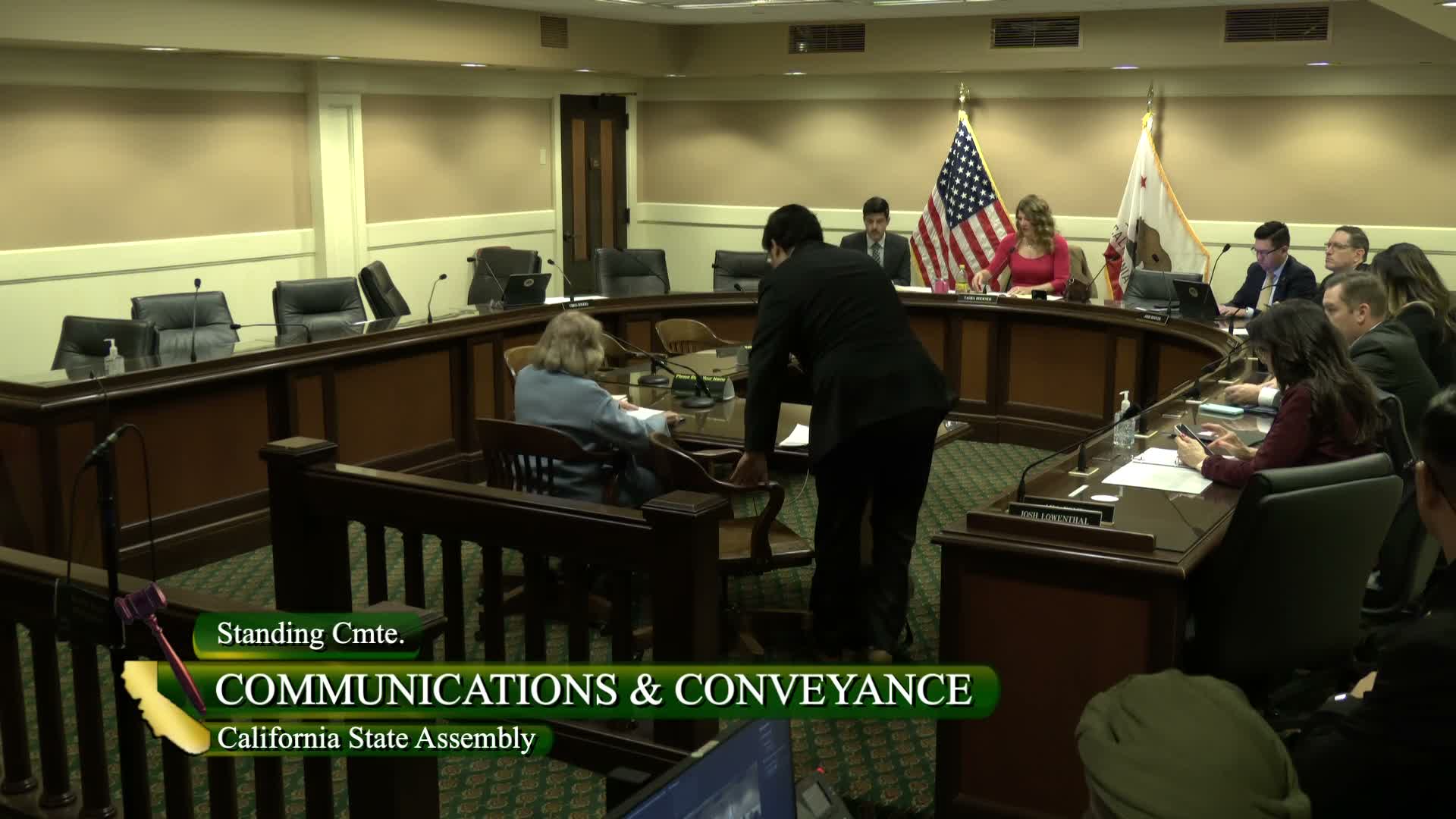
CETF and the CPUC Public Advocates Office told the Assembly committee that adoption has improved to 93% statewide but roughly 500,000 households remain unconnected; they urged using SB 716, extending CPUC pilots, targeted subsidies for the poorest households, and better outreach and data transparency to restore benefits lost with the Affordable Connectivity Program.
Consumer advocates told the California State Assembly that while broadband adoption has risen sharply over the past two decades, persistent affordability and outreach gaps remain and will not be solved solely by market forces.
Sunny McPeak, president and CEO of the California Emerging Technology Fund, said "In 2008, only 55% of all California households were online. Today, it's 93%." She told the committee roughly 500,000 households remain unconnected and that outreach is a central barrier: in 2023 only 23% of eligible households knew about affordable ISP offers. McPeak urged use of SB 716 and extension of CPUC pilots to reach low‑income households and recommended broadening the base of contributors to universal service funding.
Ernesto Valcone, program manager in the CPUC Public Advocates Office, presented a competitive-pricing analysis and warned California "is losing its edge in competition," arguing that roughly 4,800,000 residents are limited to a single gigabit-tier choice in their area. He and Sunny recommended two tracks: (1) improve the competitive structure for gigabit service (more overlapping fiber or competitive entry), and (2) pair targeted subsidies for the lowest-income households with price controls or program conditions to prevent upselling, drawing lessons from the Affordable Connectivity Program (ACP) experience.
Valcone described results CPUC staff negotiated in merger conditions with Verizon as an example of how policy can deliver low-income options and incremental supply increases: obligations to bring additional fiber to certain households and a $20 low-income plan under merger commitments. He also urged carriers to publish pricing in machine‑readable formats to allow regulators and academics to monitor advertised and actual consumer prices.
Public commenters from nonprofits, industry consortia and community-based organizations largely supported SB 716 or urged a permanent state lifeline replacement for ACP. Multiple speakers called on the committee to remove a proposed cap on the lifeline program and to fund outreach and digital‑navigator programs that have helped enroll low‑income households.
The committee did not adopt legislation at the hearing. Members asked staff for follow-ups on SB 716 details, CPUC pilot outcomes, and options to increase CASF/loan‑reserve and other state infrastructure funds to support alternative public or nonprofit network builds.