Get Full Government Meeting Transcripts, Videos, & Alerts Forever!
Get email alerts on the Dynamic Pricing topic
No spam. Unsubscribe anytime.
Assembly committee advances bill to expand dynamic electricity pricing after divided testimony
Summary
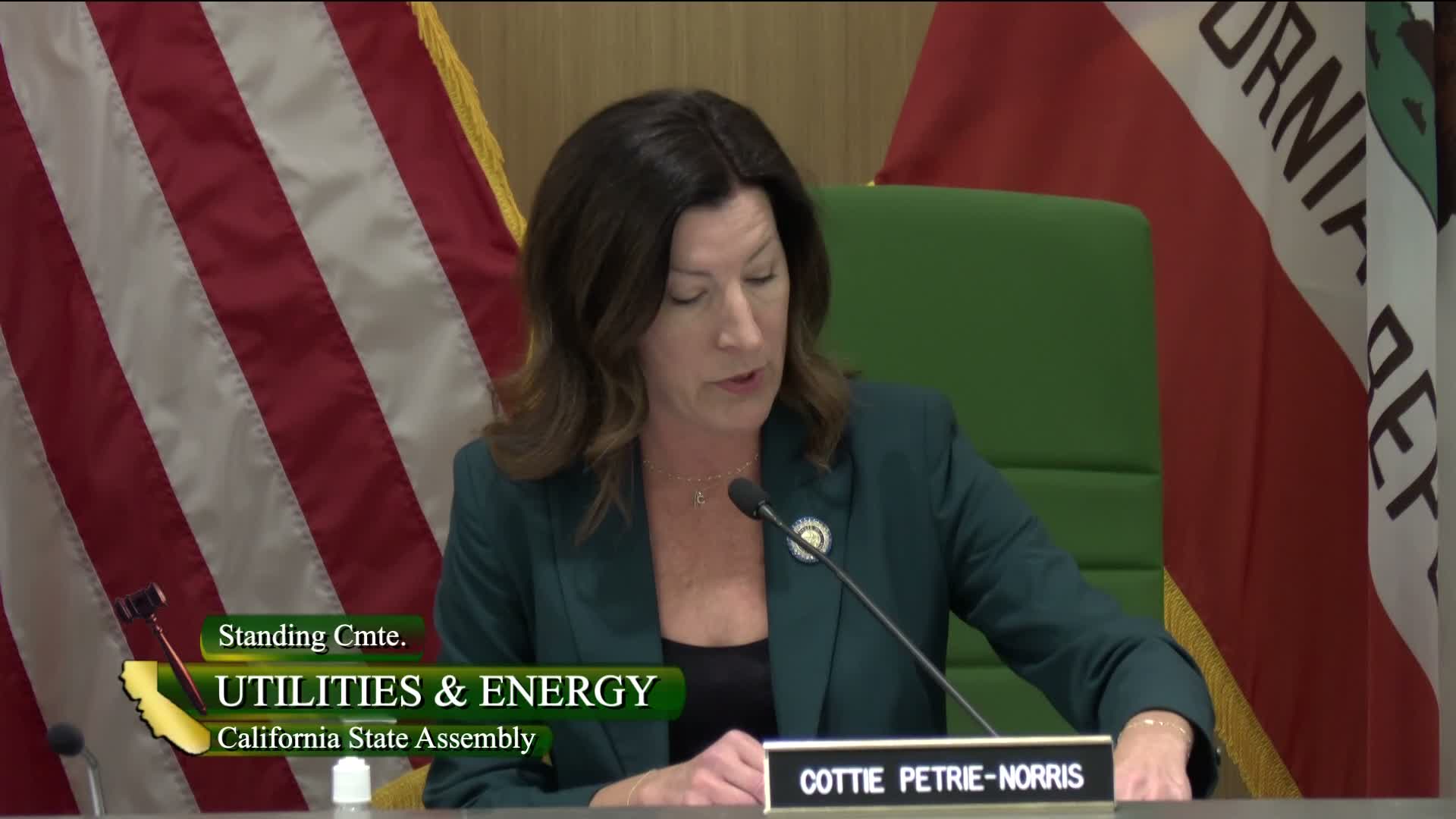
The Assembly Committee on Utilities and Energy voted to move AB 710 to appropriations after supporters said the bill would reduce curtailment and lower costs, while utilities warned hard deadlines and real‑time pricing requirements risk disruption to ongoing pilots and billing modernization.
The California State Assembly Committee on Utilities and Energy on Wednesday voted to send AB 710 to the Appropriations Committee after more than an hour of testimony and questioning. Assemblymember Erwin, the bill’s author, said AB 710 would expand dynamic pricing programs and require utilities to plan for advanced metering to enable customers to shift usage to cleaner, lower‑cost hours.
Supporters told the committee the measure could reduce wasted renewable energy and lower bills. Caleb Weiss, clean energy associate at Environment California, said, “In 2025 alone, California curtailed over 3,700,000 megawatt hours of wind and solar,” and urged lawmakers to adopt timelines and programs that let customers participate in load‑shifting programs. Allison Hilliard of The Climate Center and Caitlin Loveenthal of the California State Association of Counties also testified in support.
Utility representatives raised practical concerns. An unnamed PG&E representative told the committee the bill’s deadlines could be “very disruptive” to ongoing billing modernization and pilot programs, noting that some real‑time pricing pilots have cost tens of millions of dollars to stand up. “Our rates are down 11% in the last two years,” the witness said, urging the committee to focus on incremental time‑of‑use work that utilities and community choice aggregators can coordinate on.
Committee members pressed both sides on timing and implementation. Assemblymember Zippar urged the author to work with all three major investor‑owned utilities so the bill does not impede active ratemaking proceedings; Erwin said the measure tracks recommendations from the California Energy Commission’s 2023 load‑shift report and pledged to continue negotiating with utilities. Assemblymember Schultz moved the bill and Assemblymember Berner seconded the motion.
The committee recorded a final tally of 11–0 on the motion to pass AB 710 to appropriations and left the roll open for absent members to add their votes. The chair indicated the committee would keep working with stakeholders on technical fixes.
Votes at a glance: AB 710 — passed to Appropriations, final recorded vote 11–0; AB 34 (consent) — passed to Natural Resources, vote 15–0.
The bill now moves to the Assembly Appropriations Committee for further consideration.