Get Full Government Meeting Transcripts, Videos, & Alerts Forever!
Get email alerts on the Military Civilian Coordination topic
No spam. Unsubscribe anytime.
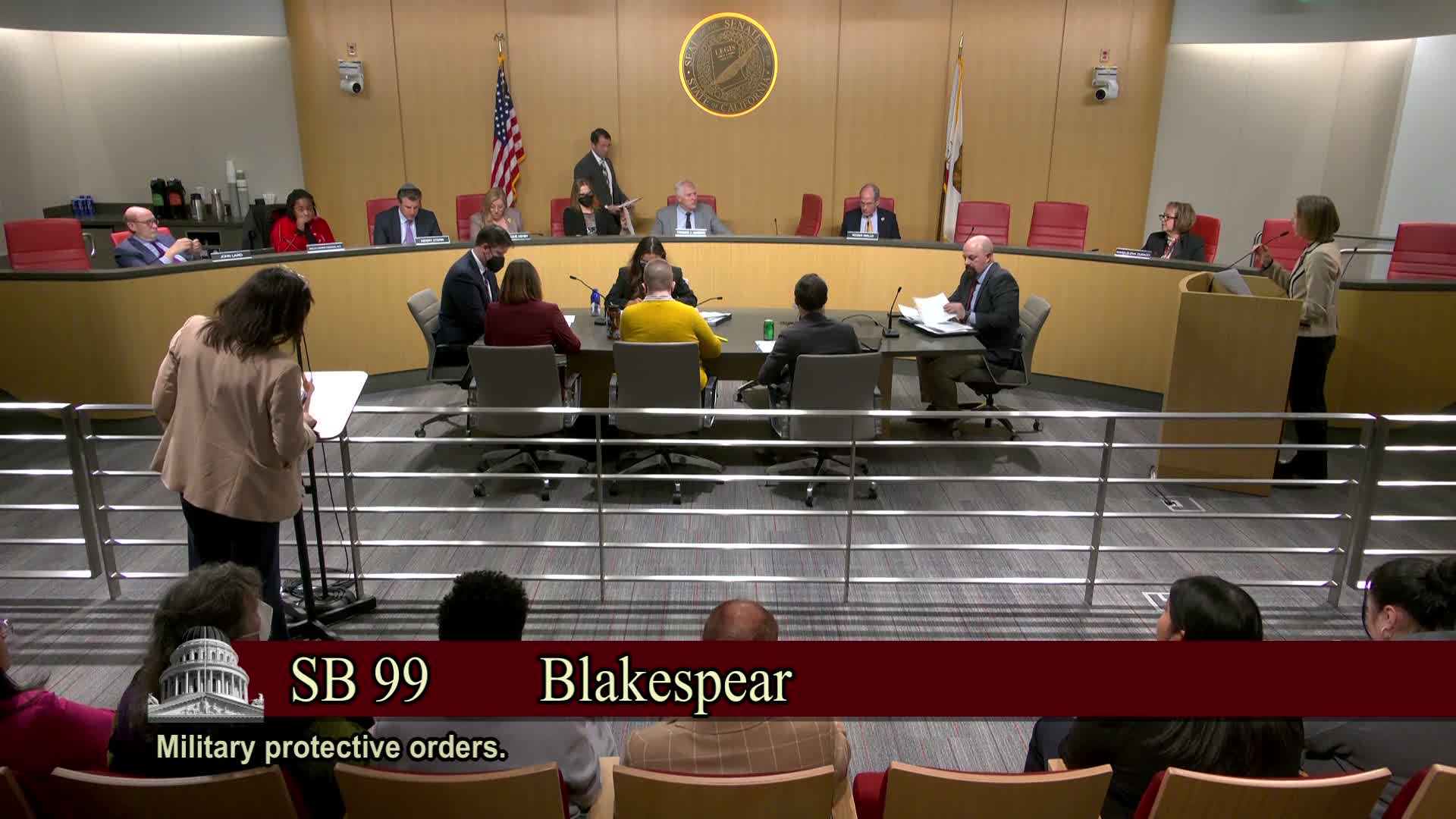
Committee advances SB 99 after debate over due process for military protective orders
Summary
SB 99, requiring better coordination and information‑sharing between military and civilian authorities about Military Protective Orders (MPOs), was advanced but drew opposition from civil‑liberties groups concerned about due process and admissibility of MPOs in civilian courts.
The committee voted to pass SB 99 to Senate Appropriations after proponents said the bill would close gaps between military and civilian systems that can leave victims without recourse, and opponents raised due‑process and recognition concerns.
The author described four ways the bill would bridge gaps: require NCIC searches for MPOs, explicitly allow MPOs as admissible evidence in some proceedings, require civilian officers to notify military law enforcement when violations are suspected, and permit memoranda of understanding between military and civilian agencies. Scott Gimlin introduced Scott Gilman from Berkeley to testify about local multidisciplinary efforts and the need to share limited information to address public‑health emergencies in encampments.
Kelly Mae Douglas, a Department of Defense liaison, testified in support saying the Department and services have guidance for commanders issuing MPOs and that the bill would empower civilian judges with relevant context. The ACLU’s George Baramthu opposed the bill unless amended, arguing MPOs are often issued by commanding officers without notice or opportunity to respond and the lack of due process makes their admission into civilian proceedings problematic.
Committee members acknowledged both victim‑protection and due‑process concerns; Senator Laura Pearson said she supported the coordination goals but remained worried about allowing MPOs into court if the subject had no opportunity to present evidence. The committee moved SB 99 as amended to Appropriations and left it on call.