Get Full Government Meeting Transcripts, Videos, & Alerts Forever!
Get email alerts on the Civil Rights topic
No spam. Unsubscribe anytime.
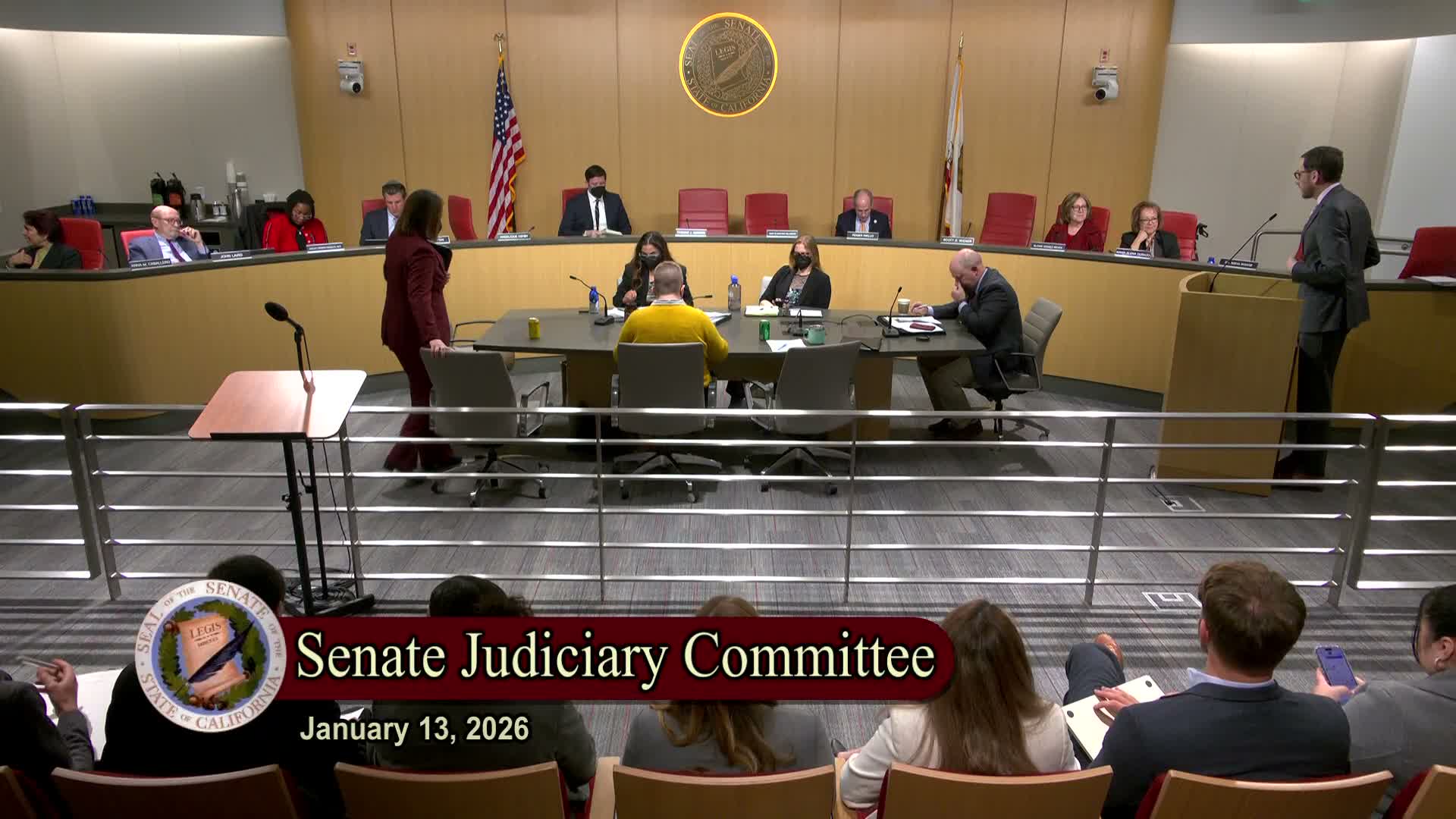
Senate Committee advances bill to allow state suits against federal officers amid disputed legal risks
Summary
The California Senate Judiciary Committee voted to pass SB 747 to Appropriations, creating a state statutory pathway to sue federal officers for constitutional violations. Supporters said the measure fills a gap; law‑enforcement groups warned it could raise litigation risk and complicate immunities.
Senators on the California Senate Judiciary Committee moved SB 747, dubbed the "No Kings Act," to the Senate Appropriations Committee after an hours‑long hearing that pitted civil‑rights advocates and victims of alleged federal enforcement abuses against law‑enforcement organizations and county attorneys.
The bill, introduced by Senator Wiener, would create a state cause of action modeled on 42 U.S.C. § 1983 so that individuals could sue federal, state or local officers for violations of constitutional rights. "If any governmental officer violates your clearly established constitutional rights, you should have a remedy," the author said during his presentation.
Witnesses for the bill described incidents they said illustrated a gap in accountability. George Velez, a U.S. veteran who said he was detained during an ICE operation, told the committee: "I was wrongfully detained... Agents engulfed my car with tear gas, smashed my window, sprayed pepper spray on my face, and dragged me out." Cameron Kistler of Protect Democracy United described the measure as a way to ensure there is a remedy when constitutional rights are violated regardless of the badge carried by the officer.
Opponents including representatives of sheriffs, police chiefs, and district attorneys urged caution. David Mistagni for the California Police Chiefs Association argued the bill is "unnecessary, duplicative, and it jeopardizes qualified immunity for California employees," and urged carving California employees out of the measure or narrowing subject matter to immigration and election‑related claims. Riverside County Lieutenant Julio De Leon questioned whether the bill would lower the evidentiary elements required under current state law for civil rights claims and thereby increase routine litigation against local officers.
Committee members debated the potential for federal preemption and sovereign‑immunity defenses, the scope of the law, and whether a severability clause could leave state employees exposed if federal‑targeted language were struck down in court. Senator Wiener said the bill "does not change the rules or the liability" for state and local officers and framed the measure as filling a gap left by recent Supreme Court decisions limiting Bivens actions against federal officers.
The committee recorded a motion to pass SB 747 to Appropriations; the roll call reflected the committee's procedural vote to hold the matter open for absent members. The bill's proponents and opponents each said they want further technical work to address concerns about immunities, severability and forum. SB 747 now heads to Appropriations for further consideration.