Get Full Government Meeting Transcripts, Videos, & Alerts Forever!
Get email alerts on the Zoning Variance topic
No spam. Unsubscribe anytime.
Clinton Zoning Board OKs variance for gravel circle drive at 1211 Harrison Drive with one‑year paving condition
Summary
The Clinton Zoning Board of Adjustments granted a variance allowing a secondary gravel circle driveway at 1211 Harrison Drive to remain, conditioned on pulling a flat‑work permit and converting the driveway to an ordinance‑approved hard surface within one year.
The Clinton Zoning Board of Adjustments voted unanimously to grant a variance on a recent gravel circle driveway installed at 1211 Harrison Drive, allowing the secondary driveway to remain if the property owner pulls a flat‑work permit and hard‑surfaces the driveway within one year.
Stephen Lee Zook, the property owner, testified he was told by a city attorney about 15 years ago that he could place gravel beside his driveway for additional parking and that he obtained a permit before installing compacted road rock to form a circular drive. "I was told 15 years ago that I could put gravel down to make my driveway wider," Zook said after being sworn in. Zook told the board the added drive improves safety at a sharp, fast intersection near his home and presented photos and a petition with 26 neighborhood signatures in support.
City staff and the engineering department opposed allowing a permanent gravel front‑yard driveway in areas with curb, gutter and stormwater systems, citing sedimentation and maintenance concerns. Deputy zoning official Karen told the board that the zoning ordinance requires front‑yard parking to be on a hard surface and that gravel lacks the structural stability and erosion control of materials like asphalt or concrete. Jason Craft, a city engineer, said the curb cut permit on file anticipated a concrete driveway leading to the south side of Zook's house and that the curb cut was constructed per plan, but the hard‑surface work was not completed as shown on the permit.
Legal counsel reminded members that their responsibility was to apply the two‑step variance test in ordinance 1590804 and Iowa Code Section 414.12: first, determine whether the alteration would impair neighboring properties or public welfare; second, find whether strict application of the ordinance would create an unusual hardship not caused by the owner. "You're here to seek permission not to comply," counsel said, urging the board to weigh the statutory criteria.
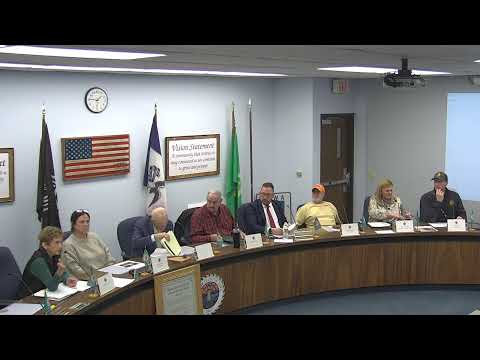
Board members discussed both policy and safety. Several members said the intersection where the home is located presents a safety concern that favored allowing the second driveway if it were brought into compliance with the hard‑surface requirement. The board crafted a motion — moved by Cliff Wilkerson and seconded by Janet Brown — to allow the recently installed secondary gravel driveway to remain with two conditions: a flat‑work permit must be pulled and the driveway must be hard‑surfaced to meet ordinance standards within one year. The motion was read aloud and passed on a 5–0 roll call (Ed Wignal, Cliff Wilkerson, Stacy Parks, Janet Brown and James Schmercy voting yes).
The board clerk read the motion's language into the record and staff offered assistance with the permit process; Karen told Zook to call the office when he was ready to proceed. The variance does not alter the ordinance's underlying requirement that front‑yard parking be a hard surface in areas served by a storm system. The board recorded the procedural findings required by the ordinance (notice, publication, site plan, oaths) before acting.
Next steps: Zook must obtain a flat‑work permit and complete a hard‑surface installation (as allowed by ordinance — e.g., asphalt or concrete) within the one‑year period specified by the board, or seek a permit extension if necessary.