Get Full Government Meeting Transcripts, Videos, & Alerts Forever!
Get email alerts on the Alley Paving topic
No spam. Unsubscribe anytime.
Clinton City staff propose cost-share program to pave roughly 16 miles of gravel alleys
Summary
City engineer Jason Kraft presented a draft alley-paving cost-share plan that would require a majority of abutting owners to opt in and could cost the city an estimated $150,000 a year under one scenario; council agreed to form a subcommittee and consider the proposal during budget season.
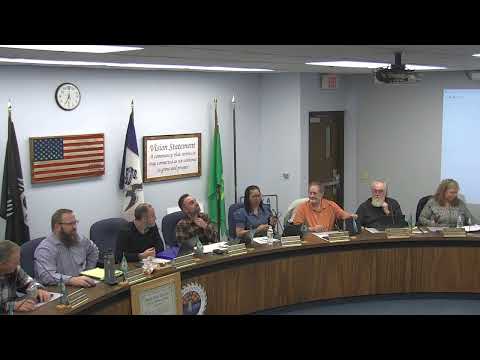
City engineer Jason Kraft told the Clinton City Committee of the Whole that the city has an inventory of roughly 16 miles of gravel alleys and presented a draft cost-share program that would let property owners request paving and pay a portion of the cost.
"A lot of citizens in this town live on the street, but their garage is in the back, and they drive on a gravel alley to get to the garage," Jason Kraft said, describing a common complaint that prompted the proposal. He outlined a hypothetical model in which the city would cover most of the cost for residential alleys while property owners pay a smaller share.
Kraft said the report included a sample arrangement with property owners paying 25% and the city covering 75% for residential alleys, and that the program would require a threshold of consenting abutting owners (he suggested at least half) before a paving project would proceed. He provided an illustrative cost example: a $25,000 alley split across 10 lots would yield about $2,000 per lot, making a 25% homeowner share roughly $500; spread over 10 years, that would amount to about $50 per year, or about $25 twice a year, Kraft said.
Resident Germaine Cox, who said he compiled a petition for his block, told the committee his neighborhood already has signatures and urged the city to adopt a program similar to one he experienced in Davenport. "I did a petition in July, and it's already been signed," Cox said, noting concerns about divots, drainage and driveway flooding on gravel alleys.
Council members pressed staff on details the proposal did not yet define, including snow removal, long-term maintenance responsibilities, and how to treat property owners who cannot afford assessments. Council member Koenig warned that paving alone would not fix alleys undermined by utilities or local riverbed conditions and urged that the city include an alley-management and maintenance plan as part of any program.
Council consensus favored advancing the concept into the budget process. Committee members agreed to form a working group to develop program standards and funding options; volunteers named during the meeting included Travis Winter and several council members and citizen representatives. Staff indicated the item will be brought to the budget discussions for further consideration.
The committee did not take a formal vote on a final program; councilmembers and staff asked for a defined plan, maintenance standards, and clearer affordability criteria before any program would be funded or implemented.