Get Full Government Meeting Transcripts, Videos, & Alerts Forever!
Get email alerts on the Ai Jobs Ca topic
No spam. Unsubscribe anytime.
California Senate panel hears workers, employers and researchers on AI and jobs
Summary
A California State Senate select committee heard labor leaders, HR representatives and Brookings researchers on how AI is reshaping hiring, workplace surveillance and early-career job prospects, with witnesses urging human oversight, transparency from AI companies and expanded workforce training.
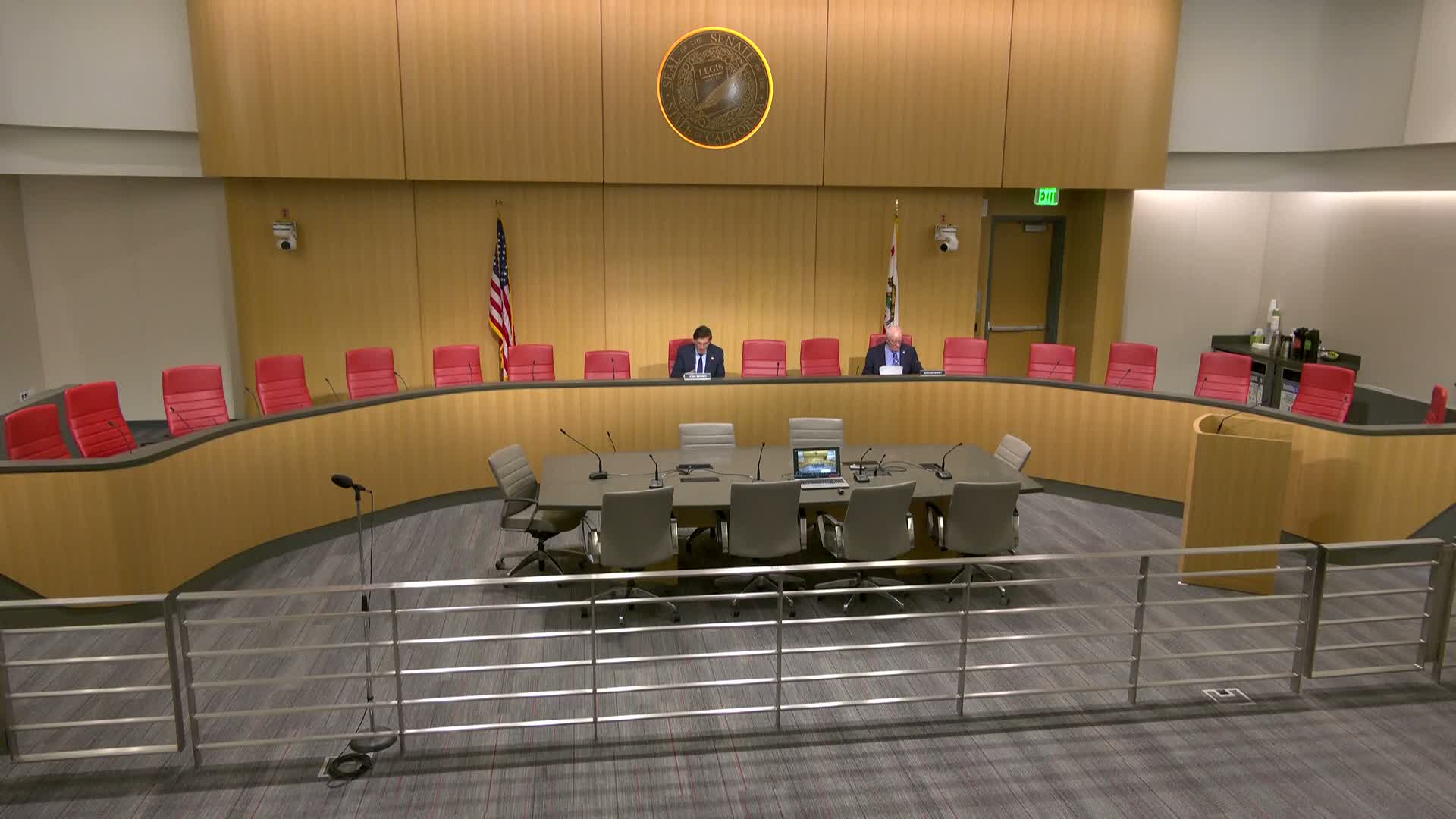
SACRAMENTO — Witnesses at a California State Senate select committee hearing urged state policymakers on Wednesday to balance the productivity benefits of artificial intelligence with protections for workers, calling for transparency from AI companies, human oversight of consequential employment decisions and investments in training for displaced and early-career workers.
Chair opening remarks framed the hearing as an urgent but manageable policy challenge: California added more than 100,000 AI-related job postings last year and hosts over 15% of the nation’s AI jobs, yet large occupational groups — from commercial drivers to warehouse staff — face automation risk. "If we do nothing, AI could widen inequality, destabilize labor markets and erode confidence in both our economy and our government," the chair said in opening remarks.
Sarah Fox, legislative director for the California Labor Federation, told the committee that many AI tools are being marketed to employers "to increase corporate power and profit by reducing labor costs and increasing managerial control." Fox cited employer survey figures, saying a majority of managers who use AI apply it to determine raises (78 percent), promotions (77 percent) and layoffs (66 percent), with about 20 percent of employers letting AI make final decisions without human input. She recommended early worker involvement in procurement, 180-day notice to unions before deployment of workplace AI, and robust human oversight for consequential decisions.
Representing employers, Tara Fournier, deputy director of SHRM California and CEO of T4 HR Consulting, described widespread HR adoption of AI and urged targeted regulation. "Used responsibly, AI can unleash new levels of productivity, creativity, and collaboration," Fournier said, while warning against rules so broad they would freeze innovation. She recommended calibrated rules for high‑risk automated decision systems, reasonable transition periods for compliance, and employer-led upskilling.
Molly Kinder, a senior fellow at the Brookings Institution, presented recent Brookings and Yale Budget Lab research showing that, to date, aggregate labor‑market data have not revealed broad, economy‑wide job losses attributable to generative AI since late 2022. Kinder said the data show "remarkable continuity" at the macro level but flagged early‑career workers and certain occupations — customer service, clerical roles, creative industries and some back‑office functions — as possible "canaries in the coal mine." Kinder urged legislators to secure more detailed usage data from AI companies to improve monitoring and to track early‑career hiring and sector adoption rates.
Committee members pressed witnesses on enforcement and measurement. Several senators asked how to compel or incentivize corporate transparency and whether independent third‑party audits or public development of tools (for example, at universities) could reduce bias and monopoly effects around hiring software. Witnesses diverged on emphasis but agreed on the need for human oversight where decisions materially affect employment.
Public commenters, including leaders from the California Nurses Association, warned of patient‑safety and liability risks when employers deploy algorithmic triage, predictive staffing tools and ambient surveillance in hospitals. "When AI tools make decisions about patient care, these decisions must be viewed as decisions about a nurse's working condition," Catherine Kennedy of the California Nurses Association told the committee, urging a precautionary approach and legal accountability for vendors and employers.
The committee signaled follow-up actions including monthly data updates from researchers, invitations to major employers and AI companies to testify, and further work on legislative options that pair transparency and human oversight with workforce development. No formal votes or bills were passed at the hearing; senators said they would continue the conversation as research and company data evolve.
• Key takeaways: labor leaders urged worker participation, unions and human oversight; employer groups pushed targeted regulation and workforce partnerships; researchers recommended better company usage data and tracking of early‑career impacts.