Get Full Government Meeting Transcripts, Videos, & Alerts Forever!
Get email alerts on the Science Public Health topic
No spam. Unsubscribe anytime.
Scientists: Tijuana River wastewater can become airborne; researchers call for biomonitoring and targeted mitigation
Summary
Scripps and public‑health researchers presented water and airborne measurements showing aerosolized pathogens and toxic gases from a Saturn Boulevard 'hot spot', urged epidemiological and biomonitoring studies, and recommended immediate protections (air purifiers, warning signage) while infrastructure fixes proceed.
Researchers from Scripps Institution of Oceanography and public‑health teams described new measurements linking polluted waterflows in the Tijuana River Valley to airborne exposures and community health impacts. Presentations focused on two linked findings: a high‑resolution water‑forecast model that predicts near‑shore wastewater concentrations and scientific evidence that surf‑zone processes can aerosolize pathogens and toxic chemicals.
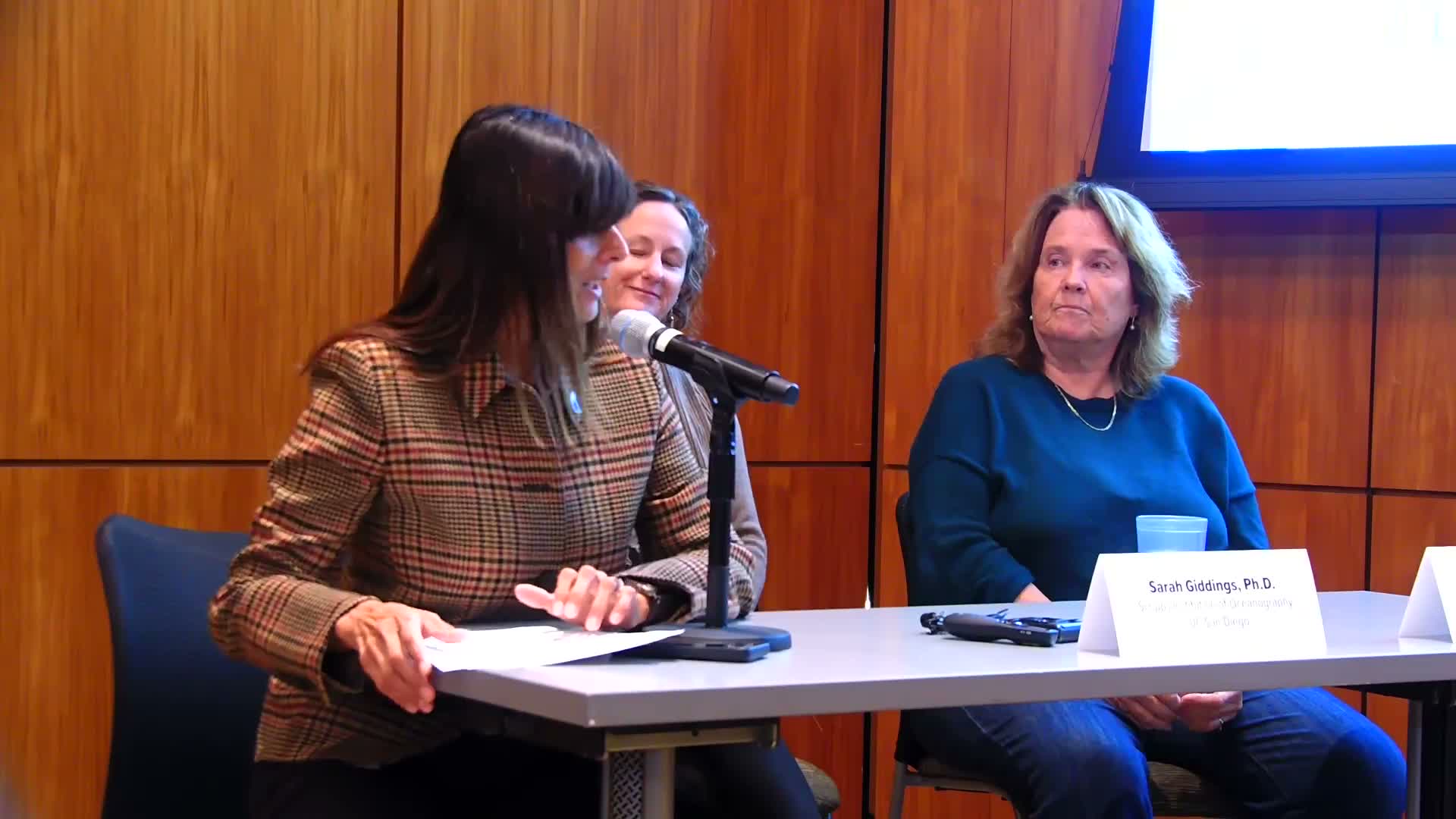
Dr. Sarah Giddings described a hydrodynamic model and a five‑day coastal water quality forecast that maps wastewater concentration and predicts beach‑closure risk. ‘‘We have developed a hydrodynamic, realistic numerical model… Our grid boxes are resolving down to less than 10 meters horizontal resolution,’’ Giddings said, and the forecast demonstrated roughly 72% accuracy against county enterococcus measurements for a January–November test period.
Dr. Kimberly Prather said her team measured dramatic nighttime spikes of hydrogen sulfide and mapped dozens of other gases and aerosols in the Nester community near a Saturn Boulevard hot spot. ‘‘You can close the beach. But you can't tell people not to breathe,’’ Prather said, explaining the team's focus on airborne exposure pathways. She reported community H2S spikes of ‘‘almost 4,500 parts per billion’’ in local measurements and higher concentrations at the riverbed; she also noted a high correlation between measured H2S and the surge of odor complaints.
Dr. Paula Stigler Granados and colleagues reported non‑targeted chemical analyses that found more than 900 unique contaminants in river samples and identified a set of 106 chemicals detected exclusively at Saturn Boulevard, which they described as a chemical fingerprint of the hot spot. Granados said passive air samplers placed at the hot spot and in nearby homes showed similar chemical fingerprints, indicating infiltration into residences.
Researchers and public‑health presenters urged the committees to fund biomonitoring and cohort studies to measure actual body burdens and long‑term health outcomes, expand indoor air monitoring and deploy protective interventions for vulnerable populations. Surface‑level mitigation proposals presented as near‑term priorities included removing or reengineering the Saturn Boulevard culvert configuration that creates turbulence and aerosolization, expanding purifier distribution and deploying sediment removal and trash‑boom operations while binational infrastructure upgrades proceed.
The scientists emphasized limitations: model and instrument uncertainties, the need for more observations to improve forecast skill, and the requirement for epidemiological and biomonitoring work to establish causal links and quantify long‑term risks.
The panel’s findings have already informed local policy moves: county purifiers, new H2S monitors and targeted notices, and a feasibility analysis to guide immediate remediation at the Saturn Boulevard hot spot.
Next steps identified by presenters include expanded sampling (including fast aerosol samplers that can compress hours of data into minutes), indoor monitoring, biomonitoring studies, and targeted infrastructure fixes as informed by the forecast model and hot‑spot feasibility work.