Get Full Government Meeting Transcripts, Videos, & Alerts Forever!
Get email alerts on the Hearing Overview topic
No spam. Unsubscribe anytime.
State, local and federal officials at San Diego hearing press for action on Tijuana River sewage crisis
Summary
Lawmakers, county officials and federal staff urged coordinated action and funding to address chronic transboundary sewage flows into the Tijuana River Valley, highlighting a nearby 'hot spot', Prop 4 allocations and a county feasibility study for immediate mitigation.
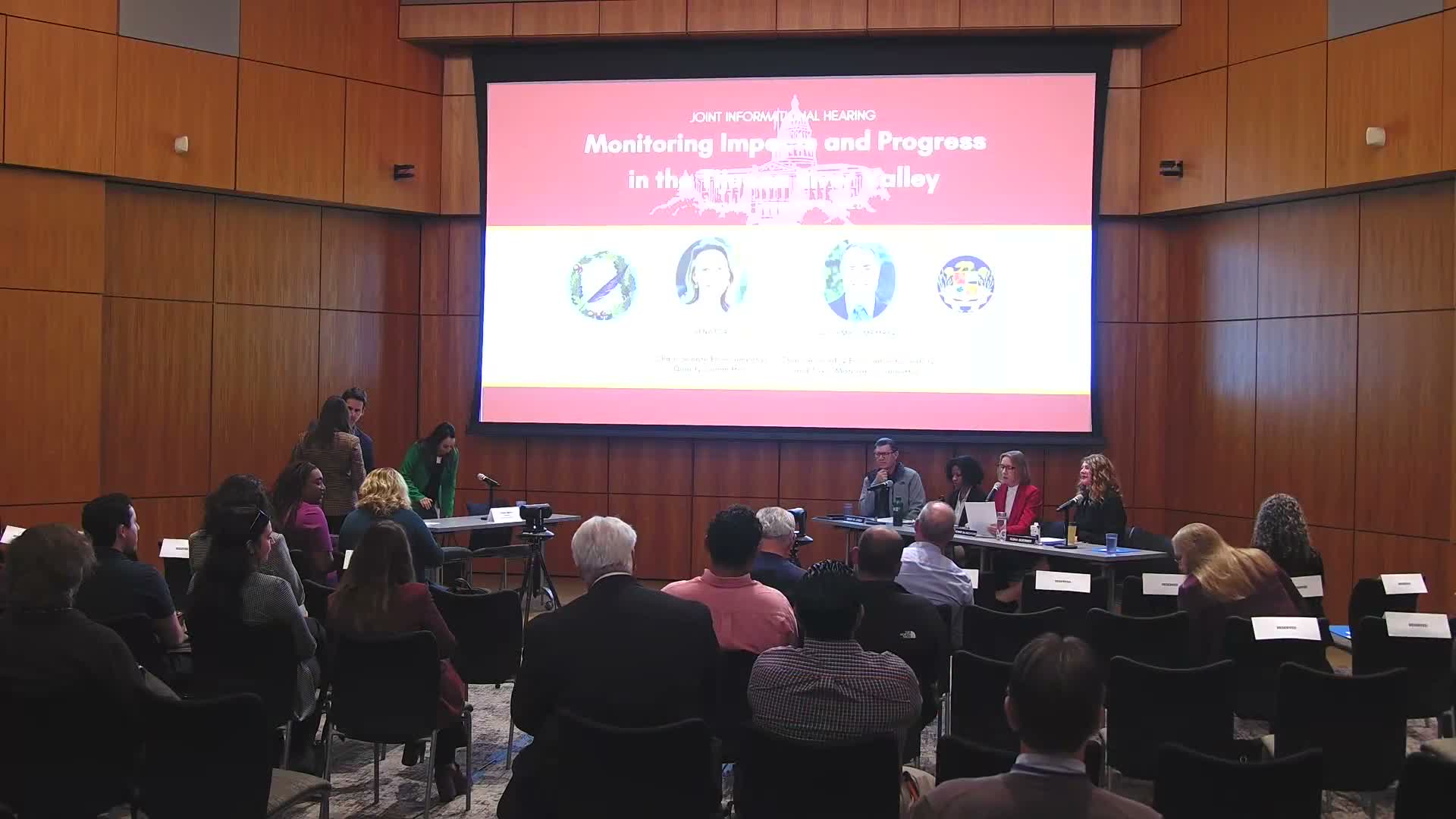
Sen. Blake Spear convened a joint informational hearing of the Senate Environmental Quality Committee and the Assembly Environmental Safety and Toxic Materials Committee to examine persistent transboundary sewage and pollution from the Tijuana River Valley and its effects on San Diego County residents and ecosystems. The hearing brought lawmakers, county officials, federal staff and scientists to the same table to discuss short‑ and long‑term responses.
The chair said the flows from Tijuana have “undermined everything that California stands for” and called for urgent action at all levels of government. Assemblymember Tasha Burner, representing Assembly District 77, described the problem as bipartisan and long‑running and thanked the congressional delegation for securing federal funding to expand the South Bay International Wastewater Treatment Plant. Kyle Crayhill, speaking for several members of Congress, said the delegation had secured more than $650 million in federal resources through USMCA and related programs to support cleanup and infrastructure.
San Diego County Supervisor Paloma Aguirre urged immediate local measures in addition to federal work. Aguirre said satellite imagery and local sampling had identified a concentrated “hot spot” in the Tijuana River Valley that is producing visible foam and aerosols close to schools and residential areas, and she announced a county feasibility analysis to map removal options and costs with a target delivery by January. She also described county actions already underway: posting warning signs near the hot spot, distributing roughly 10,000 air purifiers to date and forming a county subcommittee with public‑health experts.
State officials outlined funding and regulatory paths. Joaquin Esquivel, chair of the State Water Resources Control Board, noted the $50 million allocation in the state climate bond (Prop 4) for cross‑border rivers but said the board must complete a public process to develop guidelines before awarding funds. He also urged a holistic approach that addresses upstream sources and smaller conveyance sites in the watershed. The San Diego Air Pollution Control District reported notices of violation to the International Boundary and Water Commission (IBWC) for equipment failures and described a new H2S monitoring network and an air‑purifier distribution program that has approved over 10,400 units.
Advocates, nonprofits and residents asked the committees to fund ongoing operations of trash booms, pursue cross‑border pretreatment or source‑control programs in Tijuana, and use available state and federal tools to hold industrial dischargers accountable. Several public commenters called for interim state funding to sustain trash‑boom operations through the next storm season and for increased binational collaboration to improve industrial pretreatment and source controls.
The hearing concluded with committee members and agency directors agreeing to continue coordination across federal, state and local partners and to pursue both immediate mitigation at identified hot spots and longer‑term infrastructure solutions.
The committees will follow up through the normal legislative and funding processes; no formal votes were recorded at this informational hearing.