Get Full Government Meeting Transcripts, Videos, & Alerts Forever!
Get email alerts on the Capital Improvements topic
No spam. Unsubscribe anytime.
CIP committee endorses FY27 ranked priority list, urges council review amid debate over sports complex and carryover tracking
Summary
Clinton City’s CIP advisory committee voted to forward its FY27 ranked capital improvements list to the city council after members pressed for better carryover tracking, debated the long‑running sports complex proposal and reviewed demolition and grant‑match priorities.
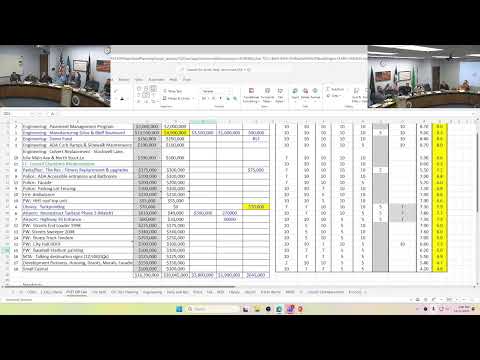
The Clinton City Capital Improvements (CIP) advisory committee voted to forward its FY27 ranked priority list to the city council after a lengthy discussion about how the list is compiled, how unfinished projects are tracked and where large projects such as a proposed sports complex fit into borrowing plans.
Chair (Unidentified Speaker 1) said the committee used a standard scoring matrix — department priorities, useful life, effects on operating and maintenance costs and revenue, grant availability and council‑directed items — to rank projects. He urged members to consider grant matches when prioritizing so the city does not forfeit awarded funding. “This is a living, breathing list,” the chair said as he described the next step of referring the package to the planning commission on Feb. 4 and then back to council.
Why it matters: The ranked list is the committee’s advisory recommendation to the council and will shape which capital needs are eligible for borrowing and which may be funded with existing or alternative revenue. Members repeatedly returned to two issues: (1) how to preserve institutional memory for long‑term requests that recur year to year (for example, North River Drive and a youth sports complex), and (2) ensuring projects with matching dollars or grant leverage are advanced so the city does not lose outside funds.
Committee members pressed for better carryover tracking and year‑to‑year comparisons so the public and future councils can see which projects remained unfinished. Unidentified Speaker 6 recommended a clear “carryover from FY…” tag for items that did not get completed; Unidentified Speaker 5 said a simple recap of “what we got done” and “what we didn’t” would improve clarity.
A recurring public concern — and one repeated by committee members — was the sports complex. Speakers summarized prior work: early Bray Architects estimates ranged as high as $16–$20 million, while comparisons to a smaller facility in Nevada, Iowa suggested costs under $8 million. One committee participant (Unidentified Speaker 9) estimated a realistic build in the $10–$12 million range and emphasized that a referendum, donor partnerships or land donations would be necessary to advance the project. “If it comes back 72% voted yes,” Chair said hypothetically about a funded referendum, noting that design and bidding would be a separate, project‑specific borrowing process.
The demolition fund and use of external revolving funds drew detailed attention. Chair reviewed demo fund levels (FY26 $350,000; FY25 $330,000; FY24 $250,000) and described leveraging low‑ or no‑interest revolving loans from the U.S. EPA and ECIA, plus a separate $1,000,000 EPA allocation tied to cleanup and asbestos abatement in a targeted block. Members urged keeping demolition capacity sufficient to respond to court‑ordered removals and redevelopment needs.
A pointed comment on long‑standing local promises came from Unidentified Speaker 2, who said, “Promises made, promises not kept,” when citing portions of the city that still lack fire hydrants and other public‑safety infrastructure. The committee discussed whether such legacy infrastructure items should be elevated in future rankings.
Formal action: Unidentified Speaker 3 moved, and Unidentified Speaker 7 seconded, a motion to forward the current priority order to the city council for planning commission review. The committee approved the motion by voice vote; members indicated assent and the chair closed the item.
Next steps and context: The CIP advisory ranking will be presented to the planning commission on Feb. 4 and then returned to council, which retains final authority over borrowing decisions and any council‑directed additions. The chair said the committee will continue refining the scoring and asked department heads to keep bringing project requests so the list can be updated with carryovers, matches and feasibility updates.
The meeting closed after administrative notes on upcoming interviews for the finance director and reminders about the council review schedule.