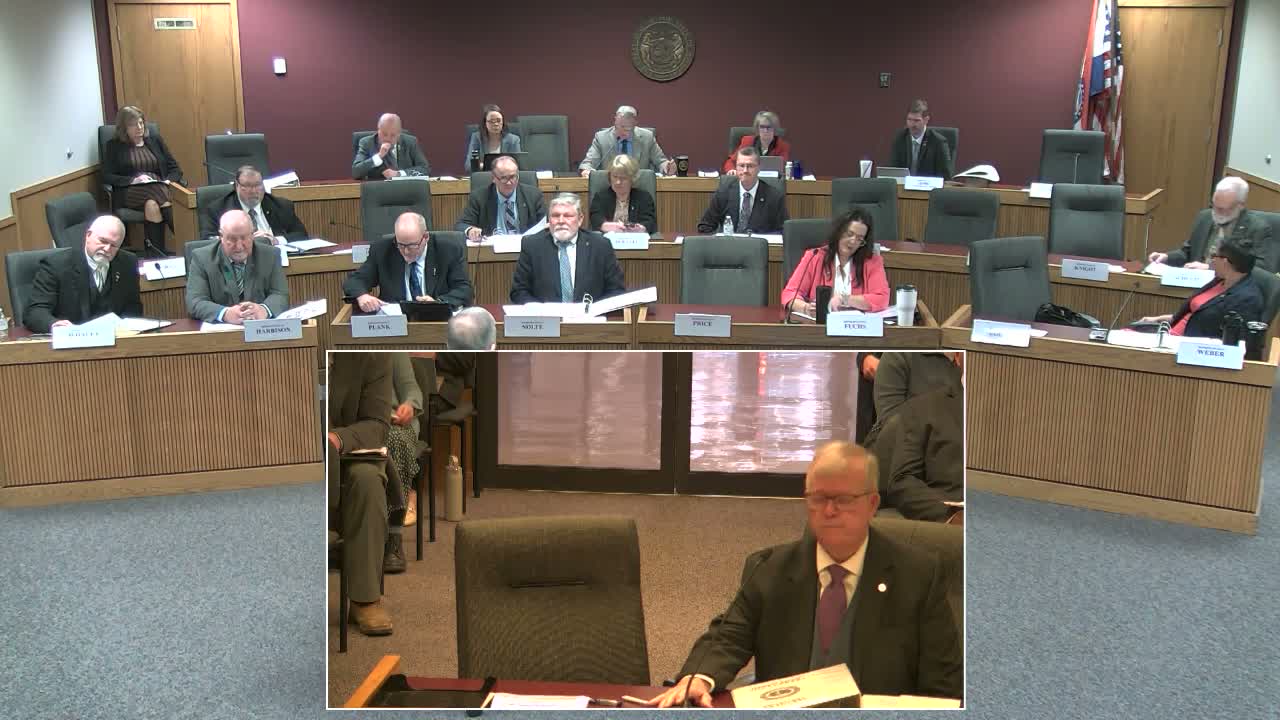
Missouri committee hears bill to allow 10-foot temporary easements for fence repair
Loading...
Summary
Lawmakers and farm groups supported HB 22 97, which would let livestock owners enter a 10-foot strip on adjacent land to build, repair or maintain fences; members raised concerns about tree removal, property rights and liability. Testimony was largely pro-farmer, with clarifying questions on statutory overlap.
Representative Kent Hayden presented House Bill 22 97 on behalf of District 43, saying the measure addresses a frequent rural safety problem when fallen trees or damaged fences allow livestock to reach busy roads. "This is a bill I presented last year, and it's a bill near and dear to my heart," Hayden said, describing a recent incident in which calves were loose near a four-lane highway.
The bill would allow a livestock owner to enter up to a 10-foot strip on an adjoining property for the limited purpose of constructing, repairing or maintaining a division fence. Hayden said the text excludes entry into buildings and omits electrical utilities and railroads from the new authority. He said the 10-foot figure reflects the width needed to operate modern equipment and that the easement is intended to be temporary, not to create permanent access.
Supporters from agricultural groups told the committee the change closes a practical gap between the legal duty to keep animals enclosed and limits on entering neighboring land to fix fences. Mark Faganbaum of the Missouri Farm Bureau said the bill "allows this 10 feet easement solely for the purpose of constructing, repairing and maintaining a fence" and described the measure as applicable in both option and non-option counties. Shannon Cooper of the Missouri Cattlemen's Association and representatives of soybean and corn growers also backed the bill, calling it a needed clarification for rural landowners.
Members pressed the sponsor on statutory overlap, the scope of vegetation removal and compensation for valuable trees. Representative Nolte noted an existing statute saying a person "may enter upon any land lying adjacent thereto for such purpose" and asked whether that language already addresses fence repairs; Hayden said he would check and acknowledged language in the bill or synopsis could be clarified. Committee members discussed treble-damage liability if valuable trees are removed and whether the bill should use terms like "possess" or "use" rather than "own" to reduce boundary disputes when surveys differ from long-standing fence lines.
Representative Job asked about duration, noting scenarios where an easement could be used to place a permanent gate; Hayden said the bill does not authorize permanent access and is intended to permit temporary construction or repair activity only. Members repeatedly emphasized negotiation between neighbors for sensitive issues such as shade trees and hunting stands.
The committee heard unanimous or near-unanimous support from agricultural witnesses but no formal amendments or votes were taken during the hearing. The chair closed testimony after several proponents spoke and moved on to the next agenda item.
The bill will return to committee work as lawmakers requested clearer statutory cross-references and explicit language on the limits of vegetation removal and liability.