Get Full Government Meeting Transcripts, Videos, & Alerts Forever!
Get email alerts on the Land Use topic
No spam. Unsubscribe anytime.
Board approves contested Thermal Ranch specific plan after hours of public testimony
Summary
After more than six hours of testimony, the Riverside County Board of Supervisors tentatively approved the Thermal Ranch specific plan and accompanying final EIR, moving forward infrastructure commitments including a proposed IID substation and a 5-million-gallon water reservoir; opponents urged further study of air quality, manure management and equity impacts.
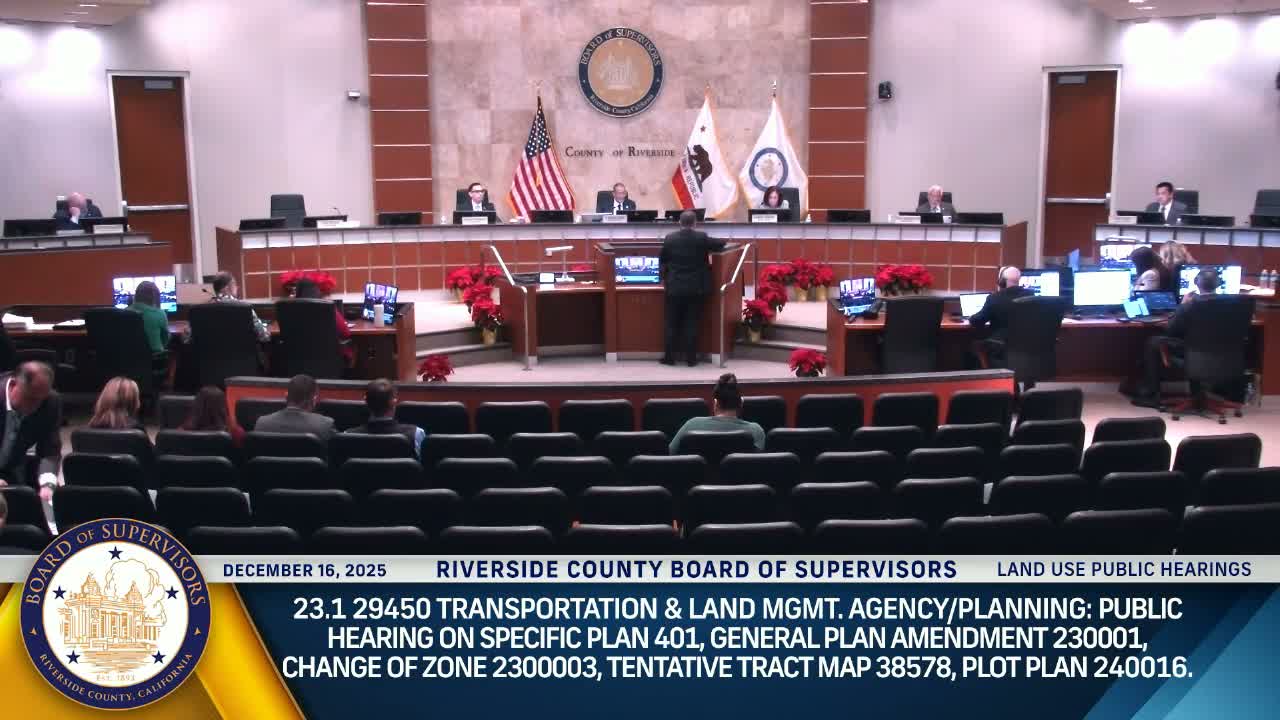
The Riverside County Board of Supervisors voted 4–0 on Dec. 16 to tentatively approve the Thermal Ranch specific plan and certify the project’s final environmental impact report, after a daylong public hearing that drew about 30 speakers and extended debate.
The proposal would transform roughly 6,190 acres in the Thermal area into a mixed-use complex built around an equestrian center, accompanied by workforce housing, an RV park and commercial components. County staff and the applicant said the project includes community-scale utilities that do not exist today: the applicant has committed to build what staff described as a 50‑megavolt-ampere class IID substation and construct a 5-million-gallon water reservoir in conjunction with Coachella Valley Water District (CVWD). County planning staff said those infrastructure elements are preconditions for onsite operations.
Why it mattered: Supporters argued the project anchors a high-profile equestrian industry cluster and will create construction and seasonal jobs, support small local businesses and generate revenue that can be used through an Enhanced Infrastructure Financing District (EIFD) to fund broader community projects. Dr. Francis Esparza, superintendent of Coachella Valley Unified School District, told the board the development would help the district by “increasing student enrollment” and creating pathways for hospitality and construction training.
Opponents, including environmental groups and East Valley residents, urged the board to delay approval, saying the EIR understates air-quality and public-health risks, omits a quantified health-risk analysis, lacks an enforceable manure-management plan for thousands of horses and offers only nonbinding language about whether new water and power capacity will be directed to existing disadvantaged neighborhoods. “We are the canaries,” one resident told the board, urging supervisors to halt approval until those concerns were resolved.
On the record: The applicant’s representatives said they already operate a large horse show and remove manure routinely for agricultural reuse. “We employ this last year over 479 people,” the applicant said in the hearing, adding that current operations already send manure to local farmers and that the new site includes covered storage and daily removal during the peak season. Environmental advocates countered that seasonal removal practices do not substitute for a comprehensive, enforceable plan or a full health-risk assessment tied to the community’s cumulative pollution burden.
What the board decided: After extended discussion of mitigation measures, utilities and community benefits, the board adopted staff’s recommendation to tentatively approve the EIR and the specific plan, and instructed staff and the applicant to continue the community outreach the board directed. Chair Manuel Perez said the project will bring “real investment” in infrastructure the area has lacked while promising to continue meetings between the developer, county staff and community leaders to refine benefits and mitigation.
What’s next: Approval is tentative pending final ministerial steps and required agreements with IID and CVWD; the board and staff said they will continue negotiating enforceable terms for infrastructure, community access to excess capacity and monitoring plans. Environmental groups signaled they may pursue legal remedies if they judge CEQA compliance insufficient.