Get Full Government Meeting Transcripts, Videos, & Alerts Forever!
Get email alerts on the General Plan Amendment topic
No spam. Unsubscribe anytime.
Commission hears strong community opposition to Rancho California GPA initiation; commissioners divided
Summary
Residents warned that initiating General Plan Amendment 240,053 would strain roads, water and fire response; commissioners expressed mixed views and passed comments to the Board of Supervisors for final initiation consideration.
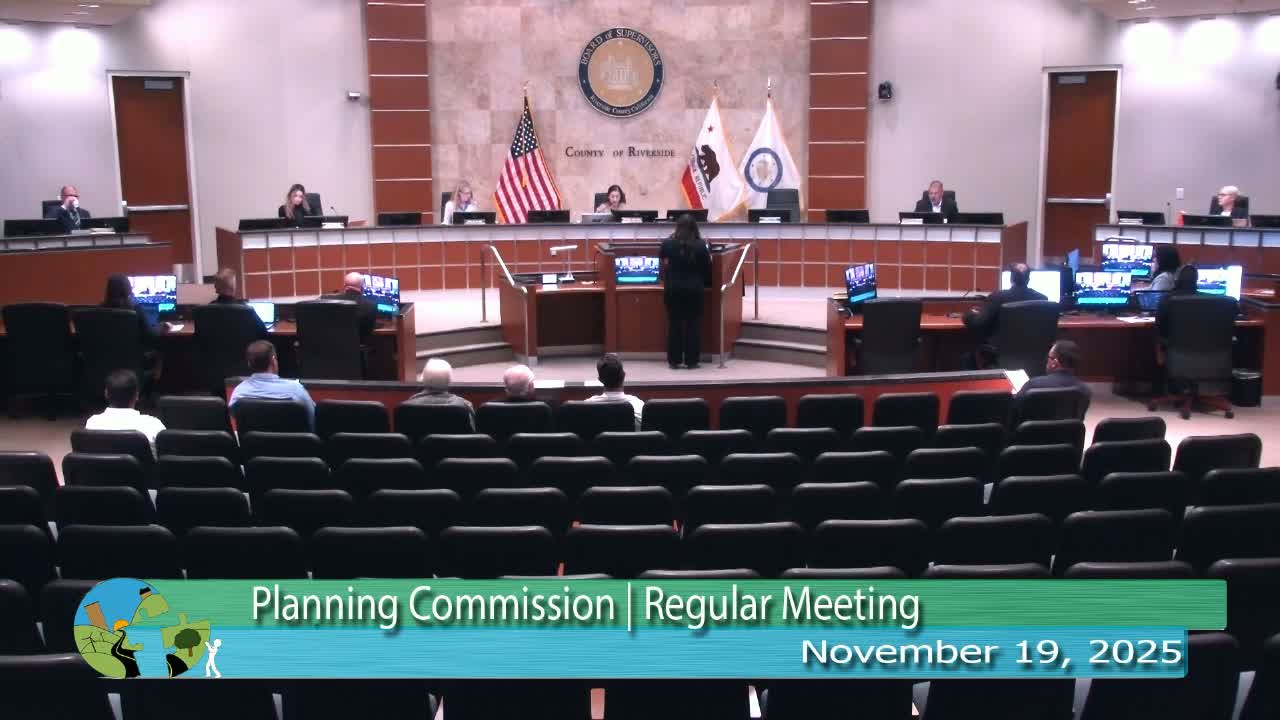
The Riverside County Planning Commission on Nov. 19 heard extensive public opposition to a proposed foundational general-plan amendment (GPA 240,053) in the Rancho California area and provided mixed guidance to the Board of Supervisors on whether to initiate the change.
Staff described the current request as a proposed change of the foundation component from rural residential to rural community very-low-density residential. Brandon Barnett of KWC Engineers, representing the owner, said the applicant has reduced the intensity of the prior request presented to GPAC, described an intent for clustered, equestrian-style housing and emphasized that the hearing was to seek initiation (not to approve a project). Barnett said an implementing tentative tract map and technical studies would follow if the Board initiates the amendment.
Scores of nearby residents and property owners urged the commission to deny initiation or preserve the current five-acre rural-residential minimum. Concerns raised included emergency evacuation challenges demonstrated during the 2022 Fairview Fire, limited road access and topography, wells running dry and wastewater limitations, insufficient outreach to immediate neighbors, and the potential for a much larger buildout under state provisions if lot-splitting or future changes were allowed.
Commissioners debated where initiation would leave neighbors and whether the proposed very-low-density option (VLDR) was appropriate. One commissioner favored initiation citing a need for housing; others were neutral or opposed the VLDR and recommended a two-acre rural community estate option over the applicant’s proposed VLDR. Staff and fire and transportation representatives explained that initiation would begin technical studies (traffic, fire, water) and that any implementing project would later require CEQA review and department approvals. The commission’s comments will be included in the staff report to the Board of Supervisors, which will make the final decision on initiation.