Get Full Government Meeting Transcripts, Videos, & Alerts Forever!
Get email alerts on the Transportation Noise topic
No spam. Unsubscribe anytime.
Highway 5 noise study finds one eligible noise wall; ballots to be mailed to affected property representatives
Summary
Carver County’s Highway 5 noise analysis found only one candidate noise wall met MnDOT and FHWA criteria. Representatives of benefited properties near the south side of Highway 5 east of Cochia Lane will be mailed ballots to decide whether the wall advances to design.
Bob Moyer, assistant project manager for the Highway 5 improvements project, and Ken Arnholtz, a principal with the project’s engineering consultant, told a project town hall that the team’s traffic noise study identified a single location that met state and federal criteria for a noise wall.
"Only 1 location met all of the criteria to justify a noise wall," Arnholtz said, referring to modeling run with FHWA traffic-noise software and field measurements taken last year. He identified the qualifying location as on the south side of Highway 5 just east of Cochia Lane (the transcript also spells the street name "Kochia" elsewhere).
The study followed Minnesota Department of Transportation guidance developed with the Minnesota Pollution Control Agency and the Federal Highway Administration and approved for use in 2017. Arnholtz said the team modeled existing, future no-build and future-build scenarios, took field noise measurements at 14 locations in late 2023 (50 minutes per site), and validated models with traffic counts that differentiated cars and trucks.
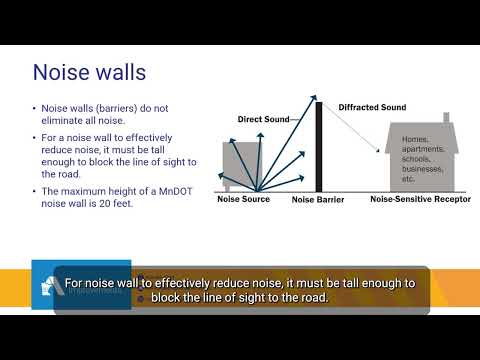
Arnholtz summarized the four tests a candidate wall must pass to advance: sufficient noise impact at receptors; physical feasibility and safety of placement; a noticeable noise reduction (a 7‑decibel decrease for a primary receptor and 5 decibels for other receptors); and cost-effectiveness, defined preliminarily as less than $78,500 per benefited receptor. MnDOT also caps noise-wall height at 20 feet, he said.
Because only one candidate met all criteria, the next step is a property-level vote. "Representatives of all of the benefited receptors for this wall will be mailed a ballot to vote on whether they want to have a noise wall or not," Arnholtz said. Ballot results will determine whether that wall advances to design; if it does not receive the required level of support it will be eliminated along with other candidates.
Moyer closed the meeting with logistical information, directing residents to a project FAQ and an email subscription for updates.
What happens next: the project team will mail ballots to representatives of benefited receptors for the qualifying location; based on the tabulated votes, the wall will either move to design or be dropped. No formal construction decision or funding authorization was reported at the town hall.