Get Full Government Meeting Transcripts, Videos, & Alerts Forever!
Get email alerts on the Town Center Planning topic
No spam. Unsubscribe anytime.
Heath EDC agrees to refine scope, issue RFP to advance Town Center plan
Summary
At a special Oct. 3 meeting the HEAP Municipal Benefits Corporation and HEAP Economic Development Corporation agreed to refine a written scope and issue a request for proposals to produce a Heath Town Center master activation plan, feasibility analysis and funding strategy; a small drafting group will finalize the RFP.
The HEAP Municipal Benefits Corporation and HEAP Economic Development Corporation agreed Oct. 3 to refine the scope and issue a formal request for proposals to develop a Heath Town Center activation plan that would translate the city’s existing Town Center Overlay District into a feasible, phased project.
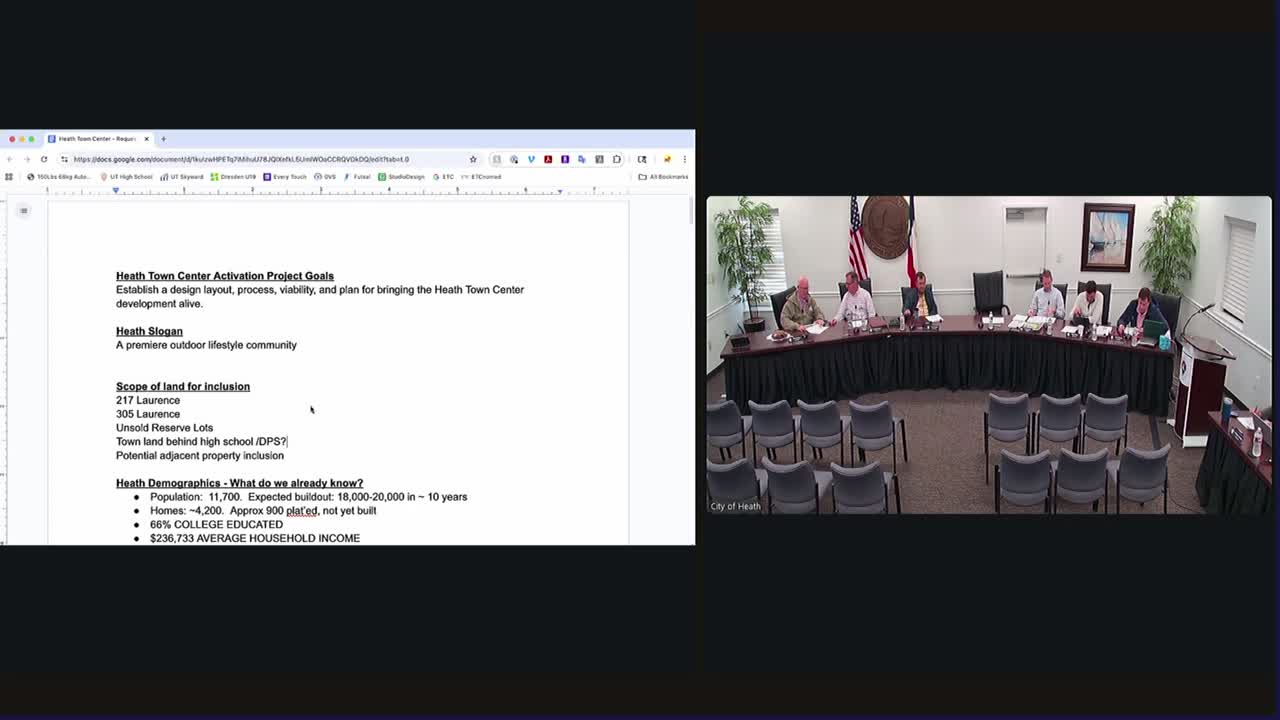
Board members said they received five consultant proposals that varied widely because the initial ask had not been captured in a single, written scope. Unidentified Speaker 1, who led the meeting, said the EDC now controls parcels at 217 Lawrence and 305 Lawrence adjacent to the reserve and city-owned land and needs a clear master plan, engineering validation and a business case to make the overlay’s vision actionable. "Establish design layout process viability and plan for bringing the Heath Town Center development alive," Speaker 1 said as the summary of the intended consultant deliverable.
Why it matters: The City of Heath’s Town Center Overlay District was created from prior community engagement and is codified in local ordinances, but speakers said the overlay document provided concept-level guidance rather than parcel-level design, phasing or funding details. The board described the RFP as the step that would turn the overlay’s aspirational design into an implementable, financeable project — and a tool to recruit developers and investors.
What the board asked consultants to include: members converged on a phased set of outputs, each with itemized pricing: a master activation plan and land-use layout; engineering/site analysis (topography, floodplain, utilities, ingress/egress); a feasibility/business-case analysis and suggested funding approaches (examples cited included TIF/TIRP or other incentive structures); an ordinance/standards review identifying code changes needed to implement the plan; and a phasing and implementation strategy. The board also agreed to require respondents to identify costs for optional work streams (for example, market validation and 3-D visualizations) so the EDC could choose phases by budget.
Program priorities the board flagged included outdoor dining and walkable retail, co-working and second/third-story residential (often discussed as "lock-and-leave" or high-end ownership rather than dense multifamily), health/wellness and limited event or recreational uses tied to local demand. Members emphasized preserving natural amenities — including the existing lake and trail connectivity to Town Center Park and the city PATH program — and making parking and circulation assumptions explicit in consultant work. Several speakers urged caution about large-scale hospitality or tournament-grade sports facilities given site and market constraints.
Vendor selection approach: Board members said consultants should be given common background materials (the comprehensive and Town Center plans plus trail standards), allowed to ask questions in a formal pre-proposal process, and provided with a single public Q&A file. The group agreed to an interview step and to request itemized, phase-based pricing so proposals would be apples-to-apples.
Next steps and governance: The board asked for a small drafting team to finalize the RFP text with staff and bring it back to the full board for publication. Unidentified Speaker 3 volunteered to help; Unidentified Speaker 1 confirmed that "Jeff and Doug will follow-up" and said, "I will reach out to both of you guys around coordinating a time to do that." The board aimed to issue the RFP within about 7–10 days and discussed using a pre-proposal meeting and question deadline to manage the procurement timeline.
What was not decided: The board did not adopt any ordinance changes or award any contracts at the meeting. No formal motion or vote was recorded to approve a specific consultant; instead members agreed by consensus to refine the scope, vet it with selected advisors (for example, Frank Bliss was suggested as a reviewer) and proceed with the RFP process.
The special meeting adjourned at 11:34 a.m.