
Brazos County staff proposes tightened Chapter 312 tax abatement guidelines, $1,000 fee and transfer rules
Get AI-powered insights, summaries, and transcripts
Sign Up Free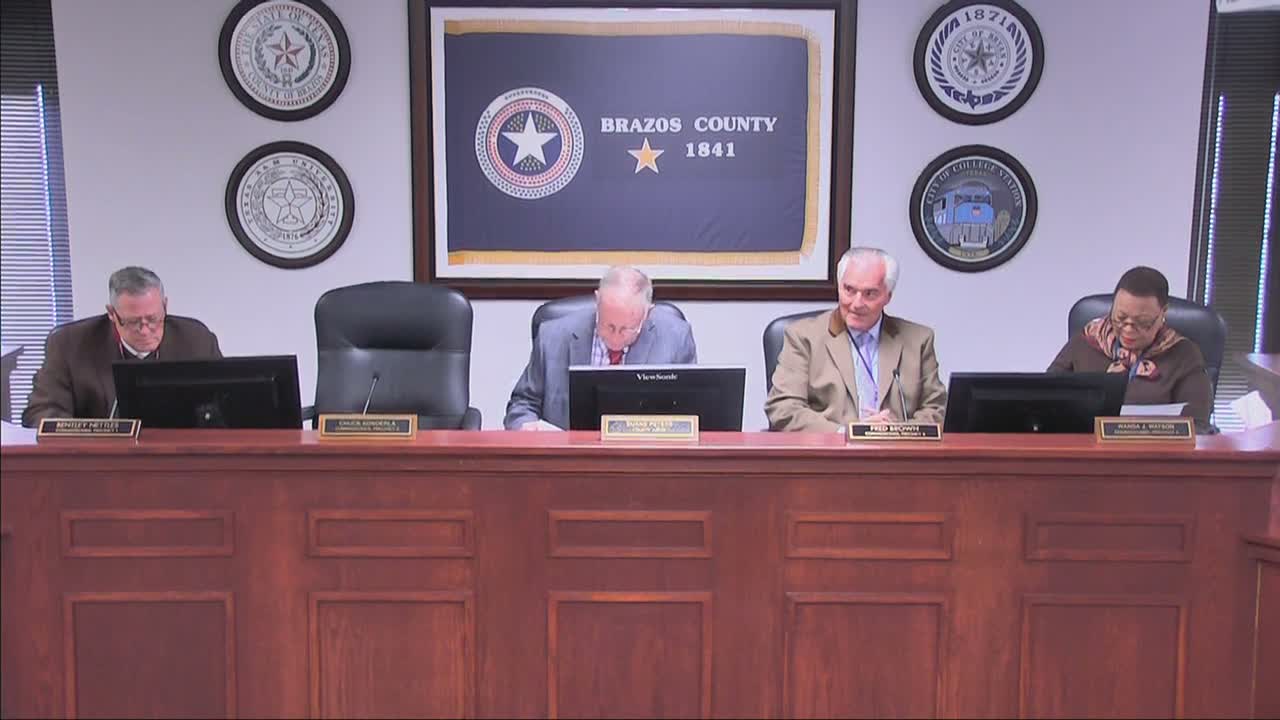
Summary
Brazos County economic development staff outlined suggested updates to the county's Chapter 312 tax abatement guidelines, including clarifying eligible improvements, an application-expiration rule, a transfer fee, and maintaining a standard 50% maintenance-and-operations abatement with a five-year baseline term.
Kimberly Gonzales, Brazos County economic development coordinator, told the commissioner's court on Jan. 27 that staff will recommend tightening the county's Chapter 312 tax abatement guidelines and return those changes to the court for consideration in February ahead of a March renewal deadline.
Gonzales said the guidelines govern property tax abatements the county may enter under Chapter 312 of the Texas tax code and that the county must adopt and publish guidelines every two years to continue offering abatements. "These guidelines are only for our chapter 312 agreements, only for our tax abatements," she said, adding the rules do not apply to Chapter 381 agreements or other tax-related arrangements the county has used.
Under the county's current approach, Gonzales said, Brazos County typically offers a standard five-year abatement and authorizes abatements up to a 10-year maximum as allowed by state law. "The amount of abatement authorized by Brazos County is 50% of the maintenance and operations portion of the tax rate," she said, noting the court may approve exceptions that exceed the 50%/five-year baseline by a four-fifths vote.
Gonzales laid out how nearby Texas counties handle terms, thresholds and fees to inform the county's revisions: Webb and Montgomery counties set a $10,000,000 minimum capital-investment threshold; Montgomery uses a tiered schedule (5 to 10 years) tied to investment bands; Jefferson County focuses on industrial and health-care projects and imposes a transfer fee of up to $10,000 for assignment of an abatement; Smith County typically requires applicants to meet one of several markers (for example, $1,000,000 capital investment or creation of 25 full-time jobs); and McLennan County's program is administered by the Greater Waco Chamber and often aligns county terms with city reinvestment-zone agreements.
Gonzales recommended several specific changes to Brazos County's guidelines: define eligible improvements more precisely (with reference to the state statute), add an expiration clause that voids an application one year after receipt and requires re-filing and a new fee, note that projects that merely transfer employment within the county will be evaluated case by case, and require that the economic life of improvements exceed the abatement term. "Include a clause in the guidelines that one year from the receipt of the application, the application expires," she said, explaining companies sometimes return with substantially different projects after long delays.
Commissioners questioned whether the county should restate statutory prohibitions or simply reference the state law. One commissioner cautioned that spelling out state-prohibited items in the guidelines could create the appearance of local discretion where none exists; Gonzales agreed staff could refer applicants to the state statute to avoid confusion. Another commissioner pointed to Brazos County's local advantages, saying the presence of Texas A&M University and the RELLIS campus reduces the need to offer 100% abatements in many cases.
On enforcement and verification, Gonzales said the county typically includes recapture (clawback) language and requires applicants to disclose expected employees and payroll; the county verifies employment using Texas Workforce Commission documents and may seek repayment if firms fail to meet agreed benchmarks.
Gonzales said staff will draft the recommended edits, add a transfer-fee provision similar to Jefferson County's, consult legal on specific language, and bring the revised guidelines back to the court in February so the county meets the March 12, 2026 renewal deadline. No formal vote was taken during the Jan. 27 workshop.
What's next: staff will prepare revised guideline language and consult legal counsel; the court will review the draft in a February meeting and decide whether to adopt the updated guidelines before the March renewal deadline.