
Boise proposes limited sewer extensions in Southwest if owners fund work and consent to annexation
Get AI-powered insights, summaries, and transcripts
Subscribe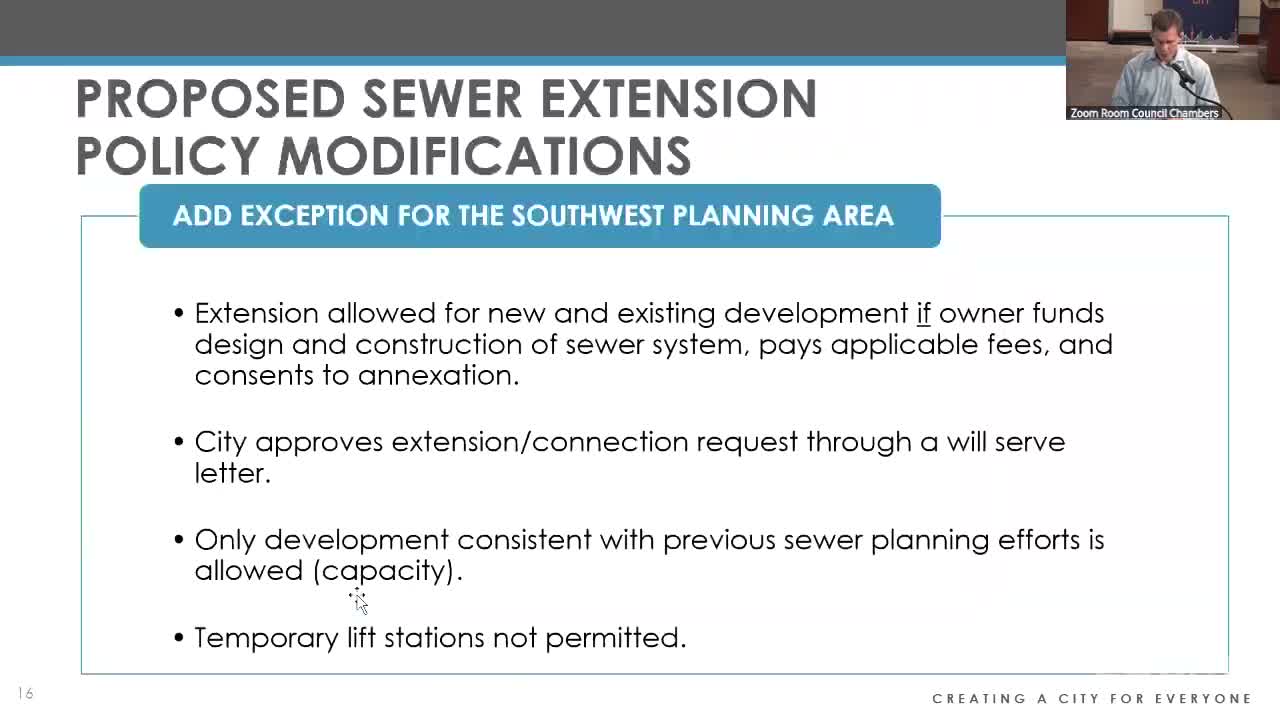
Summary
City engineer Jim Pardi presented a proposed exception to the sewer extension policy allowing connections in the Southwest Planning Area only if owners fund design and construction, pay fees, provide a will‑serve letter, consent in writing to annexation, and avoid temporary lift stations. Staff emphasized protecting existing ratepayers and the high cost of treatment capacity.
City engineer Jim Pardi told council staff are proposing a narrow exception to the city's sewer extension policy for the Southwest Planning Area that would allow extensions for new and existing development provided several conditions are met: owners must fund, design and construct the sewer system; pay all applicable fees and assessments; provide written consent to annexation; obtain a will‑serve letter from the city; and adhere to Boise's land‑use assumptions and sewer master plan. Pardi said temporary lift stations would not be permitted under the proposed language.
The rationale and mechanics: Pardi explained that sewer collection (pipes) and treatment (plants) are planned using Boise Blueprint land‑use assumptions. Gravity collection lines are preferred; temporary lift stations carry higher operation and maintenance costs and greater liability because the city assumes ownership once a developer turns over infrastructure. "Temporary lift stations...have higher operation maintenance costs," Pardi said, noting pumps, electrical components, backup generators and odor control add cost and risk.
Cost examples and capacity: Pardi provided examples to clarify individual costs: a homeowner 1,000 feet from sewer faces connection fees (roughly $4,500 under the example) and capital cost at roughly $300 per linear foot (about $300,000 for 1,000 feet) to extend pipe to their property. On a larger scale, staff offered a rough scenario that 2,000 acres of undeveloped/redevelopment potential at four units per acre could translate to about 8,000 homes over time if the Boise Blueprint densities were realized; staff and the mayor exchanged different upper‑bound build‑out estimates and emphasized that build‑out would likely be gradual.
Protections and appeals: Pardi said will‑serve letters would allow the city to review whether proposed extensions match planned land use and protect existing ratepayers from projects that would jeopardize system performance. Applicants denied a will‑serve letter could appeal first to the Public Works Commission and then to city council. Pardi also noted that treatment plant expansions are expensive and happen in large increments, so unchecked increases in flows would require major capital investment.
Council reaction and next steps: Council members generally supported the direction but emphasized concerns about fairness to existing ratepayers, long‑term sequencing of infrastructure, and the need for clear interim deliverables. Multiple members affirmed direction to staff to refine the policy and return with formal language and implementation details for council consideration.