Oak Harbor explains new local B&O tax, says revenue will fund marina improvements

City of Oak Harbor Finance Department presentation · January 27, 2026

Loading...

AI-Generated Content: All content on this page was generated by AI to highlight key points from the meeting. For complete details and context, we recommend watching the full video. so we can fix them.

Summary

The City of Oak Harbor Finance Department presented operational guidance on the new local business and occupation (B&O) gross-receipts tax, effective Oct. 1, 2025, detailing who must file, filing schedules, thresholds ($1,000,000 quarterly; $4,000,000 annual), exemptions, penalties, and how to request active nonreporting status.

The City of Oak Harbor Finance Department on Jan. 1, 2026, outlined how the city’s new local business and occupation (B&O) gross-receipts tax works and who must comply. The tax, the department said, went into effect Oct. 1, 2025, and the city will use the revenue to fund improvements at the municipal marina.

The guidance explained the tax is assessed on gross receipts — the total revenue or value of products sold within city limits before expenses are deducted — and applies only to activity conducted in Oak Harbor. "Unlike an income tax..., the B&O tax is a gross receipts tax," the presenter said, adding that state B&O and sales-tax collections remain separate.

Why it matters: the city set high filing thresholds to limit burden on small businesses. The finance department said businesses with quarterly gross receipts below $1,000,000 (or $4,000,000 on an annual filing basis) owe $0 in B&O tax, and estimated roughly 1% of local businesses will pay under current economic data. Still, all active businesses must file returns so the city can verify status and threshold eligibility.

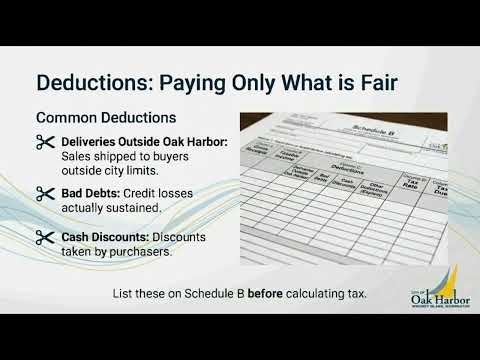
How to calculate and file: Oak Harbor calculates gross receipts as "sales plus total revenue plus value of products." Labor, materials and overhead are not subtracted. The presenter advised businesses to use the modular filing system: a main return plus schedules. Schedule A is the apportionment form for businesses operating both inside and outside city limits; Schedule B is for deductions (for example, interstate sales and bad debts); Schedule C provides the multiple-activities tax credit for manufacturing, extracting or printing operations to prevent double taxation.

The tax rate is uniform across classifications at 0.002 (0.2% of gross receipts). The city uses six reporting classifications (retailing, extracting, wholesaling, printing and publishing, manufacturing, and service/other). The finance presenter noted a 2025 state law update that redefined certain activities and urged businesses to consult Oak Harbor Municipal Code chapter 3.98 for definitions.

Filing cadence and deadlines: the default filing period is quarterly. The city listed regular deadlines: Q1 (Jan–Mar) due April 30; Q2 (Apr–Jun) due July 31; Q3 (Jul–Sep) due October 31; Q4 (Oct–Dec) due January 31. Annual filers’ returns are due April 30 of the following year. For the initial reporting period, businesses over the threshold must file two returns (for 2025 and 2026), both due April 30, 2026. Businesses consistently under the quarterly threshold may request a one-time "active nonreporting status" that pauses quarterly filing obligations while keeping the business on city records.

Penalties and recordkeeping: the presenter recited state-mandated penalties for late filing (1 day late = 9%, 1 month late = 19%, 2 months late = 29%) and said daily interest applies; the presentation cited a 6% annual interest rate for 2026. Businesses must retain books, records and invoices for at least five years.

Payments and delivery: the city cannot accept emailed returns that show a payment due and currently does not process electronic tax payments. Businesses that owe money must mail or deliver returns with a check or money order to the Finance Billing Office on the 2nd floor of City Hall during business hours.

Resources and contacts: the finance department directed businesses to oakharbor.gov for the guide and forms, provided an email (taxandlicensing@oakharbor.org), phone ((360) 279-4530) and the physical address 865 Southeast Barrington Drive, Oak Harbor, WA 98277 for in-person delivery.

Next steps: businesses should check their receipts against the thresholds, file the appropriate return on time, request active nonreporting status if eligible, and apply relevant deductions and schedules when calculating tax due. The finance department emphasized early outreach for questions and cited Oak Harbor Municipal Code chapters 3.98 and 3.99 and the Revised Code of Washington as source materials.