Get Full Government Meeting Transcripts, Videos, & Alerts Forever!
Get email alerts on the Urban Forestry topic
No spam. Unsubscribe anytime.
Lafayette Planning Commission backs update to tree protection rules, forwards ordinance to council
Summary
The Planning Commission recommended a draft Tree Protection Ordinance update to City Council after staff outlined changes including raising protected-size thresholds for some properties, a 1:1 replacement ratio, new penalties for illegal removals and clearer procedures for defensible-space pruning and fuel-breaks.
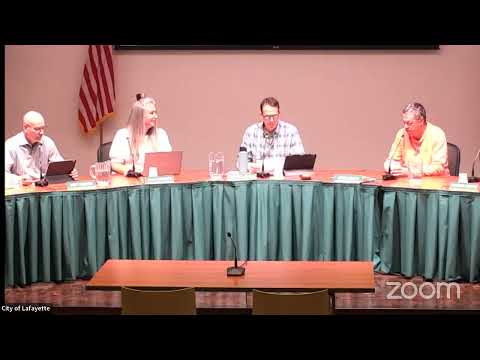
The Lafayette Planning Commission recommended that the City Council adopt an updated Tree Protection Ordinance after a public hearing and extended discussion Tuesday evening.
Planning staff presented the draft ordinance and timeline, describing revisions that include new protected-tree size thresholds (raising protection on most undeveloped properties from 6 inches to 12 inches in diameter while retaining 6 inches for native and riparian species), adding cork oak to the protected species list for developed properties, and replacing blanket protection for trees shown on development plans with a process that lists specific trees in conditions of approval. "We are now in the final arrow marked fall for hearings and adoptions of the ordinance," staff said during the presentation.
The draft also proposes a simplified 1-to-1 replacement ratio for removed trees with a minimum replacement size of 15-gallon stock, and objective options to allow in-lieu fees when canopy cover exceeds defined thresholds (staff described allowing in-lieu payments for up to half of required replacements when canopy cover exceeds 75%, and for all required replacements when canopy cover exceeds 90%). Staff said an arborist report could also justify in-lieu payment when additional trees would not foster healthy growth.
Fire-safety changes were highlighted: property owners could remove trees in Zone 0 (defined as the first 5 feet around a building or attached structure) without a permit; pruning to 10 feet from structures would be allowed regardless of health impacts for defensible-space purposes; and fuel-break removals would require a letter from the Contra Costa County Fire Protection District identifying the exempt trees. For dead trees, staff proposed removal with an arborist letter confirming the tree died of natural causes, while alternatives include staff verification or different thresholds.
Procedural updates would add fines for illegal removal based on tree diameter and remove the old practice of dramatically increasing replacement ratios as the only enforcement mechanism. Staff said penalties would escalate for repeat violations on the same property and that failure to plant replacement trees would itself be an enforceable violation. Staff indicated the fee amounts will be placed in the city's fee schedule so fees can be adjusted without an ordinance change.
Public commenter Bob MacLean, who identified himself as a local builder and frequent correspondent with staff, urged the commission to adopt the 1-to-1 replacement ratio to simplify mitigation calculations and noted inconsistent application of the current formula. "The 1 to 1 ratio I think is a great idea," MacLean said, while also warning that mitigation funds and city resources could be affected by a large number of required replacements.
Commissioners debated whether to keep the simple 1-to-1 ratio or adopt a stepped increase for very large 'heritage' trees. One proposal discussed would require additional replacement trees for removed trees above a specified diameter (members discussed triggers at 24 inches or 30 inches), and staff agreed the commission's interest in a potential step-up could be communicated to the council as an option. Commissioners also asked for clarification that replacement trees planted in the public right-of-way be placed as close as possible to the original location.
After deliberation and a few technical edits that staff agreed to include, Commissioner Heising moved to adopt PC Resolution 2024 recommending the City Council adopt the tree protection ordinance update (MCR01-24) with the discussed additions. The motion was seconded and the commission voted in favor; the chair announced the motion carries and noted the standard 14-day appeal period.
Next steps: the Planning Commission's recommendation and staff revisions will be forwarded to the City Council for its review and potential adoption. The PC motion and staff report indicate the recommended fee schedule, arborist and canopy-calculation methods, and the specific code-section edits will accompany that submittal.