
House Oversight Presentation: APS, probate and a forensic review flag possible exploitation of conservatorship ward Roselyn Byrd
Get AI-powered insights, summaries, and transcripts
Subscribe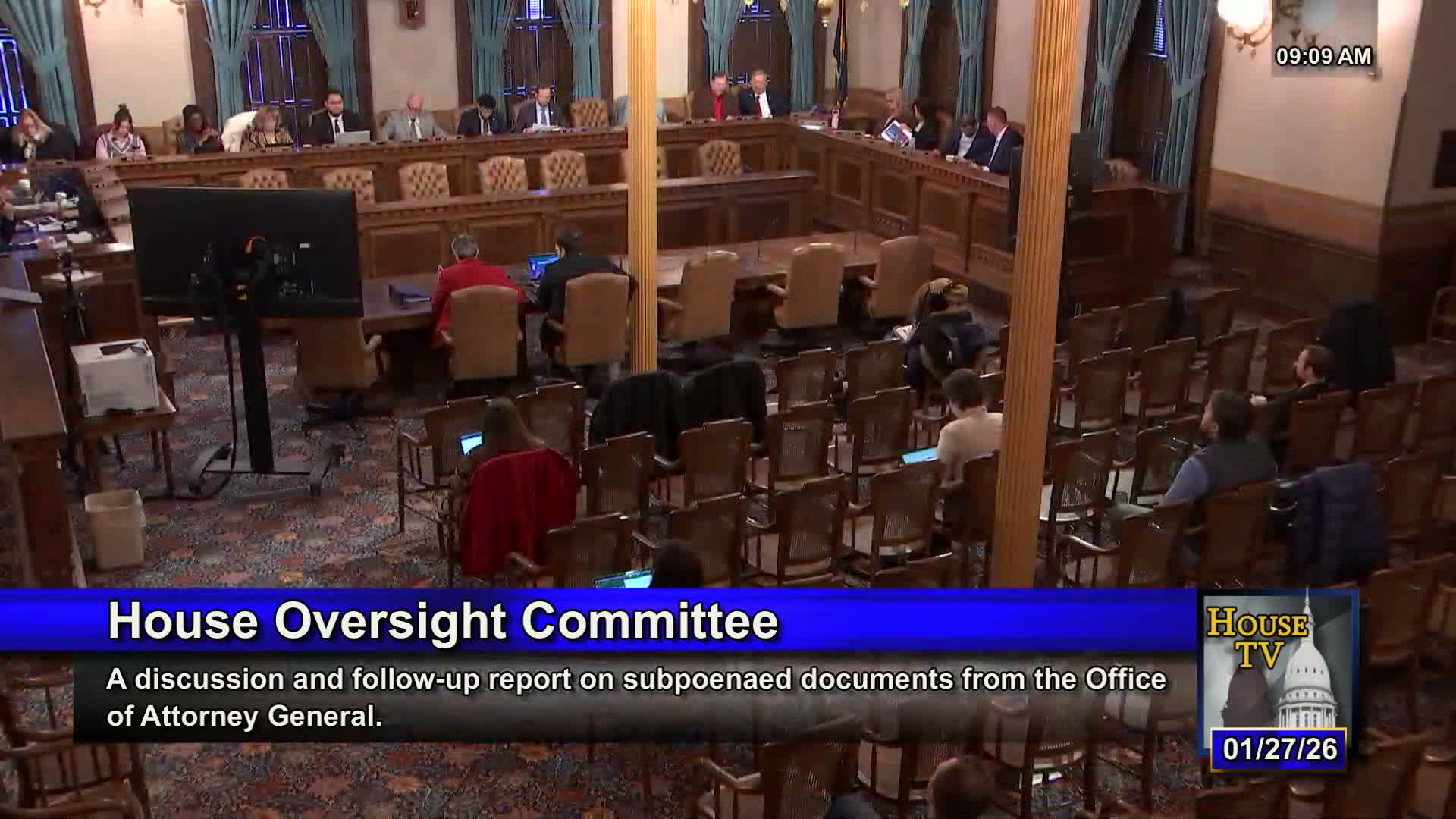
Summary
House counsel presented Adult Protective Services records, a probate-court special fiduciary's findings and a preliminary Plante Moran review that together flagged accounting errors, missing assets and roughly $420,000 in questionable transactions tied to conservator Tracy Kornack; committee members pressed why the Michigan Attorney General's office closed its earlier inquiry.
House legal counsel told the Michigan House Oversight Committee on Jan. 5 that multiple official reviews and a preliminary forensic accounting raised serious questions about how conservator Tracy Kornack handled the finances of her ward, the late Roselyn Byrd.
Catherine Edwards, a house central staff attorney, told the committee that by the time Adult Protective Services closed its two-year probe in May 2025 it had concluded that financial exploitation of Byrd was substantiated. "The Attorney General's office told APS that it should not take any action to help Miss Byrd, but should sit tight and do nothing," Edwards said while summarizing APS case notes and the agency's communications with the AG's office.
Why it matters: committee members said the findings matter because several independent reviews reached results very different from the Attorney General's office. Counsel presented four agency views: a preliminary Plante Moran accounting review that identified roughly $420,000 in questionable transactions; APS's substantiation of exploitation; Kent County law-enforcement recommendations for felony charges; and concerns recorded by the Allegan County probate court that led a judge to appoint a special fiduciary and order a back‑audit of a decade of filings.
Edwards and her colleague Casey Markarian told the panel that the probate judge twice found conservator filings deficient and that the special fiduciary reported widespread mathematical errors in annual accountings and that some assets appear missing. The fiduciary persuaded the court to expand his review back to 2015 so he can correct earlier filings and trace where settlement proceeds and trust benefits went.
The forensic accounting excerpted from APS's file raised specific transaction concerns: Plante Moran flagged about $240,000 in transfers from Byrd to Kornack, roughly $200,000 in payments from State Farm that appear to have gone to Kornack's law firm, payments of about $54,000 to Kornack's daughter Delaney for alleged attendant care, and around $26,000 in cash withdrawals including one single withdrawal for $10,943.83. Counsel described Plante Moran's findings as preliminary and said the firm sampled only a subset of months; the special fiduciary has issued subpoenas to gather sealed records and settlement documents.
Members pressed for details. Rep. Brook, a registered home-care provider, said the material raised deep concern about billing practices and conservator duties. "This really, really stinks to high heaven," Brook said, adding that small irregularities can signal larger problems. Representatives asked whether State Farm had issued payments directly to Heather Hills or Kornack and whether assignments of benefits existed; counsel said State Farm at one point sent a check to Heather Hills that facility returned, and records show complexities in who was paid and how those payments were recorded.
Counsel also told members that APS case notes document that, during interviews, Byrd sometimes did not recognize visitors and at other times said she wanted a new conservator; caregivers reported redirected mail and missing personal items, and one caregiver reported inappropriate or threatening language by Kornack in staff emails.
On the Attorney General's office: committee counsel said the AG's office opened an earlier, limited inquiry after a news report, then closed its file in December 2022. APS opened a separate investigation less than a month later. Counsel reported conversations with a special assistant attorney general who, according to APS notes, described the case as "sensitive" and warned of Kornack's political connections and potential retaliation against whistleblowers. Counsel also said the AG's office produced redacted documents in response to follow‑up subpoenas and that the chief legal counsel declined direct calls from the committee's legal staff.
Next steps and limits: members asked the committee to subpoena or invite AG office attorneys to testify; counsel said the AG office has offered internal prosecutors to testify in the past and the chair indicated he would pursue additional witness appearances. The probate judge has granted the special fiduciary 180 additional days to expand the accounting review, and Kent County investigators and prosecutors are reported to be pursuing criminal inquiries.
Actions recorded publicly: Representative Bierlein moved to approve the Dec. 16, 2025 minutes and the committee approved them by unanimous consent; the committee adjourned at the close of the hearing.
What remains unresolved: the precise amounts that are definitively improper will depend on the special fiduciary's full accounting and any sealed settlement documents; Kent County criminal proceedings and the probate-court audit are ongoing. Counsel also emphasized that some relevant records remain sealed or redacted, and that the committee's subpoenas have produced redacted AG office materials that they say lack a privilege log explaining the redactions.
The committee asked staff to produce a detailed timeline of who received what records and when, so members can evaluate what the Attorney General's office had available during its initial inquiry and whether those facts would warrant reopening that investigation. The committee adjourned without further business.