
Audit flags record-keeping and testing gaps at Michigan Secretary of State branches; department points to new feedback tools and safeguards
Get AI-powered insights, summaries, and transcripts
Subscribe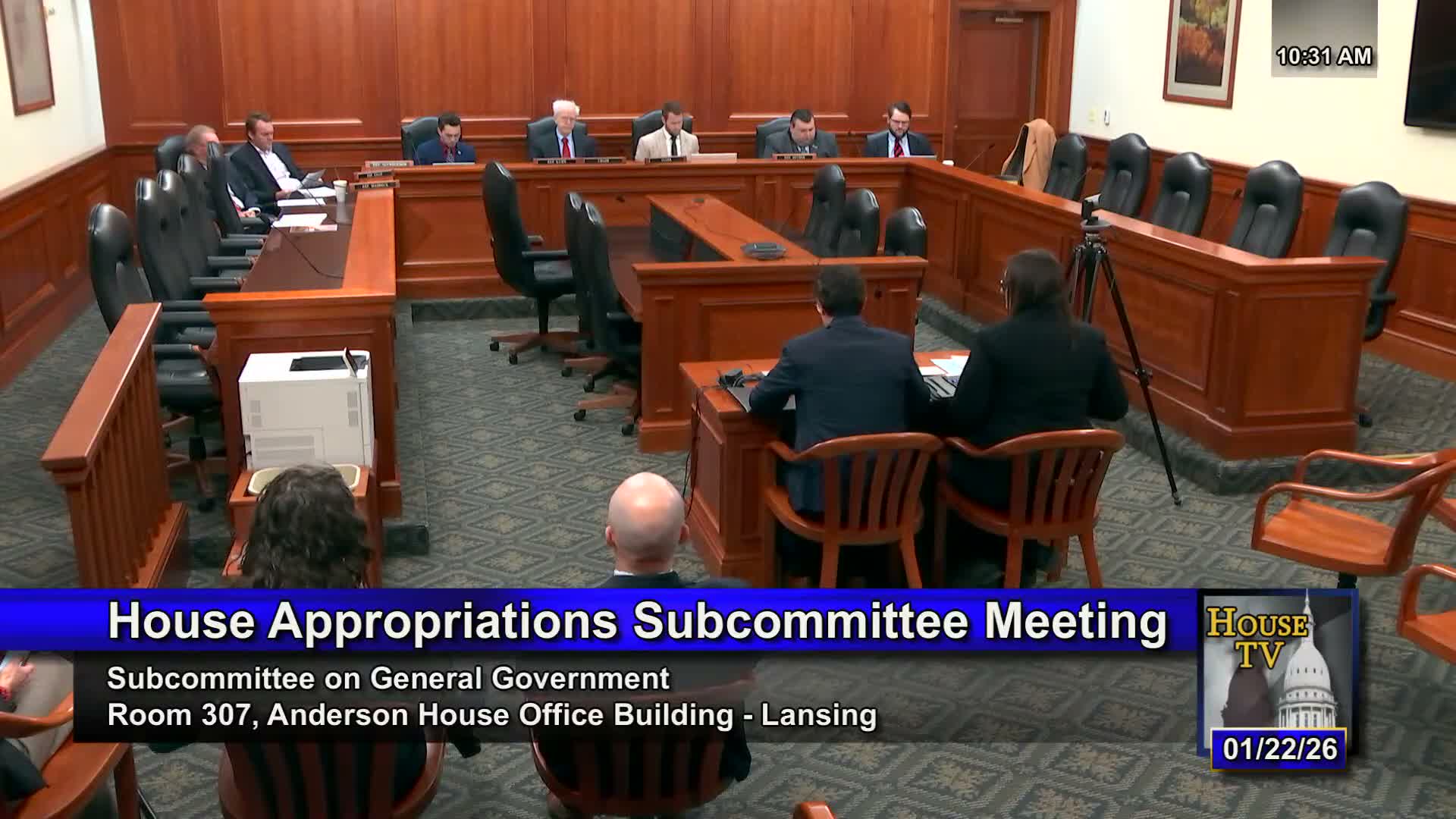
Summary
The Office of the Auditor General told a House appropriations subcommittee that Michigan Department of State branch offices need stronger customer-data collection, better documentation for some Real ID transactions, tighter testing oversight and improved training records; the department described new check-in kiosks, a Qualtrics survey rollout and other fixes.
The Michigan Office of the Auditor General told the House Appropriations Subcommittee on General Government that a review of the Department of State’s branch operations found multiple weaknesses in record-keeping, testing-area oversight and training documentation, while the department described steps it has taken and plans to implement to address the findings.
The auditors said they concluded the Bureau of Operations "provided sufficient branch office customer services" but identified reportable conditions in four areas, including inconsistent collection of wait-time data and customer feedback, incomplete supporting documentation for some Real ID and enhanced ID transactions, inadequate monitoring of test-taking areas, and missing training records. Audit manager Robert Lock and audit supervisor Katie Snyder presented the report and its methodology — including site visits and a 60-transaction sample — to the committee.
The audit notes that auditors reviewed a sample of 13 branch office visits and 60 transactions drawn from state transaction data. On customer feedback, auditors found 693 comments between Oct. 1, 2022 and May 31, 2024 — "less than one half of 1% of the 7,000,000 customers served for the same time period," the report says. On Real ID documentation the auditors reported that, within the transactions they were able to review, some Real ID applications lacked copies of proof of Social Security number or proof of residency.
"Branch operations division should strengthen its efforts for collecting and utilizing customer service information, such as wait time data or customer feedback," the auditors stated in the presentation. The auditors also reported that in site visits to 13 branches, employees at 11 branches "did not always" ensure test takers placed personal belongings away from testing stations, and they found incomplete training documentation in the sample of employee records they reviewed.
Department of State chief of staff Christina Anderson told the committee the department accepts much of the auditors' work but pushed back on aspects tied to system design and data retention. Anderson said MDOS processed roughly "11,800,000 transactions" during the audit period, collected $1,300,000,000 in revenue and spent about $136,000,000 on branch operations. She said the auditors found the agency effective at safeguarding assets.
On customer feedback and wait times, Anderson described a recent rollout of check-in kiosks and a statewide contract for Qualtrics surveys. She said the department launched Qualtrics on Dec. 17 and has received more than 36,000 responses with an average satisfaction rating of 4.6 and that "94% of respondents" were able to complete transactions on the first visit in their sample. Anderson said those surveys will provide a higher-quality feedback sample than public Google reviews.
On Real ID documentation, Anderson said the department scans documents, verifies Social Security numbers against federal databases and "retain[s] images of all documentation except for the Social Security number," arguing that keeping an image of a Social Security number for millions of residents would create a cybersecurity risk. She said TSA audited their practices in December 2024 and "found that our practices were in line with federal regulations." The department and auditors disagreed about whether the department’s approach to storing evidence relieved it of the reporting responsibility the audit describes.
Regarding testing oversight and training records, Anderson said MDOS has launched an online testing portal since the audit period ("3,800 tests conducted" online since launch, she said) and added district-manager checklists to improve monitoring. On the training-records issue, Anderson explained that the state learning system overwrites prior-year records and that the department is working with the Department of Technology, Management & Budget on workarounds so training completions can be preserved for audit purposes.
Committee members pressed auditors and department staff on specific details: the auditors said they would provide the comparator industry used for training standards and confirmed they reviewed communications with TSA; lawmakers questioned how wait time was measured because some branches start the clock at arrival while others measure from when a customer is called to the counter. The department said it will standardize the start time with check-in kiosks across branches by March and that most busy branches already have greeters who start the clock on arrival.
The committee did not take formal action on the report during the meeting. Members asked for follow-up material, including clarification on the auditors’ chosen industry comparator for training standards and the Qualtrics contract details; the department said it would provide additional information. The committee adjourned after questioning concluded.