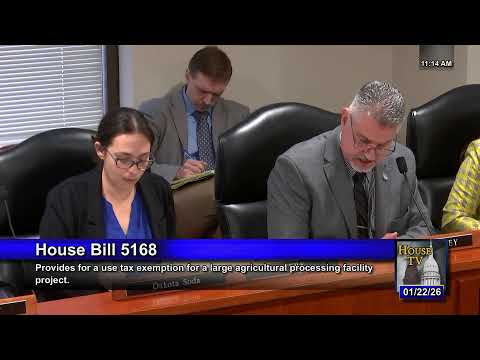
House committee advances bill tying state incentives to Uyghur forced-labor rules
Loading...
Summary
The House Committee on Economic Competitiveness voted to report House Bill 52 88, which would require Michigan incentive recipients to comply with the Uyghur Forced Labor Prevention Act and allow full clawbacks if violations are found. Testimony emphasized human-rights and economic fairness concerns.
The House Committee on Economic Competitiveness voted to report House Bill 52 88 with recommendation after testimony from multiple witnesses who urged the state to bar incentives for companies linked to forced labor.
Supporters told the committee the bill would amend the Michigan strategic fund framework to require compliance with the federal Uyghur Forced Labor Prevention Act (UFLPA) before awarding state economic incentives. Garrett Medina, identified as chief of staff to majority floor leader Bridal Postumas, said the measure ‘‘ensures that Michigan's economic incentives do not reward companies linked to forced labor abuses’’ and includes clawback provisions when violations are identified.
Jared Rodriguez, cofounder of the Free Human Project, described forced labor as embedded in global supply chains and said HB 52 88 ‘‘ensures that Michigan taxpayer dollars are not used to subsidize or reward companies that are connected to forced labor’’; he told members the bill would prohibit the state from entering into new or amended agreements with companies that appear on the UFLPA entity list and would require a full repayment of incentives plus a penalty if a company is later added to that list.
John Molzina, president of the Center for Economic Accountability, framed the proposal as consistent with declining to subsidize companies identified through federal UFLPA procedures and referenced prior oversight of the failed Goshen project to argue that state subsidies should not reward firms tied to coerced labor.
Committee members asked whether any companies currently receiving Michigan incentives appear on the UFLPA list. Witnesses said the UFLPA list changes over time, that the list is predominantly foreign entities, and that they would provide updated company counts in follow-up. The witnesses noted a range of enforcement tools at the federal level but said the bill gives Michigan a clear policy to avoid paying incentives while supply-chain reviews continue.
Before the final recommendation vote the committee considered an H-2 substitute offered by Representative Kofia. The substitute failed on roll call (3 ayes, 7 nays, 0 pass). The committee then voted to report HB 52 88 with recommendation; the roll call returned 9 ayes, 0 nays, 1 pass, and the motion prevailed.
The bill’s text would (as described by witnesses) align state practice with the UFLPA, require clawback language in contracts and economic development agreements, and apply those protections to existing agreements where feasible. Supporters said the policy sends a market signal that Michigan will not subsidize firms tied to forced labor, while also protecting ethical companies from unfair competition.
Next steps: the committee reported HB 52 88 with recommendation; the bill will proceed according to House rules for further consideration. The committee posted a letter of support from Congressman John Molineux to its website as part of the record.