Get Full Government Meeting Transcripts, Videos, & Alerts Forever!
Get email alerts on the Road Safety topic
No spam. Unsubscribe anytime.
Calaveras County presents safety plan findings to District 2, residents press for more enforcement and local fixes
Summary
Consultants presented a five‑year collision analysis for county‑maintained roads and an interactive map; residents urged greater enforcement, training and small roadway fixes while the team said widening is outside the program’s scope and promised follow‑up data and TAC coordination.
Consultants leading Calaveras County’s federally funded Comprehensive Safety Action Plan presented five years of collision data for county‑maintained roads and sought public input at a District 2 virtual meeting, where residents pushed for increased enforcement, training and targeted local fixes.
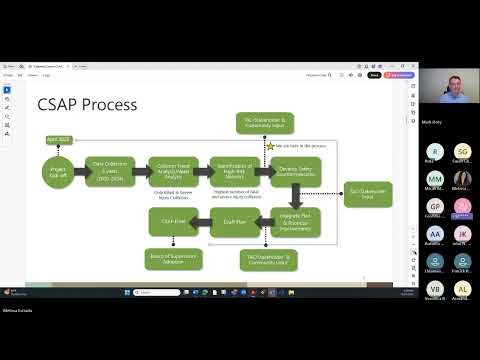
Mark Doty, a project manager with TJKM, opened the meeting and said the plan is funded through the U.S. Department of Transportation’s Safe Streets and Roads for All grant and is intended to reduce fatalities and serious injuries on county roads. “We want to prioritize human life over speed or convenience,” Doty said as he described the safe‑system approach and the project timeline.
The presentation covered 2020–2024 collision data on county‑maintained roads only (Caltrans‑managed state routes were excluded from the county analysis). The team reported 21 fatalities and 75 severe‑injury collisions (KSI) on county roads in that period, with a total of 356 injury collisions countywide. Engineers showed a 2023 spike in collisions, higher incidence on weekends and a summer seasonal peak. The team also highlighted motorcycles as a significant mode in fatal and severe‑injury crashes.
Melissa Estrada of GHD demonstrated the project website (safestreets.calaverasgov.us) and the interactive map that allows residents to place location‑specific comments, choose categories (walking, bicycling, driving, motorcycling, kids in school, safety) and submit feedback; an email address is required to post but is not shared publicly.
During public comment, Patrick Roy of Valley Springs argued the county should emphasize enforcement and driver behavior over engineering changes: “Most of our accidents … fall on inattention, excessive speed, intoxication, and just reckless driving,” he said, adding that stepped‑up enforcement has immediate effects on speeds and collisions. The project team responded that the CSAP will recommend a mix of engineering, enforcement and education countermeasures rather than a single approach.
The District 2 supervisor (name not provided in the transcript) described narrow post‑Butte Fire rebuilds, urged more turnouts, speed‑reduction measures and guardrails in icy shaded locations, and said widening roads would be highly beneficial. Project staff and consultants said some countermeasures such as new signing, pullouts and speed‑reduction features can be considered, but that recommending full roadway widening is outside the scope of this particular grant program.
Aldimer Chavez, a public‑health staff member working with an Office of Traffic Safety grant, urged more traction work (chip sealing) in icy areas and said patrol capacity and specialized training for DUI enforcement are limited; he asked whether collision data are broken down by age to target education. The team said age‑breakdown data exist and will be shared with stakeholders.
Micah Martin, Calaveras County’s director of public works, said a technical advisory committee meeting is scheduled and will include the California Highway Patrol, the sheriff’s office, Caltrans and other stakeholders to coordinate enforcement, training and infrastructure work.
Next steps include additional district meetings for districts 3–5, an upcoming public survey, development of draft countermeasures based on data and input, sharing of more detailed data on age breakdowns, and continued TAC engagement. The presentation and recording will be posted on the project web page.
The consultants asked residents to use the interactive map and sign up for project notifications; the team said draft countermeasures will return to the public for review before the plan is finalized and forwarded to the Board of Supervisors for later approval.