Get Full Government Meeting Transcripts, Videos, & Alerts Forever!
Get email alerts on the Wildfire Preparedness topic
No spam. Unsubscribe anytime.
CAL FIRE urges home hardening, explains Zone 0 and local fuel‑reduction work
Summary
CAL FIRE’s Emily Kilgore told a Calaveras County Chamber forum that fuel reduction, home hardening and defensible-space compliance are central to preventing structure loss; she summarized the 5‑foot 'Zone 0' guidance, inspection rules under Public Resources Code 4291 and the B‑38 requirement tied to real‑estate transactions.
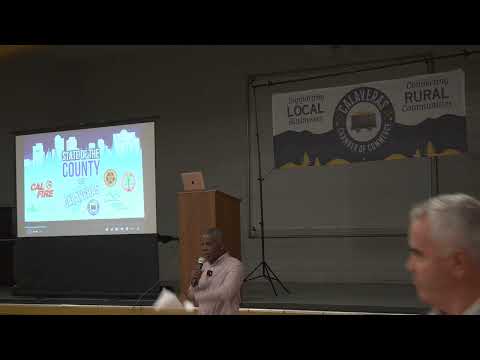
Emily Kilgore, a fire prevention specialist with the CAL FIRE Tuolumne‑Calaveras unit, told the Calaveras County Chamber on Sept. 11 that a combination of large‑scale fuel projects, neighborhood Firewise efforts and individual home hardening will best protect communities from wildfire.
"Fuel reduction partnered with home hardening ... is what's going to save our communities," Kilgore said, describing three scales of work: large landscape projects (often federally or grant funded), moderate projects led by fire safe councils, and small neighborhood Firewise efforts.
Kilgore outlined defensible‑space rules and recent emphasis on "Zone 0," the five‑foot band immediately adjacent to a house. "If it can burn, remove it from right next to your house," she said, and added that the Board of Forestry is still defining home‑hardening verbiage for Zone 0 elements such as decks and fencing. She reiterated existing standards for Zone 1 (5–30 feet) and Zone 2 (30–100 feet), noted clearance recommendations (for example, 10 feet around propane tanks and 10 feet of vertical clearance for equipment access), and said inspectors work to enforce compliance under Public Resources Code 4291. Kilgore also described the B‑38 process, a real‑estate compliance step that can affect escrow when structures do not meet defensible‑space requirements.
She named local and regional projects where fuels work is underway, including Forest Meadows, Blue Lake Springs, areas behind West Point and around New Hogan Lake, plus treatments near Copperopolis and Angels Camp. Kilgore encouraged residents to form or join Firewise communities, to maintain defensible space year‑round, and to use CAL FIRE materials and a Linktree card she offered with local preparedness resources.
The presentation focused on practical steps homeowners can take and highlighted coordination among CAL FIRE, federal agencies, local landowners and fire‑safe councils. Kilgore directed listeners with questions or who want materials to CAL FIRE and to the Tuolumne‑Calaveras unit website or the handouts at the back table.
The CAL FIRE presentation preceded remarks from local officials about a recent fire complex and regional forest‑health planning.