Missouri bill would tighten residency rules for vehicle registration; Department of Revenue outlines tech and enforcement plans
Loading...
Summary
House Bill 29-51 would create a presumption that a Missouri driver's license establishes residency for titling/registration and require titling/registration within 60 days; the Department of Revenue supported the bill while outlining a planned IT 'fusion' rollout, real-time insurance checks and enforcement tools but left some penalty and distribution questions for follow-up.
Representative Ed Lewis introduced House Bill 29-51, saying the bill seeks to curb tax evasion by persons registering vehicles in low- or zero-tax states (he cited Montana and South Dakota as examples). The bill would define 'resident' in the context of motor-vehicle titling and registration, create a presumption that a motor vehicle owned and operated by a person with a Missouri resident address must be titled and registered in Missouri, require registration within 60 days and impose a $500 penalty for failure to comply, and allow for license suspension until taxes and fees are paid.
Members questioned how widespread the practice is, whether legitimate dual residents and long-haul truckers would be caught by a strict presumption, and whether the penalties could unintentionally harm low-income drivers who could lose the ability to work. Representative Lewis and multiple committee members said language could be refined — for example, using a driver's license or voting registration as evidence of residency — and that exceptions or tighter definitions might be needed for retirees and over-the-road trucking operations.
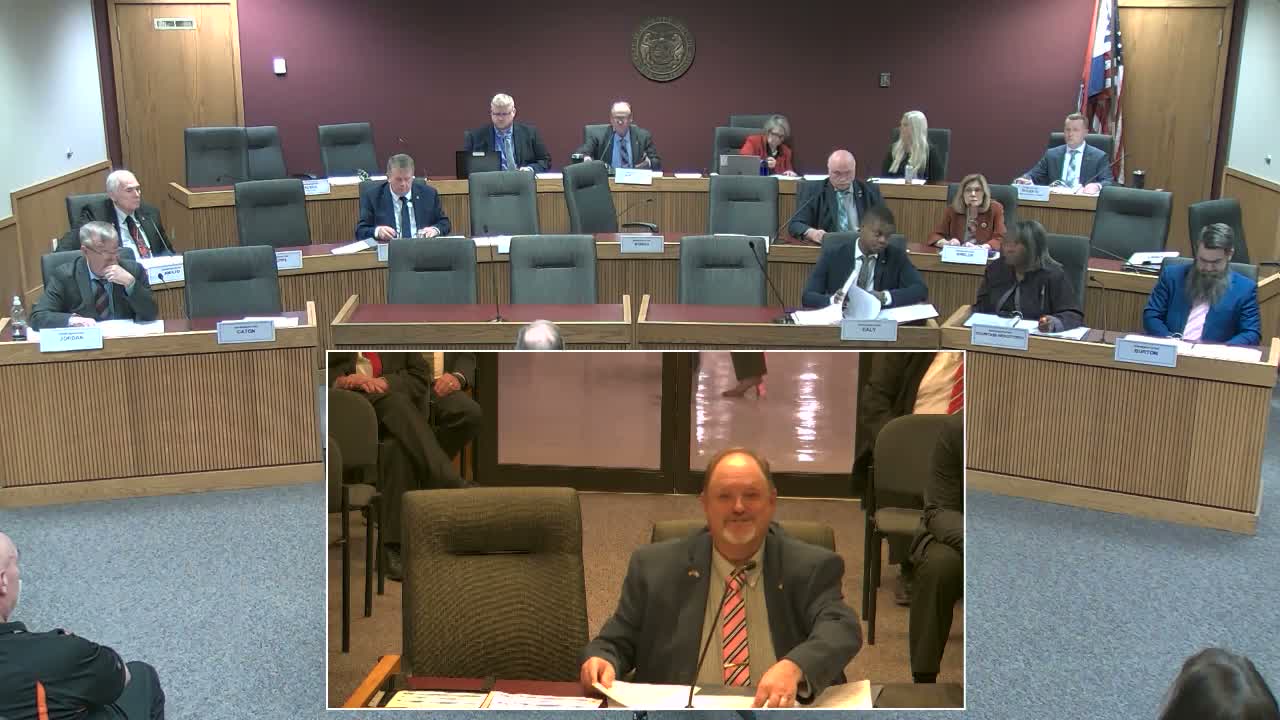
Director Trish Vincent of the Missouri Department of Revenue testified in favor and described how the department currently investigates alleged evasion: investigators receive citizen complaints and tips from law-enforcement partners; they use residency indicators such as driver's-license data and voter records; and they have pursued cases in coordination with prosecutors. Vincent said other states, notably Utah and Iowa, have passed similar laws and used insurance-industry data to identify noncompliant registrations (Utah reportedly issued tens of thousands of notices). She characterized the gap as costing "millions" in state, county and school revenue and said the department was developing a 'fusion' IT system to improve dealer integration, automate sales-tax collection at point of sale, provide real-time insurance verification (targeted for a future phase), and reduce reliance on temporary paper tags.
Department staff also told the committee that certain enforcement tools already exist (assessments and criminal statutes for fraud) but that a clear statutory presumption would strengthen investigators' ability to pursue shell-LLC registration schemes. Staff said the department currently assesses a 25% penalty through an assessment process when it can establish a purchase price or fair-market value; the bill's additional tools would be complementary to those authorities.
Trucking-industry representatives said they support the intent to stop evasion but urged changes to avoid penalizing legitimate interstate trucking and apportioned commercial vehicles.
Next steps: committee members requested written follow-up on technical questions the department could not answer at the hearing — including where penalty revenue would be deposited, whether an amnesty window should be included, and specific rollout dates and operational details for the fusion system and dealer integration.