Get Full Government Meeting Transcripts, Videos, & Alerts Forever!
Get email alerts on the Measure W topic
No spam. Unsubscribe anytime.
County health outlines Measure W plan; board debates pace, priorities and litigation timing
Summary
Alameda County Health presented Phase 1 implementation planning for Measure W funding—proposing staffing, interim housing and an acquisition fund—while the Board wrestled with timing, oversight principles and whether to proceed before the Supreme Court resolves pending litigation.
Alameda County Health presented a multi‑phase plan April 1 to spend Measure W revenues on homelessness response, and the Board of Supervisors used the update to debate how quickly and how broadly to allocate the funds.
Interim Health Director Anika Choudhry told the Board staff have been preparing "phase 1" proposals that emphasize interim housing, encampment resolution and administrative capacity. Choudhry said the Board previously authorized a Phase 1 planning envelope of about $394.5 million in the package staff presented; staff proposed immediate investments including $4.5 million for staffing and administrative infrastructure and a $40 million pool for encampment resolution and interim beds. A larger Shelter and Housing Acquisition Fund of $350 million would be developed later to acquire or lease housing and convert interim beds to permanent units.
Jonathan Russell, Director of Housing and Homelessness Services, described operational details: the proposal would initially stand up roughly 250 interim beds targeted at encampment resolution (with about 20% of those reserved for people with high medical needs) and a plan to scale to as many as 750 interim slots and ultimately stabilize around 500 permanent placements. Russell said the county also plans a flexible housing subsidy pool—modeled on similar programs elsewhere—to coordinate rental subsidies, deposits and landlord incentives and to centralize multiple funding streams for tenants.
But supervisors disagreed about pace and process. Supervisor Nate Miley urged a principled, county‑wide framework and a timeline tied to the FY2026 budget process and to the status of pending litigation, saying the allocation of Measure W (a general‑fund tax) should be considered alongside other county priorities. "I think it'd be better for the board to come up with principles, guidelines, and criteria for Measure W,'" Miley said, arguing the board should set priorities and a process before locking in large allocations.
Other supervisors—including Marquez and Fortunato‑Bass—urged urgency to address visible encampments and leverage city pipelines of affordable housing. "We know where the need is," Supervisor Marquez said, urging staff to expedite allocations that move people into interim and permanent housing as soon as possible while maintaining oversight.
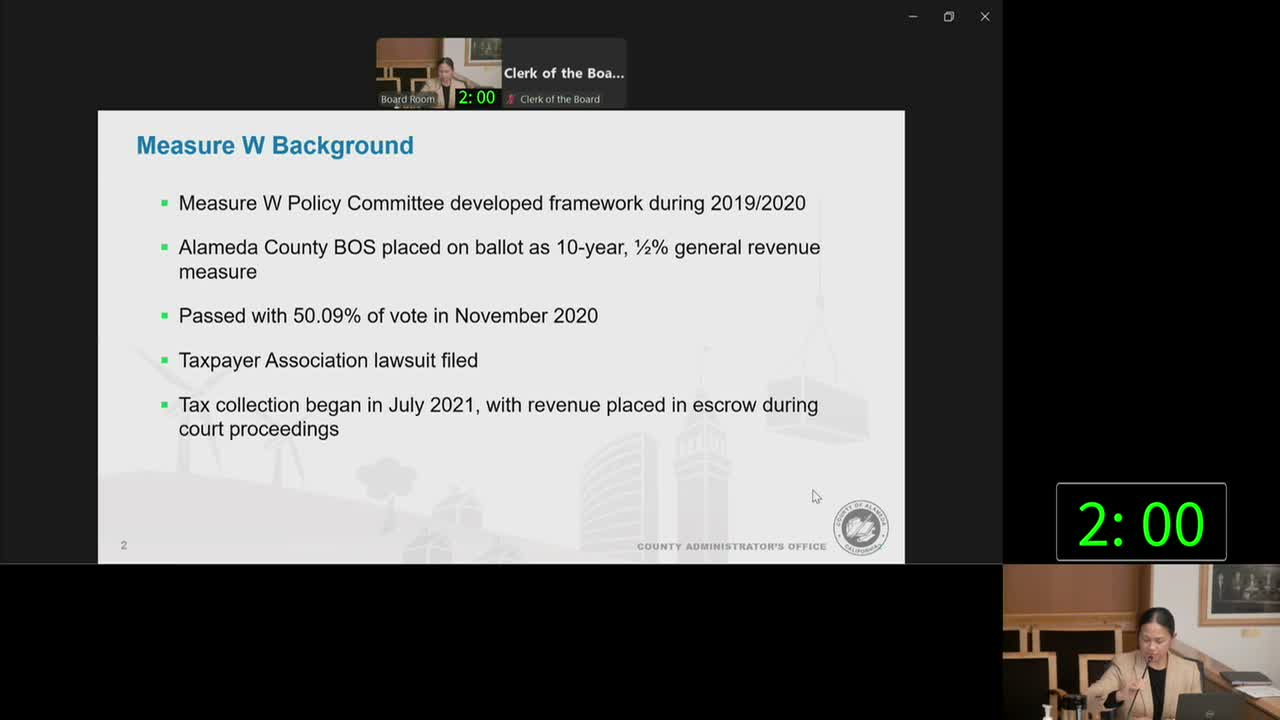
County Counsel updated the board on litigation: petitioners filed a writ with the California Supreme Court on March 12; the court has 90 days (with potential extensions) to decide whether to take the case. Staff and the County Administrator described Phase 1 proposals as "board‑directional": they were planning to proceed with staffing and preparatory steps but said any advanced funding disbursements would return to the board for approval once the legal and budget contexts were clearer.
Board members asked staff to return with a written framework and timeline. Several supervisors signaled support for advancing the staffing infrastructure ($4.5 million) immediately and continuing planning for $40 million for encampment resolution while deferring larger allocations until after further principles, city engagement and budget adoption.