
Committee considers exempting coinsurance from GRT and extending sunset; municipal leaders warn of revenue loss
Get AI-powered insights, summaries, and transcripts
Subscribe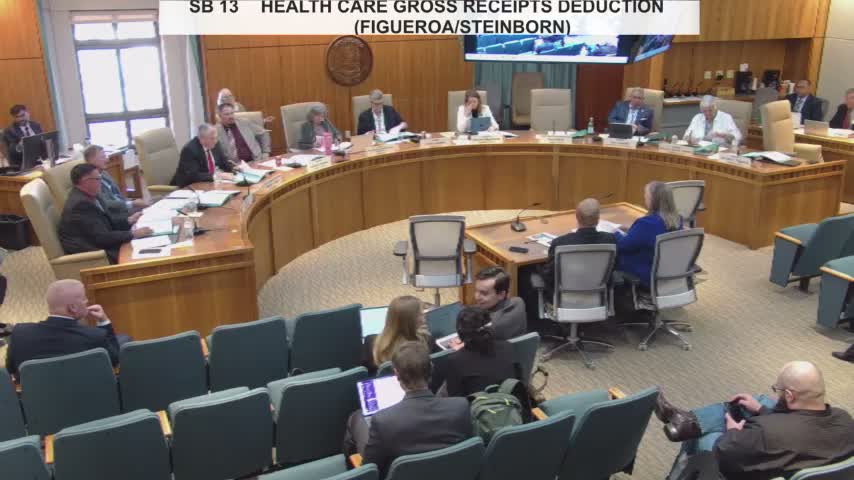
Summary
Senate Bill 13 would add coinsurance to GRT exemptions for medical costs and extend the exemption sunset from 2028 to 2031. Supporters called it cleanup to aid independent practices; municipal and county representatives warned of significant losses to local revenues. The committee held the measure for further work.
The Senate Tax, Business and Transportation Committee advanced discussion Monday on Senate Bill 13, a proposal to add patient coinsurance to existing gross receipts tax (GRT) exemptions for medical service costs and to extend the exemption’s sunset from 2028 to 2031.
The sponsor told the committee the bill is short in drafting but complex in consequences. "If you look at the bill on page 2, there is very little change to what is currently exist in law. We're extending a sunset from 2028 to 2031, and we're adding the word coinsurance to what is already GRT exempt, medical service costs," the sponsor said, and clarified that coinsurance is the percentage a patient pays after meeting a deductible, distinct from a fixed copay.
Supporters—including the New Mexico Medical Society, Think New Mexico and several resident physicians—said the change would relieve administrative burdens and help independent practices compete with large systems and out-of-state markets. "We think it's incredibly important," a representative of the New Mexico Medical Society said, noting the bill was advanced last year but vetoed by the governor.
Local governments voiced strong opposition. Lisonbee Nichols, deputy director of the New Mexico Municipal League, said municipalities rely heavily on GRT and warned of "serious concerns" about the bill’s impact to local revenues and essential services. Catherine Crociotta, representing New Mexico Counties, echoed those concerns and cited prior GRT exemptions that have left counties with revenue reductions.
The sponsor said legislative council advised that a hold‑harmless distribution mechanism exists in statute and would compensate local governments for lost GRT; the sponsor said legislative council told them the hold‑harmless distribution would be increased to cover losses. Committee members pressed for detail on that mechanism and asked how it worked in prior exemptions, noting past examples where projected local impacts grew after implementation.
Senator Heather Bergman asked whether the drafting could exclude private‑equity‑owned hospitals to limit cost. Sponsors said the intent is to focus the exemption on independent practitioners and defined health‑care associations, but acknowledged drafting changes may be necessary to achieve that aim.
After public testimony and extended questioning on fiscal effects and drafting, the committee held SB13 for further work and review of hold‑harmless mechanics and fiscal estimates. The chair said the committee expects to revisit the bill as part of broader tax‑package capacity decisions.