
Supreme Court leaders brief Senate Judiciary on court operations, budget and data needs
Get AI-powered insights, summaries, and transcripts
Subscribe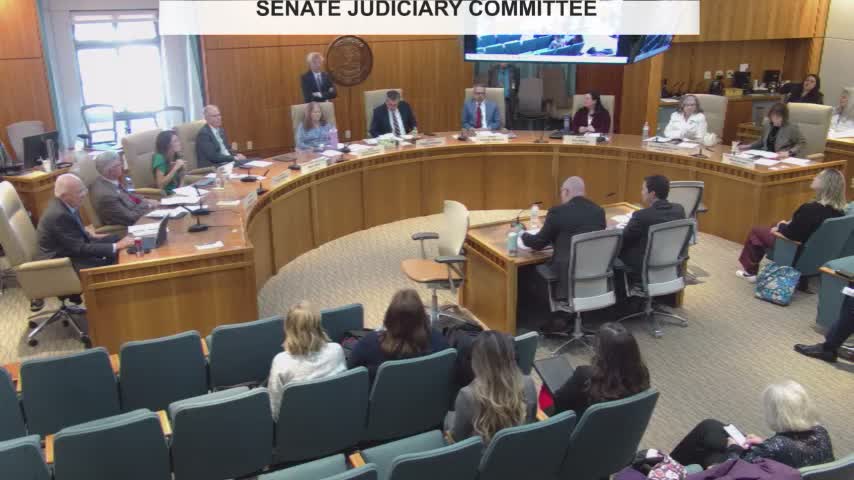
Summary
Chief Justice Dave Thompson and Administrative Office of the Courts director Carl Ryfsek told the Senate Judiciary Committee the branch is seeking modest recurring and one‑time funds to modernize courtrooms, expand analytics capacity and improve data that legislators say is necessary to assess case outcomes.
Chief Justice Dave Thompson and officials from the Administrative Office of the Courts told the Senate Judiciary Committee that the state court system is both understaffed for analytics requests and in the midst of a multi‑year courtroom modernization effort.
Chief Justice Dave Thompson said the Supreme Court plays two roles: writing opinions and administering the branch through the AOC. "We issue 2 opinions today as we're sitting here," he told senators while describing both the court's appellate work and the administrative oversight the Supreme Court exercises across lower courts.
Carl Ryfsek, director of the Administrative Office of the Courts, gave a detailed overview of court structure and services, noting the statewide footprint: five justices on the Supreme Court; a Court of Appeals that uses ten judges sitting in three‑judge panels; roughly 102 district court judges statewide; 19 metro court judges and 67 magistrate judges; approximately 80 municipal court judges; and 33 probate judges. Ryfsek emphasized that two‑thirds of district‑court dockets are family and civil matters, not criminal cases, and that the AOC provides a range of operational services including a statewide call center, interpreter services, alternative dispute resolution programs and reporting to the federal NICS database.
Ryfsek asked the legislature for a modest recurring increase — the AOC internally proposed about a 4.5% boost this budget cycle — plus one‑time funds to modernize audio, recording and case‑management systems in courtrooms. He said the legislature has helped upgrade roughly 97 courtrooms, with 24 more completed in FY26 and a goal to modernize at least 19 additional district courtrooms in FY27.
Committee members pressed the AOC on data and accountability. Senators said recent LFC reports highlighted high dismissal rates in felony dockets; Chief Justice Thompson and Ryfsek replied that many dismissals are without prejudice and can reflect prosecutorial or witness problems, not simply court performance. Both officials urged better, consistent data capture: "Let's just operate on correct and uniform facts," Thompson said, arguing that improved analytics staff and case‑management reporting would let the judiciary and legislature separate categories of dismissal and target solutions.
Ryfsek also flagged security and emergency management as top concerns, citing increased threats to staff and judges and the need for facility maintenance. He described the AOC's courthouse access policy (published in December) intended to protect court decorum and ensure law‑enforcement visitors are properly identified.
The committee did not take any formal action but scheduled follow‑up hearings on data sharing and signaled interest in the AOC's modernization priorities. The briefing concluded with recognition from senators that both funding and improved data systems will be needed to better evaluate court performance and case outcomes.