
PRC tells Senate panel community solar is live in 10 projects; senators press on low-income access, interconnection costs
Get AI-powered insights, summaries, and transcripts
Subscribe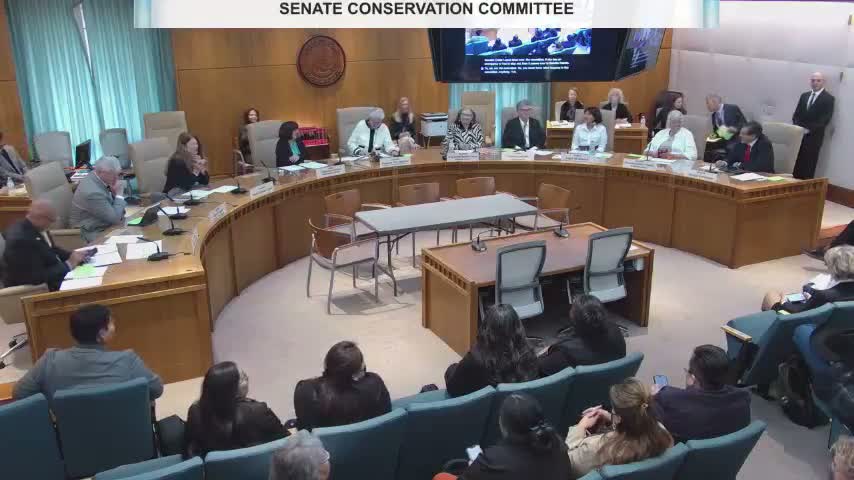
Summary
The Public Regulation Commission told the Senate Conservation Committee that 10 community solar projects are live, early subscription rates are high and many projects are exceeding the statute's 30% low-income target; senators pressed the PRC on interconnection costs, tribal participation, consumer protections and funding for program administration.
Choya Corey, chief of staff at the Public Regulation Commission, told the Senate Conservation Committee that New Mexico's community solar program has reached an early milestone: 10 projects are live and many are quickly signing subscribers. "We're seeing upwards of 87% capacity being subscribed, sometimes as high as 97, 98 percent," Corey said, and added the commission is refining data collection and a utility tracker to measure program performance.
Corey said the statute requires at least 30% of each project's capacity be dedicated to low-income subscribers, and early results exceed that floor. "Some of them are beating it by about 5 percent...the low income is upwards of 75 of the subscribers," she said, describing sample projects where 50% to 75% of subscribers are low income. The PRC expects more enrollment data as additional projects go live and said better data will inform future rule decisions about location, low-income targeting and capacity allocation.
The PRC also described a practical barrier to development: interconnection. Corey told senators that interconnection and grid upgrades have been a major struggle and that in some locations "those interconnection costs were in the millions," slowing project build-out. Senators asked whether ongoing transmission and distribution costs or federal tax credit changes might affect project economics; Corey said the commission would follow up with detailed numbers and noted many projects have met federal construction or in-service thresholds to qualify for tax incentives.
On administration, Corey said the PRC requested growth funding to bring program administration in-house and reduce reliance on contractors. She estimated the contractor-admin cost at roughly $700,000 a year and said an in-house growth funding request would be similar (Corey cited about $736,000). Separately, the PRC noted House Bill 70 would create a fund using fees utilities currently remit to the general fund to support PRC operations; Corey said that mechanism could make the PRC self-sufficient for ongoing program administration if enacted.
Senators pressed on consumer protection, tribal participation and technical questions. In response to Senator Antoinette Zedillo Lopez, Corey explained community solar differs from a microgrid: community solar serves multiple subscribers (statute requires at least 10 customers) while microgrids typically serve a single campus or customer; PRC oversight begins when a resource interconnects to the grid. To Senator Larry Scott's question about sales practices and unsubscribing, Corey said the PRC has consumer-protection standards for subscriber organizations and that consumers are free to unsubscribe or resubscribe.
Several senators asked about capacity. Corey said the commission had approved 200 megawatts for build-out under existing rules and statute; commissioners reexamined the cap and the commission has set a 300-megawatt limit for consideration, but the additional 300 megawatts have not been approved to be built. Senators noted community solar will be a modest share of statewide generation.
On tribal participation, Corey said tribes can elect to participate but that co-ops that opt out are a known barrier that the PRC will work to resolve. Senators raised whether the 5-megawatt per-project statutory limit should apply to tribal projects and asked for follow-up; Corey offered to review the statutory language and report back.
Corey and senators also confirmed that, so far, community solar projects in this phase connect directly to the grid without battery storage; storage was not part of the rulemaking to date. PRC staff said data and public comment cycles are ongoing: the PRC issued proposed rule changes with public comments due in February, response comments due in March, and the commission expects a final revised community solar rule before the end of spring.
The committee heard the presentation and asked the PRC to follow up with specific figures on average subscription costs per kilowatt-hour, ongoing transmission and maintenance cost allocations, and clarification on tribal statutory treatment. No formal action or votes were taken at the meeting.