
Oklahoma Corporation Commission urges modest appropriations, highlights IT upgrades and enforcement efficiencies
Get AI-powered insights, summaries, and transcripts
Subscribe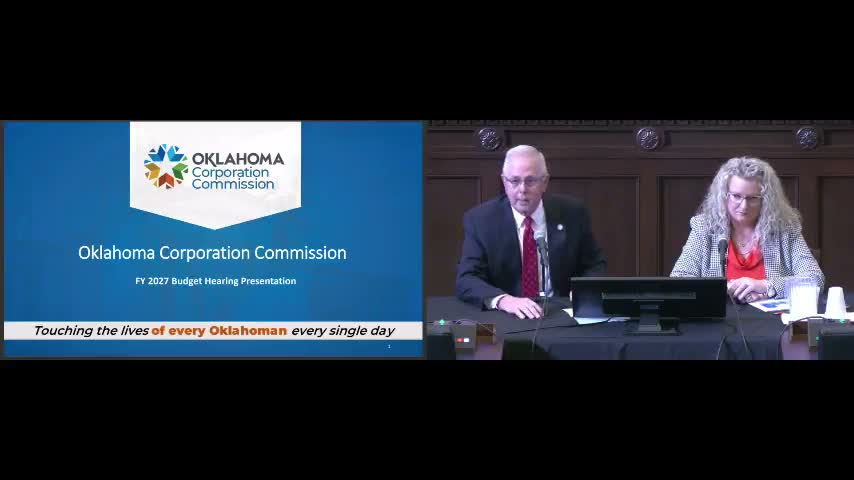
Summary
Commission officials told the Appropriations Committee the OCC manages wide regulatory responsibilities with a relatively small budget request, detailing IT investments, interdivisional enforcement efficiencies and three targeted budget asks including rent, inspector training and fleet procurement.
Oklahoma Corporation Commission Commissioner Brian Bingman and Chief Financial Officer Holly George told the legislature the commission will submit one of the smaller agency budget requests this session while underscoring broad regulatory duties across oil and gas, utilities, transportation and petroleum storage.
"We truly do touch the lives of every Oklahoman every single day," George said, framing the request around the agency's scope and the mix of revenues that fund its work. She listed the commission's oversight of roughly 245,000 wells, more than 320 utility companies, nearly 200,000 miles of electric distribution lines and thousands of regulated motor carriers and fuel facilities.
George outlined recent investments in information technology funded by a 2020 appropriation of $5.3 million that enabled online public resources, an RBDMS well search, online payments and a 24/7 electronic case-filing and revenue tracker. She said those systems helped the agency respond to 1,200 open-records requests last year by directing 65% of requests to publicly available data.
The commission highlighted an ongoing, larger oil-and-gas application modernization effort (referred to in testimony as the "Okies" project) that aims to surface permit-processing metrics such as average time on intent-to-drill filings and rejection rates. George said the project is roughly halfway complete and could add two to three more major phases over two to three years.
Agency leaders also described a cost-saving enforcement practice that uses existing field inspectors across divisions (with small stipends) to flag utility issues for the Public Utility Division, reporting 5,730 hazards last year with 2,853 confirmed critical—efforts the commission said save roughly $1 million annually.
On specific funding requests, the commission asked legislators to consider rental costs for returning to the Jim Thorpe Building, requested $104,000 for oil-and-gas inspector training, and proposed allowing certain programs to procure and manage vehicles (with Fleetio) to reduce long-term leasing and maintenance expenses.
George told lawmakers the agency tries to limit annual budget revisions and recently set a goal to spend within 10% of its budget; she said the OCC was about 11% over last year, down from historically higher revision rates.
The Appropriations Committee followed the presentation with detailed questions about IT recurring maintenance, restricted revolving funds and statutory limits on how those funds may be used. George and staff said some revolving funds are legally restricted to specific purposes (for example, LUST remediations) and that they would provide further detail as requested.
The hearing concluded with committee members thanking the commissioners and staff for the briefing; no formal vote was taken at the hearing.