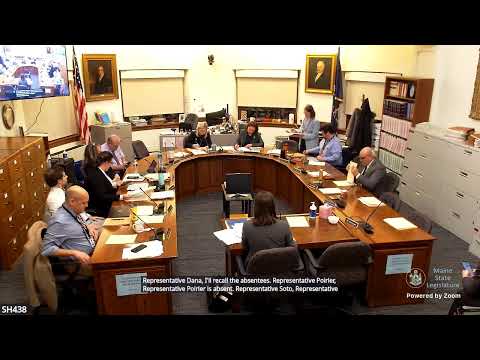
Committee pauses public defender funding bill after intense debate over one-time vs. baseline support
Loading...
Summary
Members debated an emergency funding request to cover a projected shortfall for assigned counsel and to establish a Cumberland County public defender office. The committee tabled LD 2059 after considering options to prioritize immediate pay needs for assigned counsel versus adding permanent baseline funding and new public defender positions.
The committee opened a work session on LD 2059, an emergency appropriation that would provide one-time funds to address an immediate shortfall in compensation available to assigned counsel and to establish a Cumberland County Public Defender Office.
OPLA analyst Janet Stocco reviewed the request: $13,000,000 in FY25–26 and $9,000,000 in FY26–27 to cover arrearages and preserve assigned counsel participation, plus ongoing funding to staff a new Cumberland County office (11 positions, costed at roughly $483,000 partial-year in year one and ~ $1.6M the following full year). Deputy Director Edie Mesiak (PDS) explained that assigned counsel are compensated under a point system ("270 points ... works out to 2,000 billable hours per year") while employee public defenders’ expected billable hours will be lower due to collective bargaining constraints; PDS is still finalizing employee caseload guidance.
Committee members debated several options: (a) fund only the immediate assigned-counsel shortfall as an emergency to avert losing roster attorneys, (b) fund the assigned-counsel gap plus a district defender for Cumberland County, (c) make the assigned-counsel increase ongoing baseline funding, or (d) fund the two-year plan as printed (both shortfall and Cumberland County staffing). Members voiced concern about shifting long-term costs to the baseline without better data on caseloads, the backlog of billed hours, and how quickly newly funded PD offices would reduce paid assigned-counsel costs.
After a caucus, a motion to table LD 2059 carried unanimously. Committee members requested additional data, including a caseload point breakdown (what case types carry which points), updated estimates of paid hours and arrearages, and clearer plans for how a Cumberland County office would be phased in and staffed. Members left the matter open for future supplemental budgeting or an expedited follow-up work session.