
Subcommittee backs broad higher-education bill tying preeminence funding to resident-student thresholds
Get AI-powered insights, summaries, and transcripts
Subscribe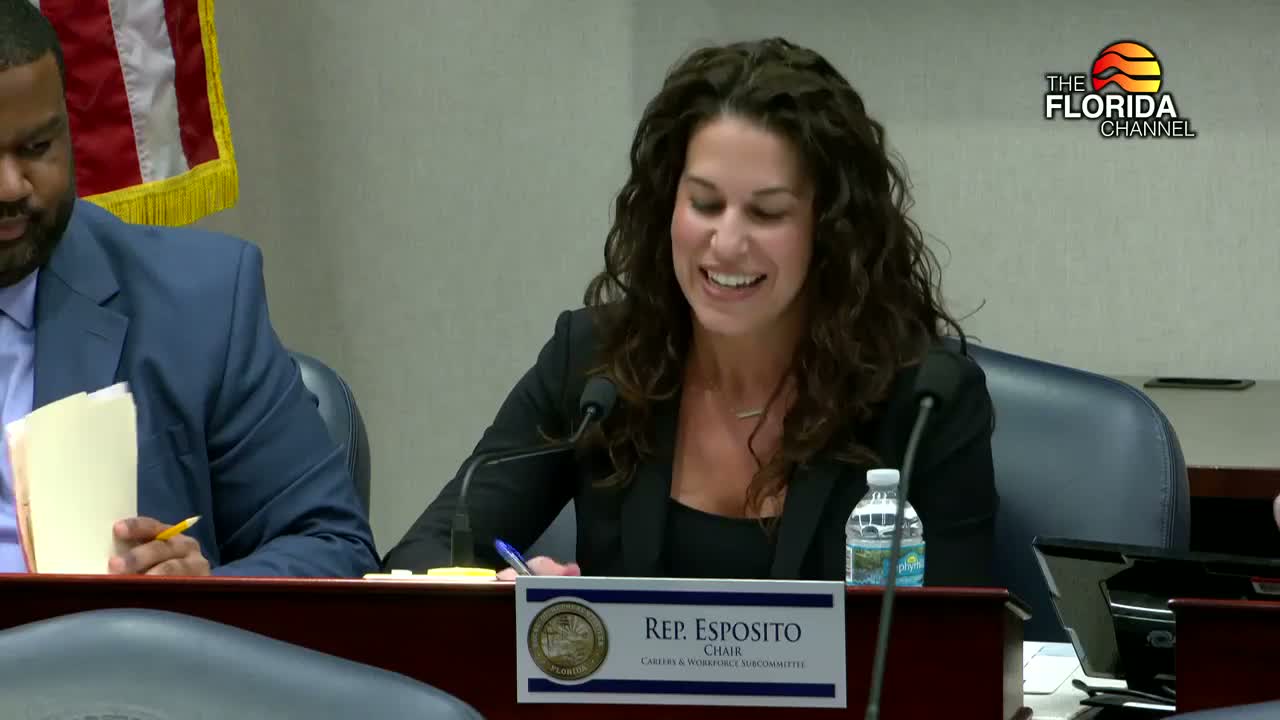
Summary
PCS for HB 1279 would standardize grading scales, remove a sole-reference to ABA accreditation, set a 95% first-time-in-college residency threshold for preeminence funding, and cap degree-seeking enrollment from any single country at 5%; the subcommittee reported the PCS favorably 12-5 after extended questioning and public opposition.
Representative Kinkert Johnson, sponsor of PCS for HB 1279, told the Career and Workforce Subcommittee the measure is intended to “put Florida students and families first” by aligning statutes with Board of Governors regulations, promoting academic rigor, and improving transparency. The sponsor said the bill would standardize certain GPA calculations, remove a sole-reference to American Bar Association accreditation, and attach preeminent-research funding to a residency threshold for first-time-in-college (FTIC) cohorts.
"At its core, this bill is about putting Florida students and families first," Representative Kinkert Johnson said in her opening remarks, arguing that some Florida applicants are being denied admission to flagship institutions despite strong credentials.
Members pressed the sponsor in lengthy questioning about the bill’s mechanics and impacts. Representative Gantt asked for evidence supporting a 5% per-country cap on degree-seeking students and about the policy rationale for using residency rather than measures of achievement or research output to determine preeminence eligibility. The sponsor said the 5% country cap applies to degree-seeking students in the FTIC cohort and that preeminence funding would be contingent on a rolling 95% residency threshold over a three-year period; she said the Board of Governors would report relevant information to the Legislature.
Multiple public witnesses urged the committee to oppose the bill or to revise specific provisions. Laura Munoz said she represents thousands of students who would be affected and urged members to consider workforce impacts. A Dental Hygiene Alliance representative warned that removing an exemption from chapter 466 could subject expanded-function dental programs to dual regulation by the CIE and the Florida Board of Dentistry and asked for a grandfather clause for the roughly 100 existing programs. Robin Goodman, president of the United Faculty at Florida State University, and Sameek March Dallas of the United Faculty of Florida both urged opposition, arguing the bill would politicize academic standards, reduce international applicants and revenue, and impair research and graduate-assistantship pipelines.
Representative Gantt and other opponents warned that the bill could weaken national rankings and the universities’ competitiveness; proponents, including Representative Jockey and the sponsor, said the measure would ensure Florida taxpayers’ investments primarily benefit Florida students.
After closing remarks, the clerk called the roll. The committee recorded 12 yeas and 5 nays and Chair Esposito announced that PCS for HB 1279 was reported favorably by the subcommittee.
Vote at committee: 12 yeas, 5 nays. The PCS contains provisions that would affect admissions, institution-wide graduation requirements, accreditation references, and program oversight; committee members asked the sponsor to provide supporting data and specifics about governance and enforcement.