
After heated remand hearing, Deschutes commissioners leave Destiny Court record open for new evidence
Summary
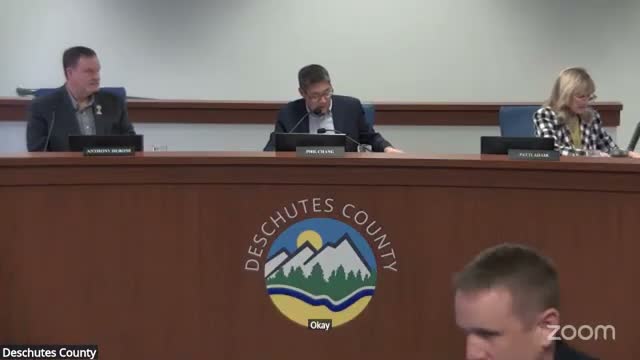
In a remand hearing on a proposed plan amendment and zone change for a 65‑acre parcel near Bend, commissioners set an open‑record period after hearing conflicting expert testimony over soils, irrigation and farm suitability and a procedural objection from Central Oregon LandWatch about notice and applicant materials.
The Deschutes County Board of Commissioners on Jan. 28 reopened and heard a LUBA remand for a Comprehensive Plan Amendment and zone change (file 247‑25‑000759‑A) for the Destiny Court property, a roughly 65‑acre parcel between Redmond and Tumalo. The remand — limited to two issues identified by the Land Use Board of Appeals — focused on (1) how Comprehensive Plan Policy 3.3.01 interacts with MUA‑10 zone dimensional standards and (2) whether specified farm uses are feasible on the property.
Caroline House, senior planner, explained the remand hearing procedures and the narrow scope of allowed new evidence. Central Oregon LandWatch objected early in the hearing, arguing that the applicant had not provided materials 20 days in advance as required by ORS notice language and that staff reports must be available seven days before the hearing; the group asked the board to remand for lack of procedural compliance. County legal staff said the record‑management rules allow the board to leave the record open and that doing so would remedy alleged defects.
Applicant counsel said the remand is narrow and that they provided new expert evidence addressing soils and particularized farm uses. Ken Katsoroff (applicant counsel) introduced evidence including three expert site assessments and economic calculations; he suggested conditions of approval that would limit future development forms and density if the board approved the change.
Expert testimony split along use and soils lines. Rand Campbell (retained expert for the applicant) summarized site visits and a soils review and testified the majority of the upland acreage is shallow, rocky and of low fertility with poor water‑holding capacity; he estimated 12–17 animal unit months (AUMs) without irrigation (roughly equivalent to one cow‑calf pair for a year) and argued that restoring productive soil or building pasture would be costly and, in his view, inconsistent with accepted farm practice on the property. The applicant also submitted an analysis suggesting gross profit potential on the parcel (A1 basis) of about $3,300, which the applicant characterized as insufficient once necessary improvements were considered.
Central Oregon LandWatch countered with NRCS mapping in the record showing about 21.3 acres mapped as Map Unit 38B (described in the record as class 3 when irrigated) and pointed to historical aerial photos and prior hay production and grazing evidence. "This land has been used to produce an irrigated hay crop," LandWatch attorney Carolyn Gebben said, citing record photos and NRCS data. LandWatch asked the board to treat irrigated acres and the county plan’s 10‑acre minimum as controlling when evaluating whether the code change would contravene plan requirements.
Board action and schedule: After extended legal and factual debate the board voted to leave the record open on a standard '777' schedule. The new evidence/testimony deadline was set for Wednesday, Feb. 4 (4 p.m.); rebuttal evidence and testimony by Wednesday, Feb. 11 (4 p.m.); and applicant final legal argument by Wednesday, Feb. 18 (4 p.m.). Staff will seek dates for deliberations in early March.
Why it matters: the remand hinges on statutory and local policy interpretation (how the Comprehensive Plan and MUA‑10 zone interact) and on the legal standard for whether the parcel is "suitable for farm use" under state rules. The board’s final decision could affect future development patterns near Bend and set precedent for how Deschutes County evaluates soils, irrigation and the potential to amend otherwise farm‑designated land.
Sources: testimony and exhibits presented Jan. 28 by Caroline House (Senior Planner), Ken Katsoroff (applicant counsel), Rand Campbell (expert), and Carolyn Gebben/Carol Macbeth (Central Oregon LandWatch), and County legal staff (Stephanie Marshall).

Create a free account
Unlock AI insights & topic search