Pasco School District reports small gains in algebra completion, shifts to tiered method for measuring improvement
Summary
Pasco School District presented a progress-monitoring report showing modest increases in ninth-grade algebra completion and adopted a tiered standard-deviation system to recognize smaller but meaningful gains. Board members asked for methodological details, clearer visuals and sample-size counts before receiving final answers.
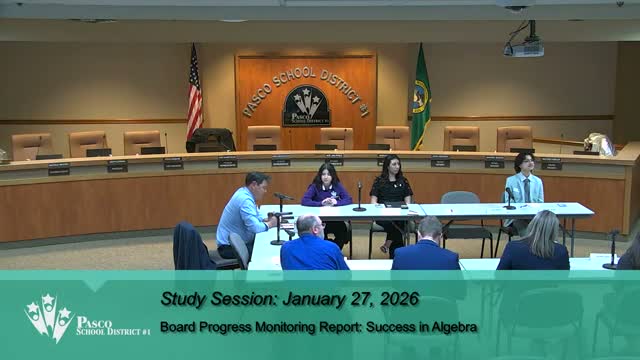
Superintendent Whitney told the Pasco School District Board of Directors at a study session that the district is using a new tiered approach to measure "significant improvement" in student math outcomes and reported modest gains in algebra completion.
"One of the goals that you identified ... connected to the strategic plan is around algebra completion or our outrageous outcome of 100 percent of our students will pass algebra by the end of ninth grade," Whitney said, framing the algebra target as a long-term ambition rather than a claim the district has already met. The presentation offered a cohort view of algebra credits earned and showed a 1.1 percentage-point increase in ninth-grade algebra passage from the class of '27 to the class of '28 and a 15-point increase from the class of '24 to '28.
Staff explained the district moved away from a single statistical-significance threshold and toward a four-tier standard-deviation model to better capture smaller but consistent gains. The tiers described in the presentation are: 0–1 standard deviations ("directional"), 1–2 ("emerging"), 2–3 ("clear") and above 3 ("very strong"). Whitney said the tiered approach better matches the board's intent to recognize meaningful change without overrelying on one strict cutoff.
Board members pressed for technical details the presentation did not include. One member asked what alpha level the team was using for separation tests; Whitney said Mark (the data team lead) had addressed the question previously but she did not recall the value and would provide it at a future meeting. The transcript records no alpha value or formal statistical test result provided during the session.
Members also raised concerns about slide labeling and cohort visuals. Whitney acknowledged a slide header incorrectly labeled a math slide as "reading" and agreed to revise the charts to make cohort comparisons clearer. She called the current visuals "fixable" and invited board members to submit suggested changes in advance.
The district also expanded the data reviewed beyond algebra to include K–8 math-proficiency measures (the presentation used the terms STAR and, in places, STAAR; staff said this data is intended to reflect math proficiency across the system). Staff identified mixed results across grades with some grades showing emerging or clear improvement and others showing declines; seventh grade was flagged during the session as a slide typo (appearing both as 'emerging' and 'decline') and staff confirmed the correct labeling.
Whitney emphasized that the district is still refining measures and said professional development and curriculum alignment remain the first levers for improvement. She described K–5 teacher training on adopted materials as complete and said middle and high schools are in year-one implementation of the new secondary adoption.
The board recessed into an executive session after the study session; during closing remarks staff said they would supply requested clarifications (alpha level, cohort counts, and sample sizes) and update the visuals before the next report.