Get Full Government Meeting Transcripts, Videos, & Alerts Forever!
Get email alerts on the Public Safety topic
No spam. Unsubscribe anytime.
Los Alamitos police update K9 ‘Elvis,’ say dog helped in arrests and drug seizures
Summary
Officer Navarro told the City Council the K9 unit 'Elvis' has assisted on roughly 20 deployments since November, contributing to arrests, surrenders and narcotics recoveries including about 103 grams of fentanyl; staff said they plan expanded deployments including at the high school.
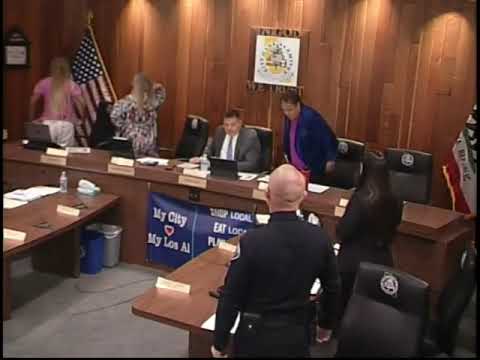
Officer Navarro updated the Los Alamitos City Council on the police department’s K9 program on Oct. 21, saying the dog known as "K9 Elvis" has been active since the unit began Nov. 23 and has supported patrol and investigative work.
Navarro, the department handler, said the program has recorded "20 calls for service or assist," with "detection deployments" and "patrol deployments" used in recent operations. "Total arrests that we've had was 11," he said, and he reported narcotics recoveries he attributed to the dog: "a little over 370 of methamphetamine" (units not specified in the presentation) and "103 grams of fentanyl." He described field examples in which the dog located suspects and evidence, produced surrenders and helped officers conduct building and vehicle searches.
Navarro described the program’s training timeline, noting an initial academy and additional canine training, and said the dog’s scent capabilities have been central to evidence recovery. "His skills have led to successful surrenders, apprehensions, surrenders meaning people give up," Navarro said. He framed surrenders as a safer outcome for officers and the public.
Looking ahead, Navarro said the department plans to expand uses for the K9, including deployments at the high school when appropriate. He noted the unit’s role in supporting other agencies and said the program has assisted nearby jurisdictions, identifying Cypress among top requesting agencies.
Clarifying details reported to the council: the handler said the program began Nov. 23, listed numeric summaries of deployments and seizures (deployments: "20 calls for service or assist," detection deployments "11," patrol deployments "17," arrests "11"; narcotics seizures quoted as "a little over 370" methamphetamine and "103 grams of fentanyl"). The presentation did not specify units for the methamphetamine figure, the accounting period that includes the September cutoff for seizures, or whether seized narcotics were seized inside city limits or during mutual‑aid assists.
The council did not take action on the presentation; Navarro answered brief questions and the presentation closed.