
Deltona commission adopts higher impact fees, approves modest interim rate increase after lengthy utility study debate
Get AI-powered insights, summaries, and transcripts
Subscribe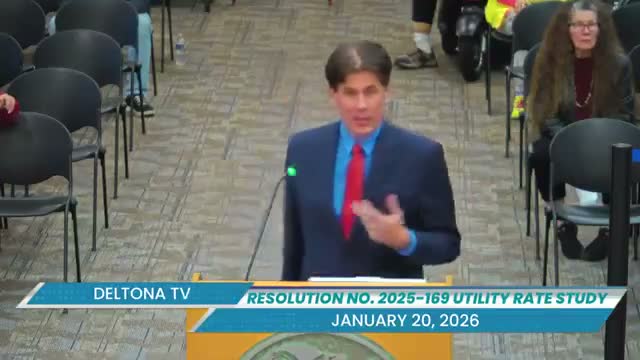
Summary
After a lengthy presentation by GovRates and extensive public comment, the Deltona City Commission approved raising development impact fees to $9,060 and a 1.6% interim user-rate adjustment while deferring full master-fee adoption to a workshop.
Deltona — The City Commission on Wednesday moved forward on funding a multi-year utility capital program by approving a higher impact fee for new development and a modest automatic user-rate adjustment while postponing adoption of the full updated master fee schedule.
Consultant Brian Manse of GovRates told commissioners that Deltona serves about 36,500 water accounts, 7,500 wastewater accounts and roughly 1,750 reclaimed-water accounts, and that the city faces significant capital reinvestment needs — roughly $172.8 million through 2030 — to maintain compliance and system reliability. Manse said those projects include a Fisher Advanced Water Treatment upgrade that received 50% grant funding but still requires local matching funds.
"Permanent increases in costs must ultimately be passed through to customers by rate increase," Manse said during the presentation, which included comparisons to neighboring utilities.
Public commenters pressed the commission on affordability and water quality. "If we're going to be paying more, will the water be filtered better?" asked Veil Barr, who said she can smell chlorine at home. David Markle said Deltona residents have seen water-and-sewer rates rise about 24.65% since 2019 and urged the city to pursue grants, low-interest loans and municipal bonds rather than rely chiefly on rate increases.
Commissioners debated whether to distribute future increases more heavily to base charges or to usage tiers to improve equity. Commissioner Novick said shifting more to base charges ensures all customers contribute year-round, including seasonal residents, while Commissioner Harriet warned that raising only base fees will not curb excessive water consumption.
After discussion, the commission voted unanimously to adopt the consultant's recommended maximum impact fee increase — raising the residential-equivalent connection fee to $9,060 from the current $6,475 — a move intended to help pay for growth-related capital needs. The vote on impact fees was 6–0.
On the broader master-fee schedule and user-rate package, a motion to adopt the staff-recommended comprehensive fee resolution failed 3–3. The commission then approved a scaled, immediate step: a 1.6% automatic user-rate adjustment tied to the Engineering News-Record index and directed staff to return with a prioritized workshop and a five-year capital improvement program review. That motion passed 6–1.
City Manager McKinney told the commission staff would return with the detailed impacts by customer class and a recommended workshop schedule; commissioners set a target workshop date for mid-February to review the rate study, past CIP accomplishments and next five years of capital projects.
What's next: The city will implement the impact-fee increase for new development and apply the 1.6% adjustment to existing users as a near-term step while the commission reviews the full fee schedule and rate structure at a workshop.
Votes at a glance: Impact fees increase to $9,060 — approved 6–0. Immediate user-rate adjustment (1.6% E& R index) and directive for workshop — approved 6–1. Broader master-fee adoption — failed 3–3.