Get Full Government Meeting Transcripts, Videos, & Alerts Forever!
Get email alerts on the Zoning Ordinance topic
No spam. Unsubscribe anytime.
Fraser steering committee advances zoning rewrite discussion, focuses on ADUs and use-variance policy
Summary
The Fraser steering committee reviewed a draft zoning ordinance that would allow accessory dwelling units (ADUs) under strict conditions and reopened debate over whether the city should retain use variances; staff will produce a revised Draft 2 for Planning Commission review in November.
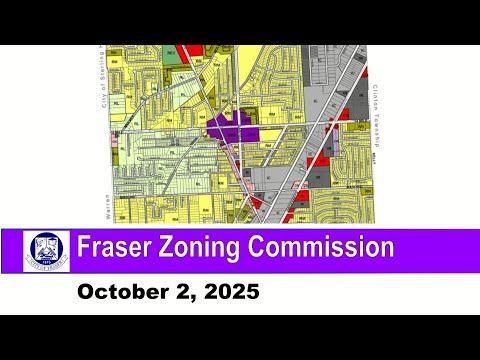
Fraser’s zoning steering committee met Oct. 2 to continue work on a comprehensive rewrite of the city’s zoning ordinance, focusing much of the discussion on accessory dwelling units and whether the city should continue to permit use variances.
Lauren (staff member) said the draft ordinance would permit accessory dwelling units only as accessory uses to single-detached homes, and that ADUs must remain under single ownership, have a separate exterior entrance, meet minimum lot-size thresholds and conform to lot-coverage and setback limits. “They have to submit that to Macomb County with the deed restriction so that those cannot be split in the future,” Lauren said, describing a recordable deed restriction requirement for ADUs.
The draft applies lot-size filters to the map and staff noted a minimum lot-size threshold in the record (the transcript cites 10,200 square feet as the threshold). Commissioners pressed staff about technical limits: whether lots that are already at maximum lot coverage could pursue variances (staff said a dimensional variance remains an option) and whether ADUs would create sewer or stormwater overloads. Lauren said she had discussed the issue with Mike Vigneron, who did not raise major concerns about impervious-surface limits, but staff agreed to follow up to clarify sewer versus storm-drain connectivity.
Short-term rentals were discussed as a likely concern. Committee members suggested the ordinance could limit ADU rentals to minimum terms (one suggestion in the meeting was 30 days) to prevent widespread short-term rental use.
Committee members also debated use variances — the special permission a zoning board can grant for a property use not otherwise allowed in a district. Staff laid out tradeoffs: use variances can enable adaptive reuse and reduce cost and procedural burden for applicants in tightly developed areas, but they can also function like spot rezones and undermine the legislative rezoning process. Members were split; several said Fraser’s limited development capacity argues for retaining flexibility, while others favored removing use variances to preserve long-term zoning intent. Lauren said staff would take the split views and the discussion back to the city attorneys for guidance and would reflect the committee’s feedback in Draft 2.
No final policy decision was made; staff said the ordinance team is addressing attorney comments and will circulate Draft 2 to the steering committee and then to the Planning Commission for formal recommendation, with planning review expected in November and a possible Council adoption in early-to-mid next year.
The committee also discussed related technical standards (deed restrictions, parking requirements for ADUs, and inspection/permitting procedures) and emphasized that detached ADUs would be subject to the same permitting, engineering and building-inspection processes as new primary dwellings.