
Council authorizes CDBG/HOME grant agreements and ESG allocations, reallocates $30,000 from Salvation Army
Get AI-powered insights, summaries, and transcripts
Subscribe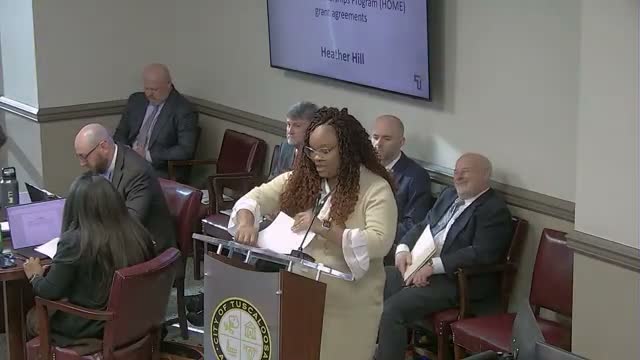
Summary
Council authorized execution of 2025 CDBG ($877,797) and HOME ($662,037.96) grant agreements and approved execution of subrecipient contracts tied to HUD action plans. The council also authorized execution of a $220,000 2025 Emergency Solutions Grant and approved allocations and a $30,000 de‑obligation and reallocation among Salvation Army, Turning Point and Temporary Emergency Services.
Tuscaloosa City Council authorized execution of grant agreements for federal housing and homelessness programs and voted to allocate Emergency Solutions Grant (ESG) funding to local subrecipients.
A staff presenter asked for council authorization to execute 2025 grant agreements for the community development block grant (CDBG) and HOME programs; the amounts cited were $877,797 in CDBG and $662,037.96 in HOME funds. Council approved moving forward with the grant agreements and with executing subrecipient agreements for projects the council had previously approved in the action plan.
Council also authorized the city to execute a grant agreement with the Alabama Department of Economic and Community Affairs for the 2025 Emergency Solutions Grant program; staff said the city was funded at $220,000. The staff presentation included specific subrecipient allocations tied to ESG implementation: Salvation Army ($94,000) for temporary emergency services ($46,200), Turning Point ($60,000), administrative costs ($8,800) and $11,000 for the homeless management information system (HMIS).
To close out 2024 funding in a timely manner, council approved an amendment that de‑obligated $30,000 from the Salvation Army contract at the organization's request and reallocated those funds to Turning Point ($15,000) and Temporary Emergency Services ($15,000), increasing Turning Point’s contract to $70,000 and TES’s contract to $61,300. Staff described program eligibility and reporting requirements for rapid rehousing and HMIS data collection; council members asked clarifying questions about how clients are evaluated and how the city reports performance to HUD.