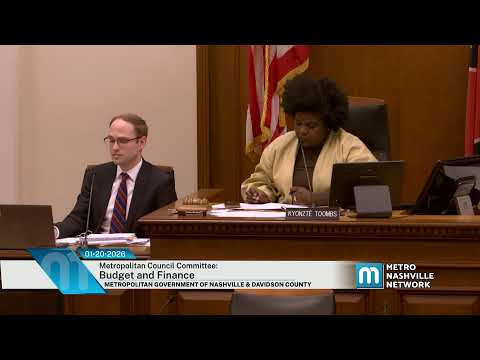
Budget and Finance Committee approves Downtown Partnership grants to MNPD after conflict-of-interest concerns
Loading...
Summary
The committee approved several measures converting donations from the Nashville Downtown Partnership into grant agreements to fund police cameras and tactical equipment; public commenters and some councilmembers raised conflict-of-interest and public-safety concerns, and the substitutes add reporting requirements to the grant agreements.
The Metropolitan Nashville Budget and Finance Committee on Thursday approved a set of measures converting donations from the Nashville Downtown Partnership into grant agreements that will supply the Metropolitan Nashville Police Department with 15 video cameras and several tactical vehicles and command units.
The committee adopted substitutes on the items to change the original monetary donations into grant agreements that add a reporting requirement: MNPD would provide publicly available data to the Downtown Partnership as part of the partnership’s reporting obligations to the state, Director Wilson said.
The substitutes drew public comment and questions from councilmembers before the committee voted. Mike Lacy, a public commenter, told the committee: "This seems like a very blatant conflict of interest that there is a potentially tens or $100,000,000 liability between an entity and there are donations being sought directly through conversations with the mayor's office." Lacy also criticized the choice of the Nashville Downtown Partnership as the donor and vendor overseeing downtown parking.
Another commenter, Doluvio Palazzolo, presented results from a community survey about how downtown funds should be spent and urged alternatives to continued surveillance and enforcement. Palazzolo said the top community choices included renovating existing properties into permanently affordable housing and restoring the downtown public library and that the survey showed strong support for housing assistance, homeless outreach, mobile community-based mental-health and crisis-intervention teams, and restorative-justice programming.
Steve Reiter, the final public commenter, urged the committee to prioritize community investments over surveillance and enforcement, saying many local incarcerations stem from probation violations and poverty: "A lot of those people are just poor," he said, urging that funds be allocated to measures that "actually gonna benefit this community, not just by locking more people up."
Director Wilson explained the practical effect of the substitute: "This substitute would take what was a monetary donation and ... turn it into a grant agreement. Essentially, this would add a reporting requirement for the Metropolitan government, to provide publicly available data to downtown partnership that is necessary, as part of their grant requirements with the state of Tennessee." He and others told the committee the substitute did not change the underlying performance expectations of the projects but did require reporting tied to Downtown Partnership grant obligations.
Dave Rosenberg of the mayor’s office clarified the flow of funds: "This Nashville Downtown Partnership is the entity that has the funds and is granting them to us. It's sitting in the Nashville Downtown Partnership's bank account. That entity has control of the money, and they're proposing ... to enter into an agreement to accept a grant from them."
Councilmembers debated whether to defer consideration to allow additional public input. Some members asked for a one-meeting deferral; Director Wilson advised that a committee deferral would, by rule, postpone the public hearing on the floor. The one-meeting deferral motion was withdrawn so speakers who had come to speak could be heard, and the committee approved the substitutes and the resolutions as substituted by voice vote.
Councilmembers also flagged the item for further review in the Public Health and Safety Committee for operational and safety questions about the equipment. Chris Gilder, deputy chief of police, explained operational use for tactical equipment: "We do currently operate a tactical operations command post. This is utilized by the SWAT team when they're handling a situation. The one that we currently have though was purchased in the year 2000."
The committee recorded the approvals by voice vote and the chair announced the motions carried. The meeting concluded after the committee finalized other items on the agenda and issued announcements about upcoming budget hearings.
Next steps: the measures will proceed per council rules with the grant agreements executed and the reporting requirements in place; several councilmembers indicated questions about operational use will be taken up in Public Health and Safety.