Board hears rising demand for social workers and TESOL staff as multilingual and special‑needs populations grow
Summary
Administrators told the Southington board that social-worker demand and multilingual-learner enrollment have climbed sharply, with TESOL enrollment rising roughly 70% in five years and social-work staffing stretched thin; board members debated funding responsibility and requested deliverables and staffing breakdowns.
Administrators told the Southington School District board that student mental‑health needs and multilingual enrollment have both grown substantially and that the district is requesting additional social‑work, special‑education and TESOL staff to respond.
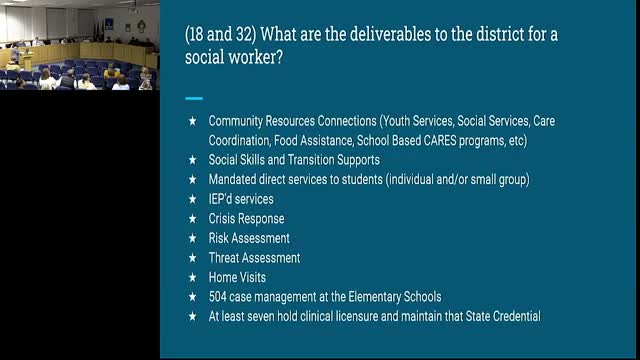
Social work: multiple board members and administrators described increases in crises, suicide attempts and behavioral incidents across grade levels and said social workers provide crisis response, risk assessments, home‑visit coordination and linkages to community resources. Administrators noted uneven staffing at elementary schools (many 0.5 FTE assignments) and said the district seeks to convert part‑time allocations into full‑time roles to stabilize coverage.
"The need for a social worker is obviously completely needed today," a board member said, calling last year's reduction of a social worker "detrimental to those students." Administrators agreed this is a district‑wide issue and acknowledged the budgetary challenge of funding positions that will become recurring if approved.
TESOL / multilingual learners: presenters said multilingual-learner enrollment rose from roughly 150 students in 2020 to about 261 in 2026 — a roughly 70% increase — while certified TESOL staff remained small: two elementary-certified TESOL teachers serving multiple schools, one high‑school TESOL teacher and effectively no certified middle‑school TESOL teacher. Presenters described the four proficiency bands used to guide instruction and said tutors (not TESOL‑certified) are currently filling gaps.
Administrators argued additional certified TESOL FTEs would provide more targeted instruction (small-group and one‑to‑one) and better oversight of tutors; the district estimated an ideal caseload around 87 students per TESOL teacher when accounting for overlapping academic and linguistic needs.
Funding and oversight: several board members questioned whether some community services (for example, crisis response or certain social supports) should be funded by town departments or other agencies rather than the school budget. Administrators responded that many social‑work functions manifest in the school day and require on‑site staff to stabilize classrooms and support IEPs.
Next steps: board members requested a staffing-by-school list, a deliverables framework for social‑work positions, and clearer funding options (town contribution, grants or state support) for ongoing mental‑health staffing.