Get Full Government Meeting Transcripts, Videos, & Alerts Forever!
Get email alerts on the Budget topic
No spam. Unsubscribe anytime.
SFMTA board debates service cuts, program reductions and reserve draw to close budget gap
Summary
CFO presented a budget gap for FY25–26 and three options to close it — summer service cuts, agency program/project reductions (including a proposed change to the school crossing guard funding), or a one‑time use of reserves. Public commenters and several directors urged protecting crossing guards and avoiding transit cuts.
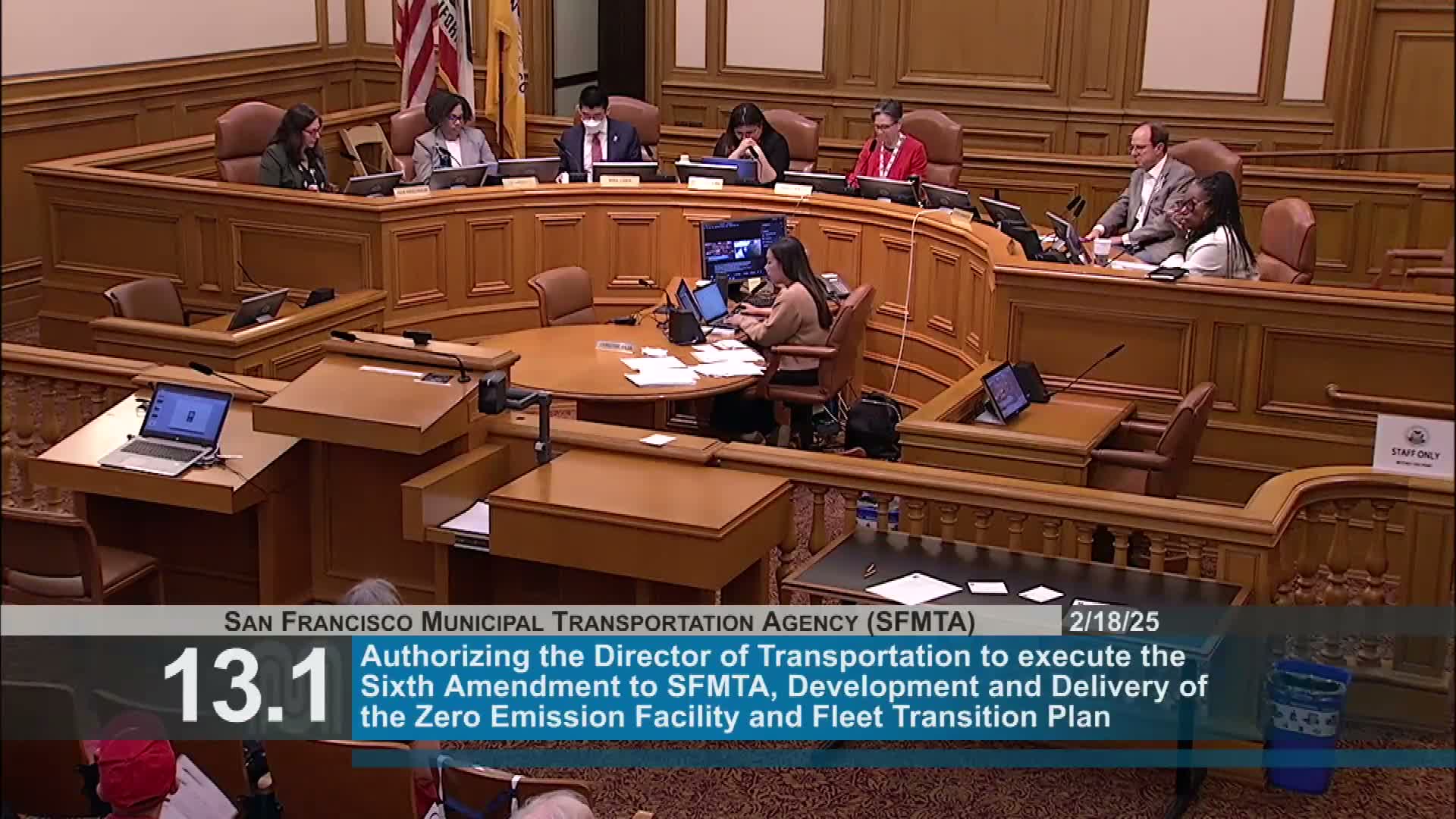
San Francisco Municipal Transportation Agency officials outlined a tightening fiscal picture and a menu of painful options to close a roughly $50 million funding shortfall affecting the coming budget year. At a Feb. 18 SFMTA Board meeting, CFO Bridal Hoarder said the agency now projects a small $4 million deficit in the current fiscal year and identified $35 million in lower‑pain adjustments, leaving about $15 million in remaining choices for 2025–26.
Hoarder told the board the agency's revenue recovery is weaker than planned, driven largely by parking revenue and operating grant shortfalls, and that the $50 million gap reflects the loss of prior federal relief and downward adjustments to city baseline support. "We are balancing on the head of a pin," Hoarder said, urging caution about one‑time fixes that do not address longer‑term structural shortfalls.
Staff presented three ways to close the remaining $15 million: (1) summer service reductions (an ongoing savings that would reduce long‑term costs), (2) a package of program and project reductions that would include deferring a vintage historic rebuild, delaying a midlife bus overhaul phase, reducing certain tow subsidies and cancelling some planned safety lighting projects, and (3) drawing from the agency's reserves (a one‑time measure that would reduce the reserve from $141 million to $126 million).
The proposals set off a large public response. Parents, school crossing guards, SEIU Local 1021 and other unions argued the proposed elimination or transfer of the school crossing guard program would endanger children and produce minimal budget savings (staff estimated the program saves about $2.9 million if cut). "Cutting 200 crossing guards saves only $2.9 million — less than 0.2% of the SFMTA budget," Paul Louie, a crossing guard and SEIU member, told the board during public comment. Several parents said removing guards would discourage walking and increase safety risks.
Advocates and community groups urged alternative approaches, including a one‑time transfer from the city general fund or implementing previously approved parking reforms (such as extended meter hours) to raise revenue. The San Francisco Bicycle Coalition and other transit advocates argued that raising curb fees is consistent with the agency's transit‑first policies and would avoid both cuts and reduced public safety programs.
Board members debated tradeoffs at length. Director Hemminger called the reserve use "the only option that helps us build a coalition toward a regional revenue measure" and argued that a modest draw could buy time for a more durable solution. Director Chen and others expressed reluctance to deplete reserves and said they preferred a blended package of targeted program reductions, modest reserve use and minimal service changes. The board directed staff to return to the March meetings with two blended packages — one that includes modest service adjustments and one that does not — along with Title VI equity analyses and implementation timelines.
The board did not take an immediate vote on cuts. Staff said that if service cuts are adopted they will need several months to redesign schedules, hire or adjust operator training, and complete Title VI work so changes could be implemented no earlier than mid‑summer. The board scheduled further finance discussions for March 4 and March 18 to finalize a package that could be implemented by July 1 if necessary.
What happens next: staff will deliver two packaged options for board consideration in March (one with modest service cuts, one without), provide a Title VI analysis and timeline for any operational changes, and continue to pursue parking optimization and other non‑service measures to reduce the need for cuts.