Get Full Government Meeting Transcripts, Videos, & Alerts Forever!
Get email alerts on the Mta Budget Funding topic
No spam. Unsubscribe anytime.
SFMTA working group favors revenue over service cuts to close $322M gap; board urged to pair funding with positive transit vision
Summary
After months of analysis, a multi‑stakeholder muni funding working group presented six packages to close a projected $320–322 million SFMTA structural deficit. The working group and many public commenters urged prioritizing ballot and non‑ballot revenue—especially parking changes—over sweeping service cuts, while calling for a clear, positive vision to persuade voters.
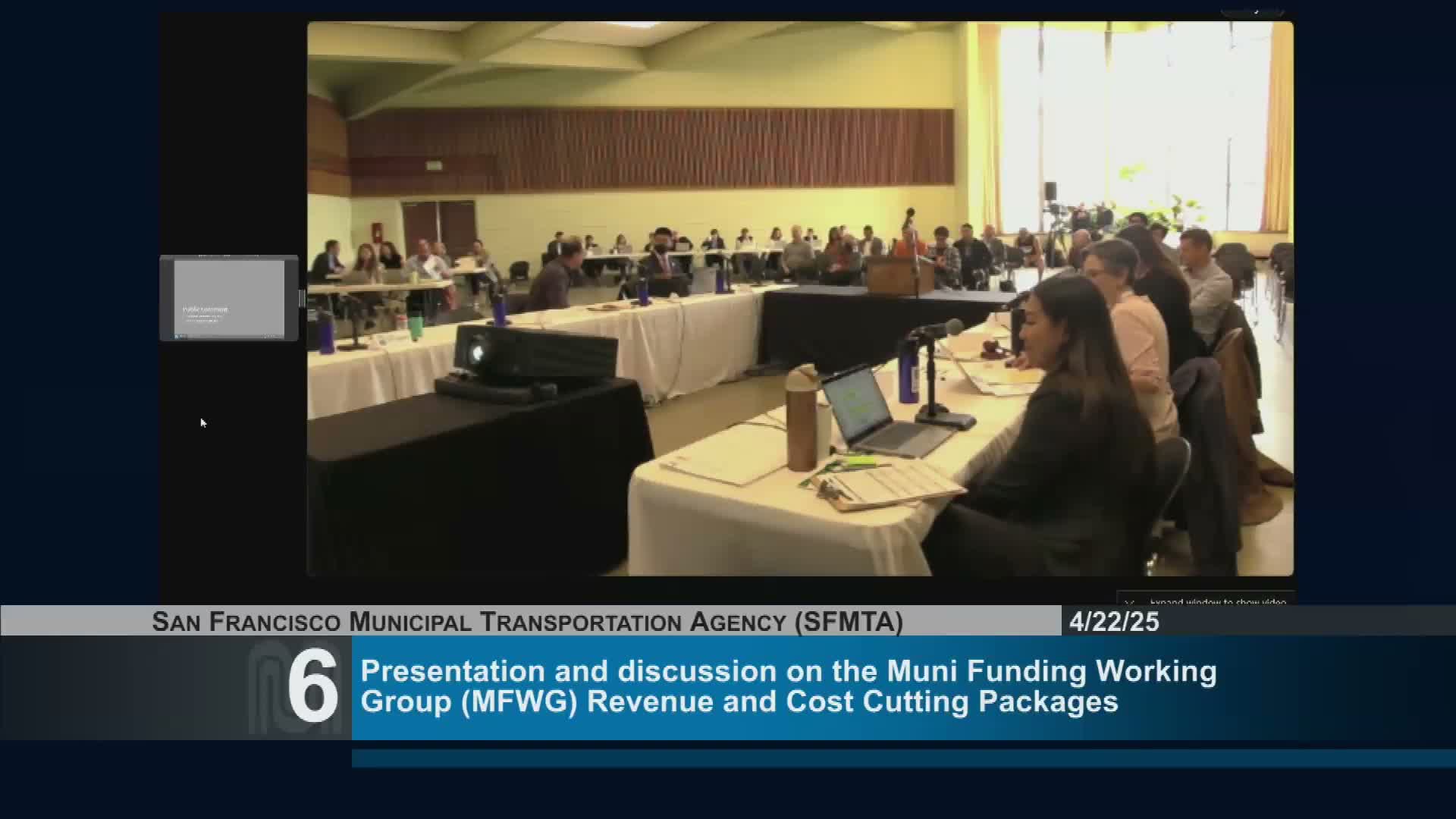
The San Francisco Municipal Transportation Agency heard detailed proposals on April 22 aimed at closing a projected structural deficit that staff estimate at roughly $320–322 million in the coming budget cycle.
Staff and the controller’s office presented six policy packages that blend revenue, internal efficiencies and possible service reductions. The options range from revenue‑heavy packages that rely on one or more ballot measures and parking optimization to combinations that would include targeted service cuts.
Julie (MTA staff lead on the working group) said the group’s work made one point clear: “There is no single solution. There’s not like we can put one thing on the ballot,” and that any successful approach will need multiple levers and careful sizing to succeed with voters. Controller Greg Wagner told the board the group’s analysis shows that the stakes are high: “There’s one scenario that’s not included in A through F, and that’s the one where we don’t get revenue on the ballot. That looks like a lot of service cuts.”
The working group’s most supported option—called Package A in staff materials—prioritizes ballot revenue (a potential regional sales tax with an option for San Francisco to opt to a higher local rate) combined with a modest set of parking and non‑ballot revenue steps and limited administrative savings. Julie emphasized the timeline challenge: ballot measures slated for November 2026 would not generate meaningful revenue until 2027, creating a temporal cash‑flow gap that staff say will need one‑time bridging funds or other short‑term steps.
CFO Bree Mahorter, who laid out the MTA’s functional budget, told directors that labor and service‑related staff account for the overwhelming share of costs and that one‑time savings and efficiencies alone cannot solve the shortfall. “The efficiencies that we have to gain are not like a steak,” she said. “They are marbled in, and they are going to take time for us to unwind.”
Panelists and public commenters piled on two consistent themes: avoid service cuts if possible, and present voters with a positive, aspirational vision for what expanded or stabilized funding will deliver. Emma Hair, representing Supervisor Mirna Melgar, said simply: “Cuts are off the table. That is not something that we should be exploring.” Stakeholder Laurie Thomas (Golden Gate Restaurant Association) and youth representative Mark Chang urged the board to combine a funding plea with concrete improvements (more frequent service, better safety and youth subsidies) so voters know what they are buying.
Labor speakers and operators warned that service reductions are not only unpopular with riders but will increase crowding and operator stress. Transit union leaders told the board that pass‑ups and crowding are already present on key corridors, and they said further cuts would worsen safety and reliability.
Board members pressed staff for a two‑track approach: continue to prioritize revenue‑first packages and non‑ballot levers—parking optimization, pricing changes and other locally controlled revenue options—while also developing a clear Plan B that lays out the specific tradeoffs if ballot revenues fall short. Several directors also asked staff to produce sharper, model‑based scenario analyses and to map the cash‑flow risk associated with delayed or reduced federal reimbursements for capital projects.
Next steps: staff will refine the packages, produce implementation scenarios and return with more detailed modeling and public‑facing messaging. Directors asked staff to center outreach on a simple, positive narrative that ties funding to service frequency, safety and reliability improvements to strengthen voter support.
The board did not take any formal votes at the workshop; staff said they will use the board’s guidance to draft implementation plans and further analysis ahead of the next budget milestones.