Get Full Government Meeting Transcripts, Videos, & Alerts Forever!
Get email alerts on the Muni Budget Servicecuts topic
No spam. Unsubscribe anytime.
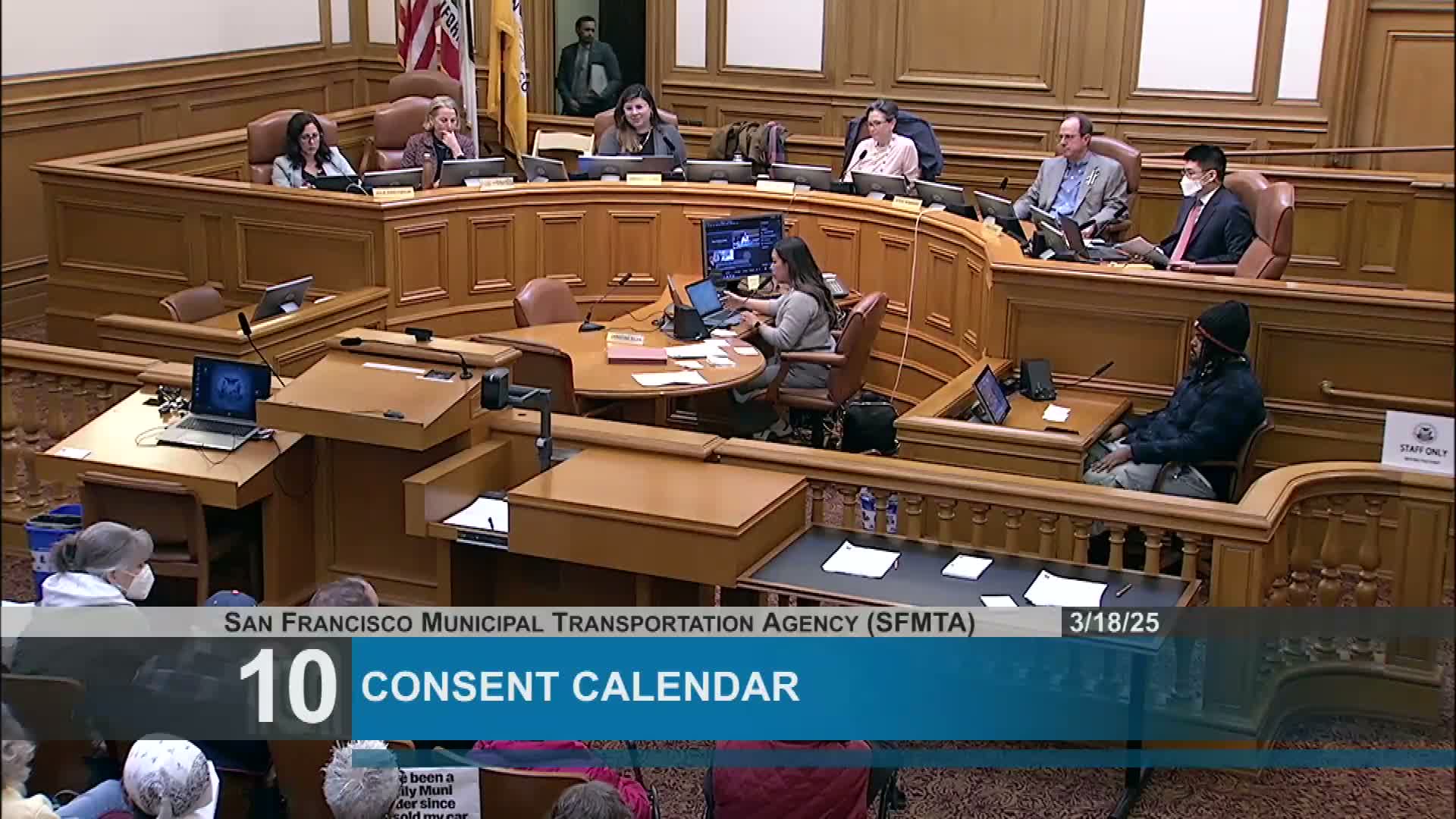
SFMTA board directs staff to pursue revised savings package after heated debate over summer service cuts
Summary
After hours of public comment and staff presentations, the SFMTA board gave staff direction to pursue a revised package of program and project savings and targeted route changes to help close a near'term $50 million gap; the board stopped short of committing to tapping contingency reserves and asked staff to return April 1 with implementation details and Title VI analysis.
The San Francisco Municipal Transportation Agency board on March 20 directed staff to pursue a revised package of program and project savings and limited route changes aimed at closing a near'term $50 million shortfall, after more than three hours of public comment and extended board deliberations.
Sean Kennedy, SFMTA'chief planning and implementation officer, told the board staff had identified about $35 million in lower'impact tradeoffs (reallocating some capital baseline to operating, delaying certain vehicle rebuilds and midlife rehabs, and negotiating reduced shared'station maintenance costs with BART), plus about $18 million in parking optimization and roughly $5 million in contracted professional'services reductions. That left a remaining gap of roughly $7.2 million that staff said could be closed either by tapping contingency reserves or through modest service changes.
"We're asking for direction from you all today on, you know, do we look into these mini cuts further for $7,200,000? Do we use the reserve?" Kennedy told the board as he described a package that aims to preserve frequency and connections where possible while using Market Street turnbacks and a proposed 6/21 route combination to reduce operating costs.
Why it matters: dozens of speakers, including neighborhood groups, transit advocates, labor representatives and students, urged the board not to cut service this summer and to use reserve or one'time funding. Supervisor Bilal Mahmood told the board, "Any cuts to transit this summer are unacceptable," arguing cuts would damage low'income riders and downtown recovery.
Board action and next steps: The board debated three options: (1) direct staff to pursue the staff'crafted package (program/project savings plus limited route restructuring); (2) tap the agency'contingency reserves to avoid cuts this year; or (3) direct staff to find additional program and project savings (an additional $7.2M) to avoid using reserves. After several motions and roll calls, the board provided direction to staff to pursue the revised staff package (Option 1) and requested staff return to the board April 1 with detailed implementation materials and Title VI equity analysis. The city attorney clarified that the board'level direction given tonight is nonbinding operational guidance and that any formal approvals (for instance, any actual service reductions or use of reserves) will require a future, formal vote of the board.
What staff proposed: Key elements staff described that would be part of the package if the board approves implementation later include: - Program and capital adjustments (e.g., delaying some F'line rebuilds and bus midlife rehabs) yielding several million dollars. - A $3.6 million reduction tied to revised BART maintenance contributions for jointly'operated stations (subject to negotiation). - Parking optimization proposals estimated at up to $18 million annually (see staff presentation at item 12) to help cover ongoing needs. - Targeted route changes using Market Street turnbacks for the 5, 9 and 31 and a proposed merge of the 6 and 21 to preserve hill and Hayes service while reducing duplication; staff said rapids would continue downtown when in service and that many turnbacks would not occur at night or on weekends.
Public reaction: Hundreds of residents attended or spoke. Transit advocates, unions and community organizations repeatedly urged using reserves this year to avoid service cuts that, they warned, could cause permanent ridership loss and erode public trust ahead of future funding measures. Opponents of tapping reserves argued the reserve exists for true emergencies and that dipping into it makes the agency more vulnerable to the much larger structural deficit projected for fiscal 2026'27.
Limitations and procedural notes: Staff and the CFO told the board the contingency operating reserve is set at the board'adopted policy level of 10% of the operating budget (about $140 million on a roughly $1.4 billion budget) and is intended for emergencies; if the board were to use reserves, the policy currently expects replenishment. Staff repeatedly emphasized that one'time fixes do not solve the projected $320 million structural gap the agency faces in 2026, which will require a combination of revenue and long'term structural changes.
The board asked staff to refine the details, return April 1 with materials including Title VI analysis for any proposed service changes, and to bring the parking optimization proposals forward for vote as appropriate. Formal approval of any service reductions or reserve use will require a future, binding vote of the full board.