Get Full Government Meeting Transcripts, Videos, & Alerts Forever!
Get email alerts on the Street Safety topic
No spam. Unsubscribe anytime.
SFMTA board adopts 'safe‑system' street safety commitments, cites data and equity focus
Summary
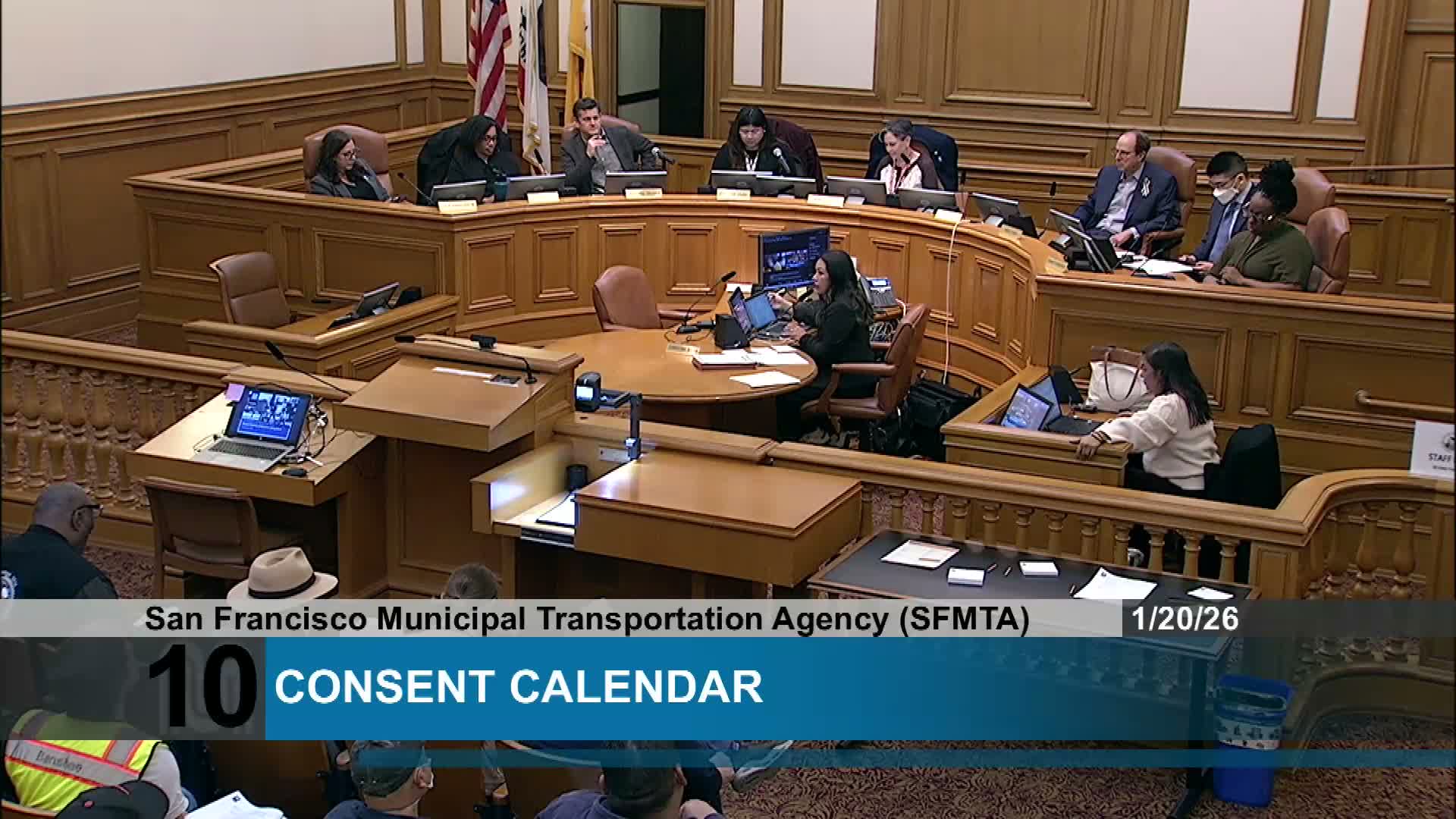
At its Jan. meeting the SFMTA Board voted unanimously to adopt a safe‑system approach and agency street‑safety commitments tied to the mayor’s executive directive and the Board of Supervisors Street Safety Act, directing staff to publish dashboards and coordinate a 100‑day interagency working group.
The San Francisco Municipal Transportation Agency Board of Directors on Jan. 27 adopted a package of street‑safety commitments that formalizes the agency’s use of the “safe system” approach and directs SFMTA staff to coordinate citywide action, publish outcome dashboards and prioritize high‑injury corridors.
Victoria Wise, SFMTA streets director, told the board the package consolidates lessons from more than a decade of Vision 0 work and aligns the agency with a mayoral executive directive and the Board of Supervisors Street Safety Act. “We are ready and excited to step into the next chapter of street safety,” Wise said, asking the board to formally adopt the approach and the SFMTA commitments.
The measure asks the board to: adopt the safe‑system approach; adopt SFMTA’s four street‑safety commitments (managing speeds, protecting vulnerable users, reducing vehicle miles traveled by expanding safe travel choices, and balancing multimodal efficiency); commit to deliverables defined in the mayor’s executive directive; and target deployment to the high‑injury network. The presentation cited national and local crash statistics and described a fiscally constrained 18‑month work plan that includes quick‑build projects, left‑turn safety treatments, daylighting, speed management and a public dashboard for monitoring implementation and outcomes.
Public testimony at the hearing pressed the board to move faster on construction and to harden low‑cost treatments where crashes are concentrated. Claire Amabile, director of advocacy for the San Francisco Bicycle Coalition, said the proposal’s near‑term build targets were too small and urged more immediate action: “Rather than riding this wave and setting ambitious goals, we are concerned the action items in this proposal will not actually achieve the commitments you are being asked to adopt.” Labor speakers including Dante Vickers of Local 1414 warned that proposed operations or maintenance cuts would undercut safety and reliability, saying reductions to frontline maintenance or premium shifts would “harm the SFMTA’s long‑term ability to provide safe and reliable service.”
Directors pressed staff for more data. Wise said SFMTA is publishing pilot data and intends to include quarterly reporting on enforcement, infrastructure miles treated, speed reductions and outcome measures; she said the mayor’s 100‑day interagency working group has already convened and will coordinate near‑term priorities. The board discussed automated speed‑enforcement pilot results and a staged timeline for moving cameras to different locations after an 18‑month pilot period.
The board voted 7–0 to approve the package, with the secretary calling the roll and each director recorded as voting “aye.” The motion directs staff to implement the safe‑system approach, adopt the SFMTA commitments, coordinate with city partners on the mayoral directive and return with dashboards and metrics as specified by the directive and the board.
What happens next: staff said dashboards and a street‑safety implementation dashboard will be published over the next six months and the draft high‑injury network map from the Department of Public Health will be reviewed in coordination with SFMTA. The board also asked staff to report back periodically in its quarterly updates on pilot results, dashboard metrics and project delivery timelines.