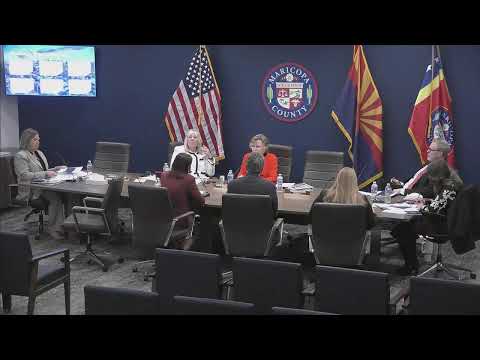
County school superintendent seeks $6.9M in above‑baseline spending for professional development and oversight
Loading...
Summary
Superintendent Shelly Boggs asked supervisors to fund a five‑person professional‑development team, an assistant for district oversight, expanded workforce pathways, and detention‑education staffing; she said pilot programs yielded measurable student gains and that many requests are discretionary under ARS 15‑302.
Maricopa County School Superintendent Shelly Boggs presented an FY2027 above‑baseline package totaling roughly $6.9 million that she said would expand county‑led professional development, strengthen school‑board governance training, provide financial oversight capacity for struggling districts, and grow workforce and career pathways.
Boggs said a one‑time $200,000 pilot on teacher professional development enabled the office to demonstrate measurable gains—she cited average county partner improvements (reading 45%, math 34%, writing 53% for participating classrooms) and said the next step is a 5‑person PD team (assistant superintendent plus three coaches and an admin) to scale in‑person classroom coaching. She described statutory authority for discretionary programs under ARS 15‑302 and requested an assistant superintendent to coordinate school‑district fiscal oversight and to work with the auditor general when credible financial red flags arise.
The superintendent also briefed the board on the Maricopa County Regional School District operations (detention education and Hope Academy), an ongoing partnership with ASU for college credits at Durango detention education, and a planned sale of the Grace Court property to reduce ongoing legal exposure. Presenters said many proposed programs would be funded by special revenues, grants and philanthropic partners where possible; they requested budget office follow‑up for revenue/cost reconciliation.
Board members asked for additional detail on which positions are new versus reassigned, the operational cost of Hope Academy, and whether the oversight role would duplicate state functions; presenters said they would coordinate with state auditors and provide follow‑up materials and cost breakdowns.