Get Full Government Meeting Transcripts, Videos, & Alerts Forever!
Get email alerts on the Housing topic
No spam. Unsubscribe anytime.
Madras planning commission hears financial analysis of housing action plan; tax abatements discussed
Summary
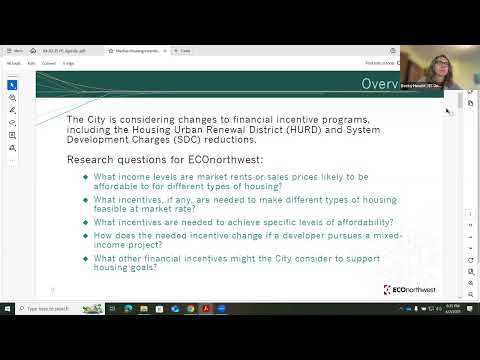
Eco Northwest consultant Becky Hewitt presented a financial analysis showing that smaller, middle‑income housing types and garden apartments in Madras need subsidies to be financially feasible, while large new single‑family homes would require very large subsidies to be affordable to lower‑income households. Commissioners discussed MUPTI and VHDZ tax abatement tools, trade‑offs, and next steps toward a final plan.
Madras — The Madras Planning Commission on the evening of the meeting heard a financial analysis from Eco Northwest showing how local market prices, interest rates and development costs affect which housing types can be built without public subsidies and which will require incentives.
Becky Hewitt, the Eco Northwest consultant who presented by Zoom, said the firm modeled four for‑sale prototypes and rental prototypes and compared market prices to affordability at different shares of area median income (AMI). "For a household at 60% of area median income, what's considered an affordable monthly rent ... is about $950 a month," Hewitt said, and noted that sales‑price affordability is sensitive to interest rates (she gave an example of roughly $177,000 at a 7% mortgage rate versus just over $200,000 at about 5.5%).
Why it matters: commissioners are updating the Madras Housing Action Plan and must choose which incentives to use to deliver more housing that local residents can afford. Hewitt told the commission that smaller units — cottage housing, townhouses and some garden apartments — are closer to being affordable but often still need additional incentives to be financially feasible for developers. By contrast, she said new large single‑family homes would require very large buy‑downs to be affordable to lower‑income households: "If you have a large single family home and you want that ... to be affordable to a household at 60% of AMI, it's going to need over $250,000 worth of subsidy," Hewitt said.
Hewitt described two tax‑abatement tools the city could consider: the Multi‑Unit Property Tax Exemption (MUPTI) and the Vertical Housing Development Zone (VHDZ). Both are structured as 10‑year property tax abatements, she said, but differ in scope: MUPTI is flexible and can apply with or without a commercial component, while VHDZ applies only to mixed‑use projects with ground‑floor commercial space.
On who benefits, Hewitt explained that the abatement reduces the property‑tax bill for the property owner, which can improve a project's financeability. "The incentive is generally, making the development viable that would not otherwise have been viable," she said. Commissioners pressed on whether abatements must be paired with affordability requirements; Hewitt said cities can write eligibility criteria (for example, a public‑benefit checklist or a percentage of units at specified AMI levels), but deed restrictions and long‑term affordability requirements also create administrative burdens and can narrow that pool of eligible buyers or renters.
Commissioners cited other Oregon examples during the discussion. Hewitt and staff referenced a large Bend project that received a substantial abatement while providing a small number of affordable units; Hewitt said the Bend project received a significant tax abatement but produced just 10 affordable units. She also cited Cottage Grove as an example where MUPTI helped unlock an apartment development that otherwise would not have been built.
Staff described next steps: city staff and consultants will bring a final draft of the housing action plan back to the planning commission in roughly a month to six weeks for a recommendation to the city council. Implementation details — including whether and where to apply MUPTI or VHDZ, how large an abatement to offer, and whether to require deed restrictions or other long‑term affordability mechanisms — will be developed after the plan is adopted.
The planning commission approved the meeting minutes from March 5, 2025, by voice vote earlier in the session and had no formal vote on the incentive recommendations during the presentation. Commissioners asked staff to return with a final plan that identifies implementation priorities and, where possible, suggested phasing or geographic focus so commissioners and the council can evaluate trade‑offs.
The commission adjourned at 7:50 p.m. and staff will follow up with the consultant and commissioners about scheduling a follow‑up meeting once the final plan is ready.